
Gae Aulenti: architecture you can switch on
Gae Aulenti designed lamps the way she designed buildings, as part of a space. Her Pipistrello became an icon, and her Musée d’Orsay turned a station into a museum.
Gae Aulenti was an architect first, and she designed lamps the way she designed buildings: as part of a space, in relation to people and to other objects. Her Pipistrello, a table lamp with a wing shaped shade on a , has become one of the defining Italian lamps of the 1960s. The same mind that shaped it also turned a Paris railway station into one of the world’s great museums.
A Milanese architect of her time
Gaetana Aulenti was born on 4 December 1927 in Palazzolo dello Stella, in Friuli in northeast Italy. In 1948 she enrolled in the architecture programme of the Politecnico di Milano, at a time when architecture in Italy was still very much a male profession.
From 1955 to 1965 she worked on the editorial staff of the magazine Casabella-Continuità under Ernesto Nathan Rogers, one of the most influential voices in post-war Italian architecture. Those years placed her at the centre of debates about how modern design should relate to history and place, a theme that runs through all her work.
Pipistrello: a lamp designed for a room
In 1965 Aulenti designed the Pipistrello, Italian for “bat”, to furnish the Olivetti showrooms in Paris and Buenos Aires. It was put into production by Martinelli Luce, a lighting company in Lucca founded by Elio Martinelli, and reached the market in 1967.
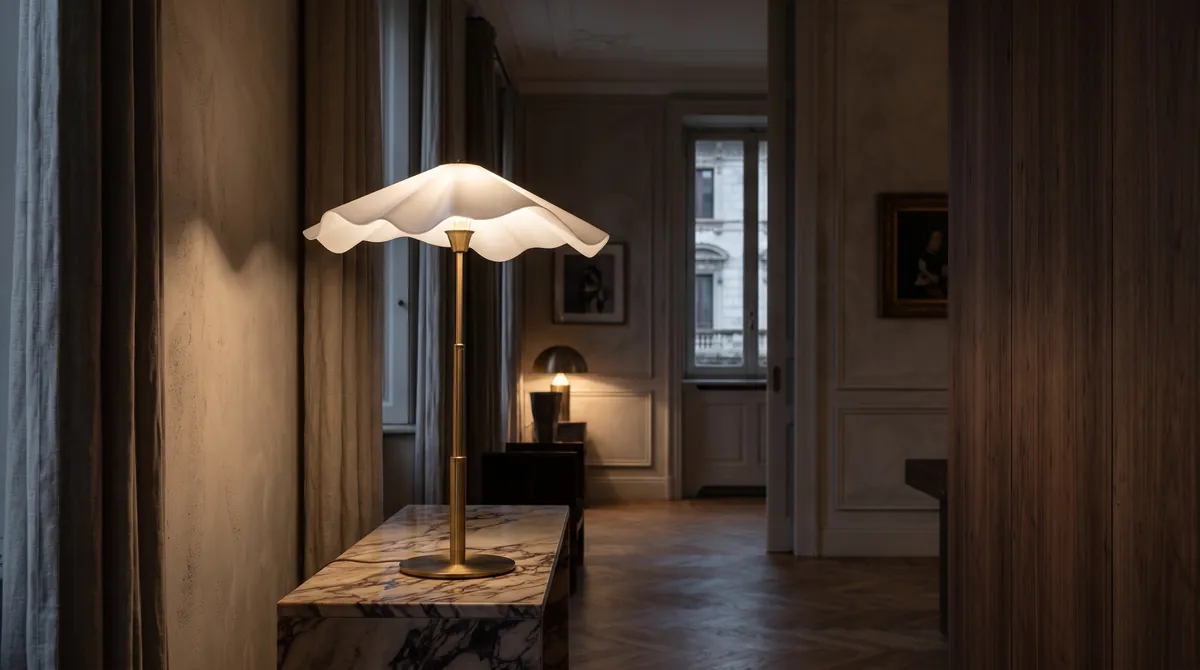
The design is a play of contrasts. A shade of white opal with scalloped edges spreads out like a pair of wings and hides the bulbs beneath it. Below, a stainless steel telescopic stem lets you raise the shade by about 20 cm (8 inches), and a flared base, classically in black, anchors the whole lamp. The curves recall Art Nouveau, yet the materials are entirely of their time.
Aulenti later remarked that she had hardly ever designed lamps as stand alone objects, and the Pipistrello proves the point. It was conceived for a particular space and scaled to sit among other things. That is why it works as well on a console in a hall as on a desk: it brings its own small architecture wherever it goes.
The lamp was shown in 1972 at the Museum of Modern Art’s exhibition “Italy: The New Domestic Landscape”, and it is held in collections including those of MoMA, the Centre Pompidou and the Metropolitan Museum of Art. Martinelli Luce still produces it, now also in medium and mini sizes and in a cordless version.
The Pipistrello brings its own small architecture wherever it goes.
More lamps, more collaborations
Aulenti designed many other pieces for Italian manufacturers, and glass played a large part in them. For FontanaArte she created the Giova lamp in 1964, and the relationship lasted: in 1980 she designed the Parola lamp for the same company with the lighting designer Piero Castiglioni. It combines a sphere of blown , a clear glass stem and a polished glass base, three kinds of glasswork in one calm object.
- Giova (1964), lamp for FontanaArte
- Pipistrello (1965), table lamp with telescopic stem for Martinelli Luce
- Parola (1980), table, floor, wall and lamps for FontanaArte, with Piero Castiglioni
- Showrooms for Olivetti in Paris (1967) and Buenos Aires (1968), and for Fiat in Turin, Zurich and Brussels (1968)
In the showrooms in particular, furniture, light and architecture were planned together. They prepared the ground for the projects that would make her famous far beyond the world of design.
The Musée d’Orsay and the museum years
Aulenti’s best known project is the conversion of the Gare d’Orsay, a grand railway station built in Paris for the World’s Fair of 1900, into the Musée d’Orsay. She shaped the interior, organising galleries and rooms within the vast iron and glass hall, and the museum opened to the public in December 1986. Critics were divided at first, but the museum soon became one of the most visited in Paris.
More museum work followed: the galleries of the Musée National d’Art Moderne at the Centre Pompidou in Paris, Palazzo Grassi in Venice for the Fiat group in the 1980s, the Museu Nacional d’Art de Catalunya in Barcelona, the Scuderie del Quirinale in Rome, opened as an exhibition space in 2000, and the Asian Art Museum in San Francisco, completed in 2003.
Museum architecture is, above all, work with light: how daylight falls on a sculpture, how a painting is lit, how a visitor passes from bright halls into quieter rooms. Her lamps and her museums share one conviction, that light is a building material in its own right.
Honours and legacy
Aulenti was made a Chevalier of the Légion d’honneur in 1987 and received the Praemium Imperiale, Japan’s international arts prize, in 1991. She died at her home in Milan on 31 October 2012, aged 84. In December of the same year, a new square in the Porta Nuova district, near Porta Garibaldi station, was named Piazza Gae Aulenti in her honour.
Her lamps remain in production, and the Pipistrello in particular has found a new audience with every generation. For anyone who loves design, Aulenti offers a useful lesson: the best lamps are not isolated objects but small pieces of architecture, made to belong to a room.
glaminia is independent and does not sell lamps or recommend dealers. Images are AI generated illustrations, not photographs of specific products. Have fixed electrical work done by a qualified electrician.