
Eclisse: Vico Magistretti’s lamp that eclipses itself
Turn the inner shell and the light narrows to a crescent, then a thin halo. Vico Magistretti’s Eclisse for Artemide, designed in 1965, turned an old lantern idea into a perfect bedside lamp.
Most lamps are either on or off. Eclisse lets you decide how much of its light you want to see, with nothing more than a turn of the hand. Vico Magistretti designed it in 1965, Artemide began producing it in 1967, and it won the that same year. Small, round and disarmingly simple, it is still one of the best bedside lamps ever made.
An idea from the Milan metro
Magistretti later recalled that the idea came to him in 1965 on the Milan metro. He was thinking about the lantern of Jean Valjean, the hero of Victor Hugo’s Les Misérables, and about the blind lanterns once carried by miners and thieves: lanterns with a shutter that could hide the flame without putting it out.
The question was how to translate that old device into a modern electric lamp. Magistretti’s answer used nothing but geometry. A lamp made of spheres could close in on itself, just as the moon passes in front of the sun during an eclipse. The name followed naturally: eclisse is the Italian word for eclipse.
Three hemispheres and a turn of the hand
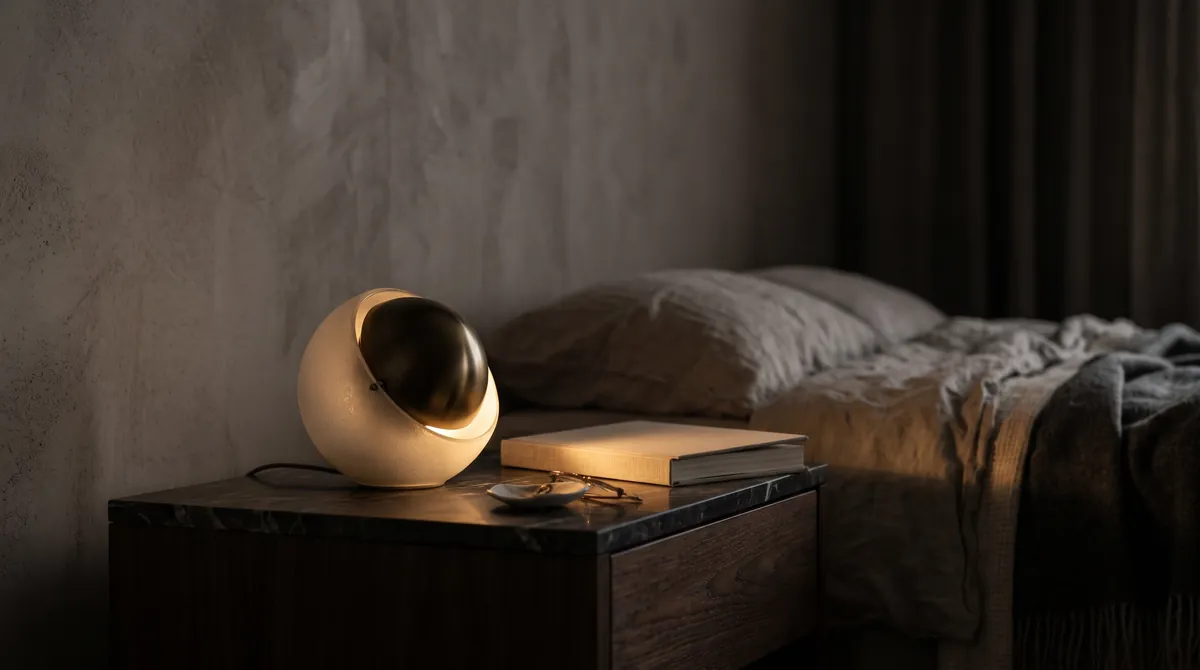
Eclisse consists of three hemispheres. The first forms the base. The second, the outer shell, is fixed to it and holds the light source. The third, the inner shell, sits inside the outer one and can be turned around the bulb.
Rotate the inner shell and it slides across the opening. The light narrows from a full circle to a crescent and then to a sliver. Close it completely and only a soft ring of light escapes around the edge, like the corona around the moon during a total eclipse. The lamp gives direct light when it is open and gentle, when it is almost closed. In practice, you get three moods from one object:
- Open: direct light for reading in bed or at a small desk.
- Half closed: a softer crescent for conversation or for winding down.
- Closed: only a halo at the rim, enough to find your way at night.
Eclisse is made of painted metal. It is designed as a table lamp, but it can also be mounted on a wall, where the rotating shell works just as well.
Its entire function is visible: one sphere turns inside another.
Artemide and the Compasso d’Oro of 1967
Artemide, founded in 1960 by Ernesto Gismondi and Sergio Mazza, was still a young company when it put Eclisse into production in 1967. The same year the lamp received the Compasso d’Oro, Italy’s most important design award, and in 1968 it was shown at the XIV Triennale in Milan.
Museums soon took notice. Eclisse is held in permanent collections including those of the Museum of Modern Art and the Metropolitan Museum of Art in New York and the Triennale Design Museum in Milan. For a lamp small enough to hold in two hands, it has travelled far.
The bedside lamp, perfected
Magistretti did not design Eclisse only for the bedroom, but that is where it shows its genius. Two people sharing a bed rarely want the same amount of light. With Eclisse, one can read while the other turns away, and when the book is finished a quarter turn is enough to reduce the lamp to a glow instead of plunging the room into darkness.
The shell also controls , the uncomfortable brightness of a bare bulb in your line of sight. Because you can turn the opening towards the page and away from your partner, the light goes where it is needed and nowhere else.
Choose warm light for the bedroom. Colour temperature is measured in (K): a bulb of 2,700 K gives a warm, golden white, while 2,200 to 2,500 K feels even softer, closer to candlelight, and suits the last minutes of the evening.
The bedroom is not the only place where Eclisse earns its keep. In a hallway niche or on a shelf by the front door, a nearly closed shell gives a welcoming glow without lighting the whole space. In a child’s room it can serve as a reading lamp at bedtime and a reassuring night light afterwards. On a desk in a guest room, it offers just enough task light for a letter or a laptop, and then turns back into an ornament.
Because it is so compact, Eclisse also works well in groups. Two or three on a long sideboard, each turned to a slightly different position, create a play of crescents and halos that changes as you walk past.
Why simple ideas last
Eclisse has no dimmer, no electronics and no hidden mechanism. Its entire function is visible: one sphere turns inside another. That clarity is why it still feels fresh more than half a century later, and why children understand it as quickly as designers do.
It is also typical of Magistretti, the Milanese architect who designed Atollo for Oluce twelve years later. Both lamps start from a single, almost obvious idea and refine it until nothing more can be taken away. In an age of apps and remote controls, there is something deeply satisfying about dimming a lamp with your own hand.
glaminia is independent and does not sell lamps or recommend dealers. Images are AI generated illustrations, not photographs of specific products. Have fixed electrical work done by a qualified electrician.