
Marble and stone in lighting: weight, veins and balance
Stone gives a lamp weight, calm and a pattern no other material can copy. Marble, travertine and other stones in lighting, their finishes, and how to care for them.
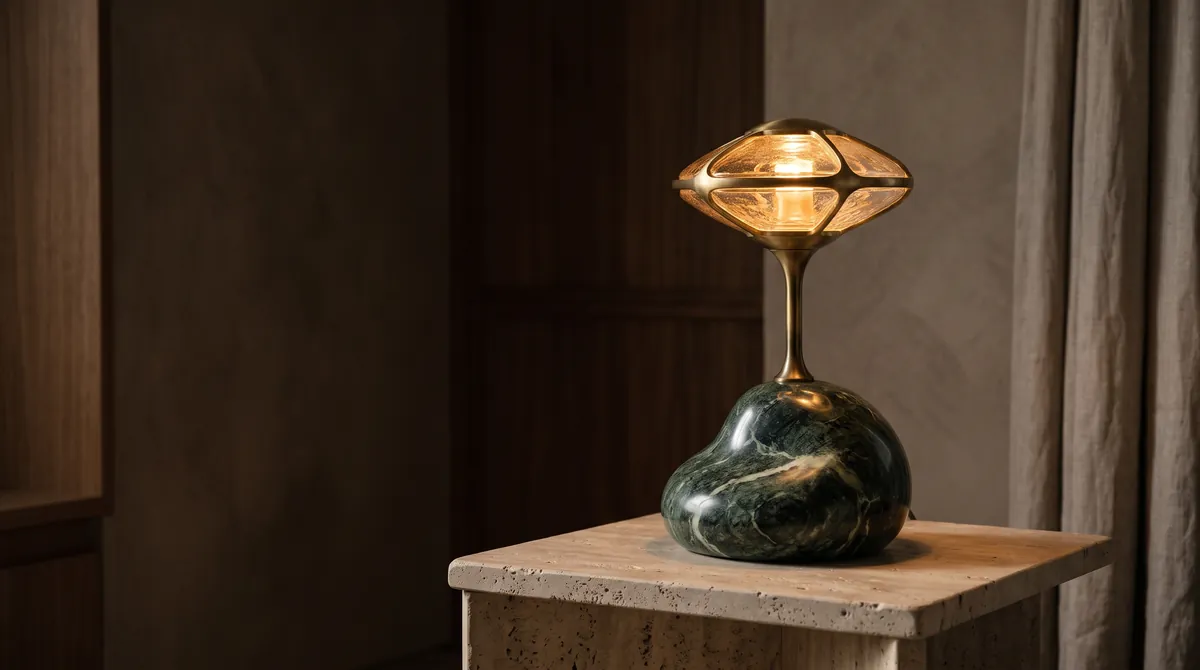
Stone gives a lamp something no other material can: gravity. A marble base holds a tall stem steady, anchors an arching arm and adds a quiet sense of permanence to a room. Each block also carries its own pattern of veins and colour, so no two stone lamps are quite alike. Here is what to know about the stones used in lighting, their finishes, and how to look after them.
Why designers reach for stone
The first reason is practical. A lamp needs a low centre of gravity to stand safely, especially when the light sits high or reaches far from the base. Stone is dense, so a compact base can carry a long stem or arm without tipping. It also feels cool to the touch and does not dent or warp.
The most famous example is the Arco floor lamp by Achille and Pier Giacomo Castiglioni for Flos (1962). Its steel arc reaches far over a table or sofa, and an upright block of white Carrara marble keeps it in place. A hole through the block lets two people pass a broom handle through it and lift it together, a solution as witty as it is practical.
The second reason is visual. Veins and colours bring a natural, almost painterly element to brass, glass and lacquered metal. A dark green or black base makes a slim lamp read as a sculpture, while a pale base feels warm and calm.
Stone gives a lamp something no other material can: gravity.
Marble, travertine and other stones
Marble is a metamorphic rock: limestone or dolomite that has recrystallised under heat and pressure deep in the earth. Pure white marble comes from very clean limestone, while veins and swirls come from impurities such as clay, iron oxides or minerals like serpentine, which can give green tones.
- White marbles such as Carrara, from Tuscany, range from bright white to soft blue-grey with fine grey veining.
- Black and dark marbles with white veins give strong graphic contrast and suit brass and gold finishes.
- Green marbles and serpentines bring deep colour and pair well with brass and natural linen shades.
- Travertine is a limestone deposited around mineral springs, with characteristic pits and channels. Near Tivoli, east of Rome, it has been quarried for at least 2,000 years.
- Granite, basalt and slate are harder and more resistant to acids, and appear in architectural, minimal designs.
- Alabaster and onyx are translucent when cut thin, so they are used for shades and glowing bodies rather than heavy bases.
Honed, polished and textured finishes
The same stone can look completely different depending on how its surface is worked.
| Finish | Look | In practice |
|---|---|---|
| Polished | High gloss, deep colour, sharp veins | Reflects light beautifully but shows etching and scratches |
| Honed | Smooth matt or satin surface, softer colour | Hides small marks; can absorb stains more readily |
| Brushed or leathered | Gently textured and tactile | Hides fingerprints; dust settles in the texture |
| Rough or split | Raw, natural surface | Sculptural and robust; needs a soft brush to dust |
A polished surface reflects the light of the lamp itself, which can be beautiful on a dark stone at night. A base absorbs light and leaves the focus on the shade and the glow. Travertine is often sold with its natural pits filled for a smoother surface, or left open for a more rustic feel.
Sealing and everyday care
Marble and travertine consist mostly of calcium carbonate, which reacts with acids. Vinegar, lemon juice, wine, many bathroom cleaners and limescale removers etch the surface and leave dull, pale marks. Marble is also fairly soft and porous, so it scratches more easily than you might expect and can absorb coloured liquids and oils.
Many stone bases are treated with an , which soaks into the pores and makes stains less likely. A sealer slows down staining but does not prevent acid . Ask the maker how the stone was treated and whether it will need resealing over the years.
For everyday care, switch the lamp off, dust the base with a soft dry cloth and, when needed, wipe it with a damp cloth and a stone cleaner, one that is neither acidic nor alkaline. Dry it straight away. When you polish a brass stem, mask the stone with tape or keep a cloth between them, as metal polish can mark marble.
Weight, stability and transport
Stone is heavy, and that is part of its charm, but plan for it. Check that shelves, side tables and consoles can take the load, and place heavy lamps on solid furniture rather than on thin glass tops. A large floor lamp with a stone base is a job for two people whenever it moves.
Before moving a stone lamp, remove the shade and bulb, and never lift it by its stem or arm: the joint between stem and base is not made to carry the full weight. Wrap the base in a blanket, protect its corners and edges, which chip easily, and transport it upright and secured so it cannot roll. Felt pads underneath protect floors and furniture.
Stone as shade and sculpture
Stone is not only a base. Alabaster and onyx, sliced thin, let warm light through and glow from within, with every vein visible. Some designers carve solid marble or travertine into sculptural lamps where the stone itself frames or reflects the light, or shape it into thick discs and spheres arranged around a small LED source.
Such pieces are often made in small series or by hand, so differences in colour and veining are part of the design. If you can, look at the actual stone before you buy, and ask about the electrical parts as well as the material. Rewiring and electrical repairs belong with a qualified electrician; chips and cracks in the stone are a job for a stone restorer.
glaminia is independent and does not sell lamps or recommend dealers. Images are AI generated illustrations, not photographs of specific products. Have fixed electrical work done by a qualified electrician.


