
Tree uplighting: dramatic light for trees and plants
A single well-aimed light can turn an old olive tree into the sculpture of the garden. How to uplight, moonlight and silhouette trees, palms and hedges without glare or wasted light.
At night a garden loses its depth. Lawns, beds and paths merge into one dark plane, and only what you choose to light comes back. Trees are the obvious candidates: they have height, structure and texture, and a single well-placed light can turn an ancient olive or a tall palm into the sculpture of the whole plot.
Good tree lighting is not about brightness. It is about direction, beam width and restraint, and about respecting the neighbours and the wildlife that share the garden after dark.
Three techniques: uplighting, moonlighting, silhouetting
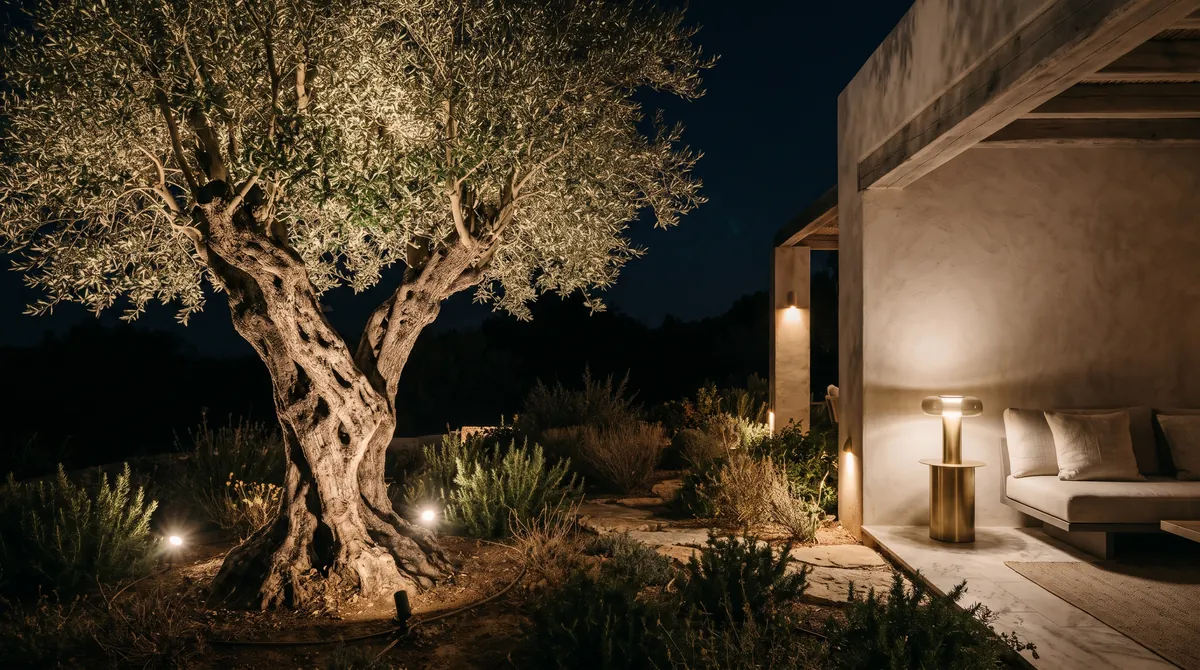
Uplighting is the classic. A fitting at ground level points up into the trunk and canopy, so the tree glows against the night sky. It reveals bark, branch structure and the underside of the leaves, the part of a tree you rarely notice by day. The effect is theatrical, so one or two uplit trees usually say more than ten.
works the other way round. Fittings are mounted high in a mature tree, often 6 to 8 metres (20 to 26 feet) up, and aimed down through the branches. The light falls on the lawn or terrace below in a soft, dappled pattern of leaf shadows, like a clear night under a full moon. It is the most natural of garden effects and doubles as gentle light for paths and seating.
leaves the tree itself dark. You light the wall, fence or hedge behind it instead, and the trunk and branches stand out as a black outline. It suits trees with a strong graphic shape, such as a multi-stemmed acer, a gnarled fig or a pine bent by the wind.
Design ideas
- 01
The lone olive as sculpture
Place two spike lights 60 to 90 cm (2 to 3 feet) from an old olive trunk, one narrow and one medium beam, so the twisted bark is grazed and the silver canopy glows above.
- 02
A palm avenue along the drive
Set one narrow ground recessed uplight at the foot of each palm, aimed tight up the trunk, so the crowns float like lanterns at the same height.
- 03
Moonlight over the dining terrace
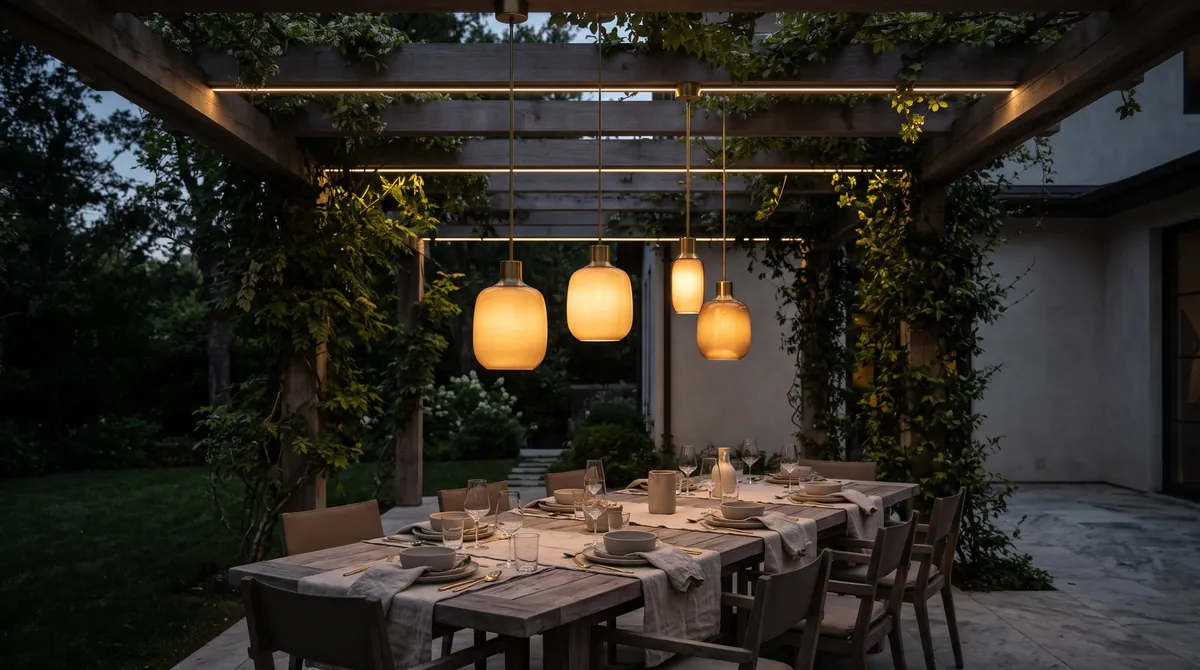
Strap two or three small downlights high in a mature plane, oak or carob tree and let the dappled shadows fall across the outdoor table.
- 04
Shadow play on a white wall
Light a small tree from the front with a wide, low fitting so its shadow is thrown large onto a whitewashed garden wall behind it.
- 05
Silhouette against a lit hedge
Wash a tall clipped hedge with soft light and leave a multi-stemmed tree in front of it unlit, so the branches read as a black drawing.
- 06
Layered depth across the garden
Light one tree near the house softly, one in the middle distance more strongly and a final one at the boundary, so the eye travels to the end of the garden.
Beam angles and fittings
The is the width of the cone of light a fitting throws, measured in degrees. It matters more than wattage. A narrow beam reaches high and keeps light on the trunk; a wide beam spreads over a broad canopy but fades quickly with height. Fittings with interchangeable lenses let you fine tune on site.
| Tree or plant | Beam angle | Typical placement |
|---|---|---|
| Tall and slender (palm, cypress) | 10 to 15° | At the base, aimed up the trunk |
| Medium, open crown (olive, acer) | 25 to 40° | 60 to 90 cm (2 to 3 feet) from the trunk |
| Broad, dense canopy (oak, plane) | 40 to 60° | 1 to 2 m (3 to 7 feet) out, two or three fittings |
| Hedge or shrub border | 60° or wider | Along the base, about 1 m (3 feet) apart |
Rules of thumb. Test with a temporary light before anything is fixed.
Two families of fitting do most of the work. Spike lights push into the soil on a stake and can be moved as plants grow, which makes them ideal for beds and young trees. Ground recessed uplights sit flush in paving or lawn, invisible by day and safe to walk over. Look for a glare cowl or a honeycomb louvre on either type: it hides the bright source from anyone walking past and keeps light where it belongs.
- Protection: the (ingress protection) shows how well a fitting resists dust and water. IP65 suits spike lights; recessed lights that may stand in water need IP67 or higher.
- Materials: stainless steel, brass or powder-coated aluminium survive damp soil and sea air.
- Aiming: a head that locks, so a hose or a passing dog does not shift the beam.
Olive trees, palms and hedges
Olive trees reward close, low light. Their trunks are the main event, twisted and hollowed over decades, so set a fitting near the base and let the light graze the bark at a steep angle to bring out every ridge. A second, wider beam further out lifts the silver grey canopy. Keep the light warm: is measured in Kelvin (K), lower figures look warmer, and at 2,700 to 3,000 K olive leaves turn soft silver instead of the cold cast of cooler light.
Palms need a different approach. Their beauty sits high up, so a narrow beam at the base runs up the smooth trunk and catches the crown from below. For a row of palms, use identical fittings at identical distances so the rhythm holds.
Hedges and topiary are best treated as architecture. Wide beam fittings along the base wash a clipped yew or box hedge into a green wall that gives the garden a boundary at night. Patchy hedges look better grazed from a low angle, which hides gaps.
Seasons, growth and maintenance
Trees change, and good lighting changes with them. A deciduous tree that glows as a dense green crown in summer becomes a fine drawing of bare branches in winter, often the more beautiful view. Evergreens such as olives, pines and palms look much the same all year, so they are the reliable anchors of a scheme.
Check aim and position every spring, when canopies thicken and shrubs grow in front of spike lights. Moonlighting fittings need particular care: fix them with adjustable straps rather than nails or screws, and loosen the straps as the trunk grows so they never cut into the bark.
Wildlife, light pollution and safety
A lit tree is also a habitat. Birds roost in canopies, bats hunt along tree lines and many insects are drawn to light, particularly cooler, bluer light. Keep the colour at 2,700 K or lower and point light only where it is needed. Never light a tree with nesting birds or a known bat roost, and leave parts of the garden fully dark as corridors.
Timing matters as much as colour. Put the scheme on an astronomical timer, which follows the changing time of sunset through the year, and let it switch off at a set hour such as midnight. It saves energy, keeps the sky darker and gives nocturnal animals their hours back. Avoid any light that spills over boundaries or into windows.
Fixed outdoor wiring, buried cables and garden sockets are a job for a qualified electrician. Low voltage systems, running at 12 or 24 volts through a transformer, make fittings easier to move, but the connection to the mains still belongs in professional hands.
One or two uplit trees usually say more than ten.
glaminia is independent and does not sell lamps or recommend dealers. Images are AI generated illustrations, not photographs of specific products. Have fixed electrical work done by a qualified electrician.