
Mid-century modern lighting: the lamps of the 1950s and 1960s
Teak, brass, enamel and shades that soften the bulb: why the lamps of the 1950s and 1960s still feel fresh, and how to live with them today.
Few styles have aged as gracefully as mid-century modern. The lamps of the 1950s and 1960s were made to be lived with: warm wood, spun metal, coloured enamel and shades that soften a bulb rather than show it off. Seventy years on, they still look fresh, and they still make a room feel good in the evening.
What defines mid-century modern lighting
The term covers design from roughly 1945 to 1970, although it only became a common label after the writer Cara Greenberg used it for her 1984 book on furniture of the 1950s. Post-war optimism, new production methods and smaller, more open homes shaped the period. Lighting followed the same ideas as the furniture: honest materials, clear function and forms borrowed from nature.
You recognise the style by a handful of features that appear again and again, whether a lamp was made in Copenhagen, Milan or California.
- Organic shapes: cones, domes, petals and soft curves instead of the strict geometry of pre-war modernism.
- Mixed materials: teak or walnut combined with brass, painted aluminium, , paper or linen.
- Shielded light: shades, louvres and layered reflectors that hide the bulb and spread a soft glow.
- Slender structures: tripod legs, thin stems and articulated arms that keep a lamp visually light.
- Colour with restraint: enamel in mustard, olive, teal or red, usually set against white, black or wood.
Three traditions, one look
In Denmark and Sweden, designers treated light as a matter of comfort. Poul Henningsen spent decades refining shades that direct light without glare, and his PH5 pendant and PH Artichoke, both from 1958 and made by Louis Poulsen, remain the clearest expression of that thinking. The Scandinavian contribution is calm, practical and warm, closely tied to the idea of hygge.
In the United States the style was more playful. George Nelson’s Bubble lamps stretched a translucent plastic skin over a wire frame and turned light into floating, glowing volumes. Greta Magnusson Grossman, a Swedish designer who settled in Los Angeles in 1940, brought European craft to Californian modernism: her Grasshopper floor lamp dates from 1947, and her Cobra desk lamp received a Good Design award in 1950. The sculptor Isamu Noguchi began his Akari light sculptures in 1951, after a visit to Gifu, a Japanese town known for its paper lanterns.
Italy and France added drama. The Arco floor lamp, designed by Achille and Pier Giacomo Castiglioni in 1962 for Flos, swings a long steel arc from a heavy marble base to hang light over a table without a ceiling point. In France, Serge Mouille worked from 1953 on black-painted metal lamps with articulated arms and pointed shades that look like drawings in space.
Materials that make the style
Wood was used sparingly: a teak stem, a walnut collar, the turned base of a table lamp. Brass gave a warm glint and, if left unlacquered, ages to a soft brown . Enamelled steel or aluminium carried the colour, often with a white inner surface to reflect light downwards.
Opal glass, paper and linen worked as a , a translucent material that scatters light so the bulb appears as an even glow rather than a bright point. The common thread is that every material works with the light. White inner surfaces bounce it, brass warms it, and paper or glass soften it. That is why a well-made lamp from the period looks as good switched on as it does switched off.
A well-made lamp from the period looks as good switched on as it does switched off.
Why the style is popular again
Part of the appeal is scale. Mid-century lamps were designed for compact post-war homes, so they suit today’s apartments better than many oversized contemporary pieces. They are also easy to live with: warm materials and soft light fit almost any interior, from a city flat to a country house.
There is also a wish for objects with a story. A lamp with a known designer and a clear idea behind it feels more personal than an anonymous fitting. Many classics are still made, or have been reissued under licence by their original manufacturers, and a lively vintage market keeps well-kept originals in circulation instead of in landfill.
Mixing vintage and new
You do not need a period room to enjoy the style. One or two strong pieces are usually enough, set against simple contemporary furniture. A good rule is to let one era lead and the other support: a vintage pendant over a modern dining table, or a new reissue of a classic floor lamp beside an old teak sideboard.
Original lamps bring patina and history, but they often need attention. Wiring from the 1950s and 1960s may be brittle or lack an earth connection, so have any vintage lamp checked and, if needed, rewired by a qualified electrician before you use it. Licensed reissues offer the same design with modern electrics and current safety marks.
Bringing mid-century light into your home today
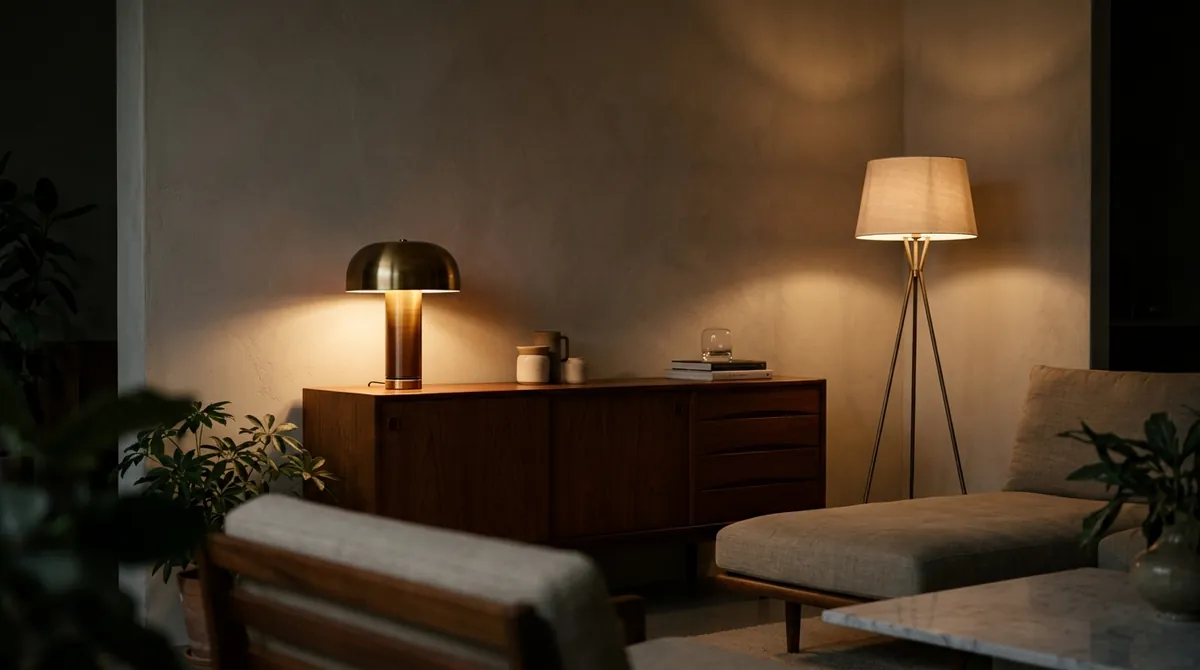
Start with layers. Combine one statement pendant, a floor lamp for reading and a small table lamp on a sideboard or shelf. Three sources at different heights create the pools of light and shadow that make mid-century rooms feel intimate, while a single bright ceiling light would flatten them.
Hang a dining pendant so the bottom of the shade sits about 65 to 75 cm (26 to 30 inches) above the table top. Choose dimmable LED bulbs with a high , the colour rendering index that shows how naturally a light source reveals colours. A value of 90 or more keeps teak, brass and enamel looking rich.
Finally, let the lamps breathe. Mid-century design is about clarity, so a few good pieces in well-chosen places will say more than a room full of period objects. Choose the lamp you love most, give it a calm background and build the rest of the light around it.
glaminia is independent and does not sell lamps or recommend dealers. Images are AI generated illustrations, not photographs of specific products. Have fixed electrical work done by a qualified electrician.