
Serge Mouille: the silversmith who drew with light
Thin black arms, pointed shell shaped shades and crisp shadows: in 1950s Paris, the silversmith Serge Mouille created some of the most graphic lamps of French modernism.
Some lamps light a room; Serge Mouille’s lamps draw in it. Thin black arms reach out from walls and ceilings, ending in pointed shades that look like shells, beaks or insects poised to move. Made by hand in Paris in the 1950s, they gave French modernism one of its most graphic signatures, and they cast shadows almost as striking as the lamps themselves.
A silversmith’s training
Mouille was born in Paris on 24 December 1922. At the age of 13 he was admitted to the École des Arts Appliqués, the Paris school of applied arts, where he studied metalwork and silversmithing. He graduated in 1941 and went to work in the studio of his teacher, a sculptor.
In 1945 he opened his own metalworking workshop and began to teach at his old school. His early commissions were handrails, chandeliers and wall sconces, but his training as an orfèvre, a , shaped everything that followed: a respect for line, for hand finishing and for the way metal catches light.
1953: a commission that became a career
The turning point came in 1953, when the designer and decorator Jacques Adnet asked him to design lighting. From then on, lamps became the focus of Mouille’s creative life. His first designs, from 1953 and 1954, were large, angular wall and floor lamps with several arms, as light and alert as insects, alongside smaller wall sconces with curved arms.
The Three-Arm floor lamp became the emblem of this period. Three long rods swing out from a slender stand, each ending in a shade that can be turned and tilted, so a single lamp can light a reading chair, a wall and a corner at the same time. Seen from across the room, it reads like a drawing in black ink.
His work was shown at the Paris gallery of Steph Simon, an important address for French modern design. In 1955 he joined the Société des Artistes Décorateurs and received the Charles Plumet prize, and at the Brussels World’s Fair of 1958 he was awarded a diploma of honour.
Shells, rods and shadows
Mouille’s shades are his signature. Painted black and shaped like shells, eyes or cones with pointed tips, they sit on swivelling joints so that each one can be aimed on its own. The rods are kept as thin as possible, and decoration is left out altogether: the silhouette does all the work.
- Black painted metal shades, often with pointed, shell like tips
- Long, thin rods that read as lines drawn in space
- Swivelling joints that let each shade be aimed independently
- No applied decoration: structure and silhouette carry the design
- Wall, ceiling, desk and floor versions, from a single arm to many armed spiders
The names in today’s collection describe these forms plainly: the Agrafée desk lamp, the Eye and Seashell wall lamps, the Saturn, the Totem and the Signal. The Antony lamp recalls the university residence at Antony, south of Paris, one of several institutions that ordered his lamps.
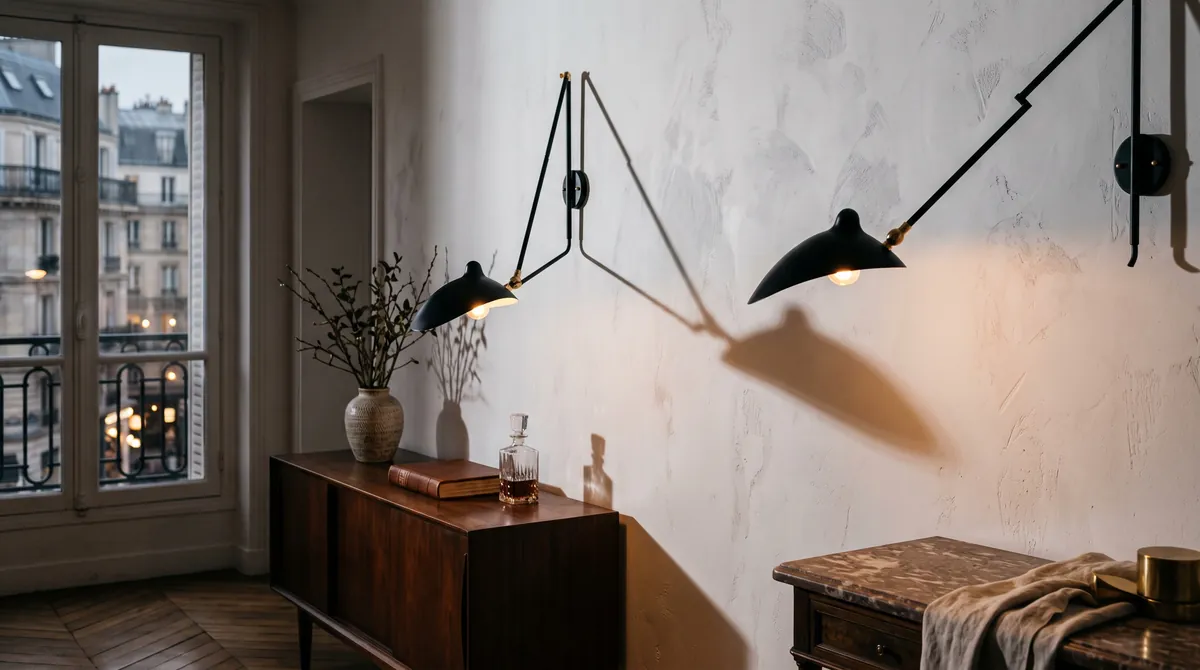
Because the arms are so fine and the shades so sharply drawn, a Mouille lamp throws crisp, graphic shadows onto a pale wall. In the evening lamp and shadow become a single composition, which is why his pieces look their best against plain plaster rather than busy wallpaper.
A Mouille lamp and its shadow form a single drawing on the wall.
Institutions, new light sources and an early end
In the late 1950s Mouille also designed lighting for public buildings, including the university residence at Antony, educational buildings in Strasbourg and Marseille and the cathedral of Bizerte in Tunisia. He developed floor lamps that combined bulbs with fluorescent tubes, inspired by neon lighting.
Ill health forced him to pause his work in 1959, and in the early 1960s he stopped making lamps altogether to concentrate on teaching at the École des Arts Appliqués. He died on 24 December 1988, his 66th birthday. His lighting career had lasted barely a decade, yet it left a body of work that still defines a moment in French design.
Handmade reissues and collectors
Because his production was short and made by hand in small numbers, original Mouille lamps are rare and highly prized by collectors and museums. In 1999 production began again in France under the name Les Éditions Serge Mouille, led by Gin Mouille and Claude Delpiroux with the help of one of Mouille’s former students, using his original measurements and materials.
Each reissued lamp is still made by hand, then stamped, numbered and supplied with a . The appeal is easy to understand. In an age of anonymous recessed spotlights, a Mouille lamp is unmistakably the work of a human hand, and it gives even an empty white wall a sense of movement.
glaminia is independent and does not sell lamps or recommend dealers. Images are AI generated illustrations, not photographs of specific products. Have fixed electrical work done by a qualified electrician.