
Anglepoise: the spring-balanced lamp born from engineering
A car engineer, a set of springs and a lamp that stays exactly where you put it. George Carwardine’s Anglepoise of the early 1930s became the model for every jointed desk lamp since.
Few lamps explain themselves as honestly as the Anglepoise. You can see the springs, follow the joints and understand, almost at a glance, why the arm stays where you leave it. That clarity comes from its inventor, a British engineer who thought about balance and movement long before he thought about light.
An engineer, not a lamp designer
George Carwardine (1887 to 1947) was a car designer and freelance consultant who specialised in vehicle suspension. Springs, levers and loads were his daily material. In the early 1930s he applied that knowledge to a new problem: a lamp that could be pointed in almost any direction and would then hold its position without clamps or screws.
On 4 July 1932 he applied for a for a design with four springs, and he built the first lamps in his own workshop, Cardine Accessories, in Bath. A version with three springs, meant for the home, followed with a further patent in 1934. On 22 February 1934 he signed a licensing agreement with Herbert Terry and Sons of Redditch, who manufactured and marketed the lamp under the name Anglepoise.
How the springs balance the arm
Every part of a jointed lamp has weight, and gravity pulls the head and arms downwards. Carwardine’s idea was to set springs against that pull. When you lower the arm, the springs stretch and store energy; when you raise it, they give that energy back. Matched carefully to the weight of the parts, the springs cancel the pull of gravity across the whole range of movement.
The result is often described as constant balance: a light touch moves the lamp, and it stays put when you let go. A key part of the patent was the position of the springs, grouped near the base rather than spread along the arms, so the weight stays low and the upper arm can stay slim.
- Base: a heavy foot that keeps the lamp stable at full reach.
- Springs: three or four, depending on the model, mounted close to the base.
- Arms: two jointed sections linked by pivots, which together define where the head can go.
- Shade: a compact metal reflector that directs light onto the work and keeps it out of your eyes.
A light touch moves the lamp, and it stays put when you let go.
1935: the 1227 comes home
In 1935 Terry released the 1227, a three-spring model aimed mainly at domestic use. It became hugely popular and set the image most people still have of the Anglepoise: a stepped base, a pair of slender arms and a bell-shaped shade. On 3 September 1939, the day Britain declared war on Germany, a Terry advertisement promoted it as the ideal blackout lamp. A beam that could be aimed precisely suited a country that had to keep its windows dark.
Early prototypes were made entirely of steel; later models used brass and aluminium parts as well. The Original 1227 is still made today and remains the best-known model of the brand, now simply called Anglepoise.
The ancestor of every jointed lamp
The principle spread quickly. In Norway, Jac Jacobsen developed the Luxo L-1 of 1937 from the same idea, and jointed, spring-balanced lamps soon became standard on drawing boards, workbenches and office desks around the world. Whenever you see a lamp with two arms, a few springs and a pivoting head, you are looking at a descendant of Carwardine’s patent.
The brand itself kept evolving. In 2003 the British product designer Sir Kenneth Grange became design director of Anglepoise, and in 2004 he created the Type 75, inspired by a 1970s version of the earlier Apex 90 model. Since then the range has grown to include giant floor versions, wall lamps and editions in collaboration with fashion designers.
| Year | Milestone |
|---|---|
| 1932 | George Carwardine applies for his patent for a four-spring lamp |
| 1934 | Patent for a three-spring home version and licence to Herbert Terry and Sons |
| 1935 | Launch of the domestic model 1227 |
| 1937 | Jac Jacobsen’s Luxo L-1 takes the principle to Norway |
| 2003 | Kenneth Grange becomes design director of Anglepoise |
| 2004 | Launch of Grange’s Type 75 |
Dates as commonly given in the history of the Anglepoise.
Setting one up for work
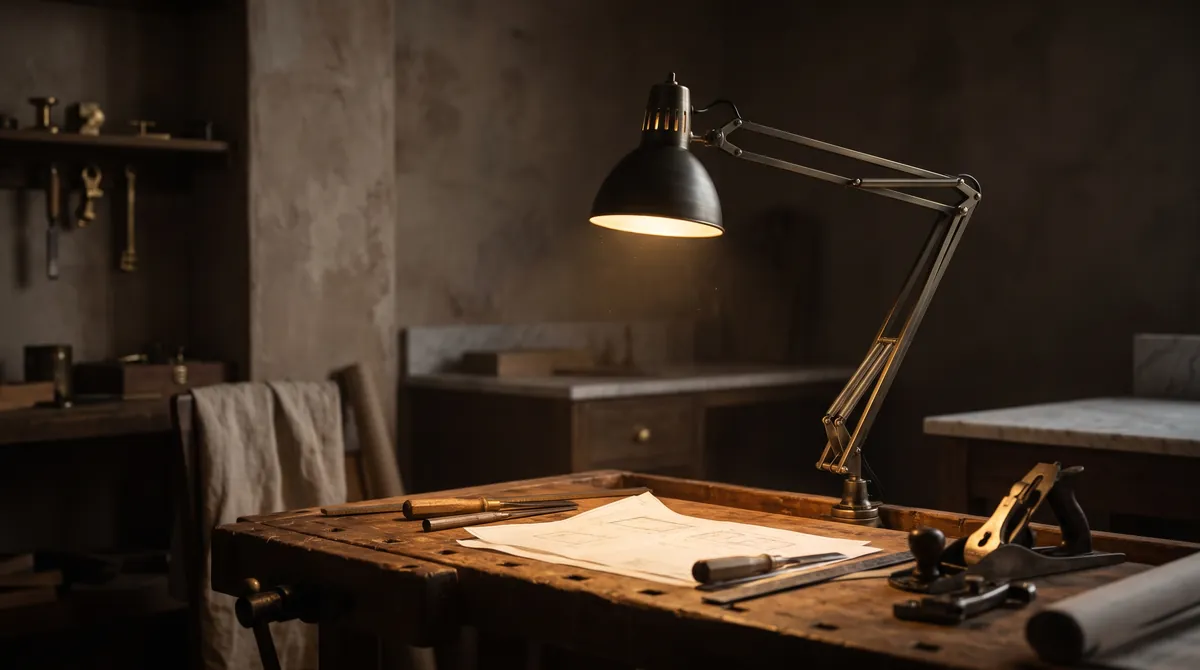
An Anglepoise is a : it lights an activity, not a room. Use it for reading, writing, sewing or model making, and keep a softer light elsewhere so your eyes do not jump between a bright desk and a dark room.
Choose a neutral white of about 3,000 to 4,000 K for detailed work. (K) measures how warm or cool white light looks: lower numbers feel warmer and cosier, higher numbers crisper. For colour work, look for a of 90 or more. CRI, the colour rendering index, rates how naturally a light shows colours.
If an older lamp starts to sag or bounce, the springs may be worn or the joints loose. Replacement parts exist for many models. Rewiring a vintage lamp, especially one with an old cable or a metal body, is a job for a qualified electrician.
glaminia is independent and does not sell lamps or recommend dealers. Images are AI generated illustrations, not photographs of specific products. Have fixed electrical work done by a qualified electrician.