
Atollo: Vico Magistretti’s lamp made of three shapes
A cylinder, a cone and a hemisphere: in 1977 Vico Magistretti reduced the table lamp to three pure solids for Oluce and created one of the most recognisable silhouettes in Italian design.
Ask a child to draw a lamp and the result will look a lot like Atollo: a stem, a shade and a glow underneath. Vico Magistretti designed it in 1977 for the Italian manufacturer Oluce, and he took that familiar picture and reduced it to three pure geometric solids. Almost half a century later, it still looks less like a product than like the idea of a lamp.
Three shapes, one silhouette
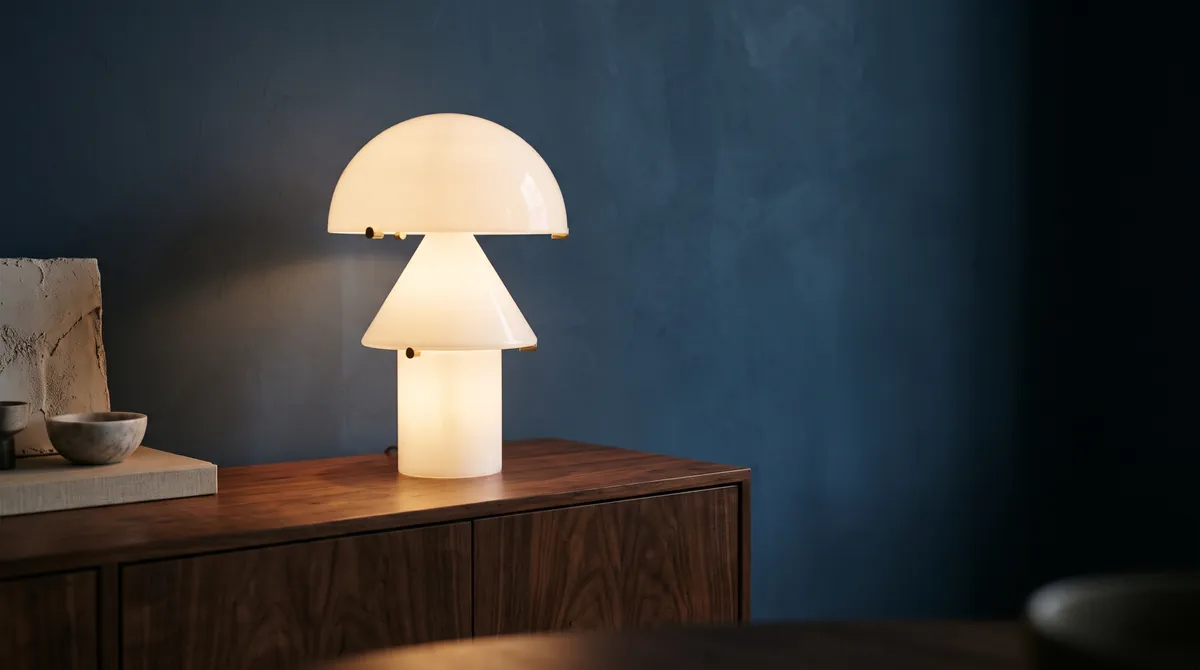
Atollo is built from a cylinder, a cone and a hemisphere. A slim cylindrical stem stands on the table and opens into a cone, and on the point of that cone rests a dome, the hemisphere that serves as the shade. There is no fabric, no visible bulb, no hinge and no decorative detail. Everything you see is structure.
The light source sits inside the dome. It shines down onto the cone, which catches the light and reflects it, so the lower part of the lamp glows softly too. Because the dome meets its base at only one narrow point, it seems to float when the lamp is switched on. That hovering shade is what most people remember after their first encounter with an Atollo.
Magistretti (1920 to 2006) trained as an architect in Milan and was known for reducing objects to a single clear idea. He worked closely with Oluce for many years as its leading designer, and Atollo became the company’s signature piece. Its name is simply the Italian word for atoll.
A Compasso d’Oro and a place in museums
In 1979 Atollo won the , Italy’s most important design award, first presented in 1954. The same year it entered the design collection of the Museum of Modern Art in New York. In the 1980s further museums acquired it, among them the Philadelphia Museum of Art, Die Neue Sammlung in Munich and the Kunstmuseum Düsseldorf.
Curators liked it for the same reason designers still study it. Atollo is a lesson in proportion: the narrow stem, the steep cone and the generous dome are balanced so precisely that the lamp looks calm from every angle. It also arrived at an interesting moment. Italian design in the late 1970s was turning towards radical experiments and, soon after, the colourful provocations of Memphis. Atollo went the other way and returned to the archetype.
Because the dome meets its base at only one narrow point, it seems to float.
Metal or opal glass
Oluce makes Atollo in two materials, and they behave quite differently. The metal versions are lacquered in white, black or gold. The metal is opaque, so the dome reads as a crisp, solid shape and the light falls mainly downwards, onto the cone and the surface below. The effect is graphic and a little theatrical.
The glass versions are made of , a milky white glass that works as a : it scatters the light so that the whole lamp glows evenly, dome and base alike. The glass Atollo gives far more ambient light and looks soft and luminous, almost like a lantern. Both materials come in three sizes, each with its own model number.
| Size | Height | Dome diameter | Metal model | Glass model |
|---|---|---|---|---|
| Large | 70 cm (27.6 in) | 50 cm (19.7 in) | 233 | 235 |
| Medium | 50 cm (19.7 in) | 38 cm (15 in) | 239 | 237 |
| Small | 35 cm (13.8 in) | 25 cm (9.8 in) | 238 | 236 |
Approximate figures. Check the current specifications before you plan a space around the lamp.
How the light behaves
Atollo is a mood lamp first and a reading lamp second. With the metal version, the light gathers in a pool below the dome while the top stays dark, so the lamp draws a strong silhouette against the wall. The glass version lights the room more generally and works well wherever you want a soft glow at eye level, for example on a sideboard in a dining room.
The colour of the light matters as much as its amount. Colour temperature is measured in (K): lower numbers mean warmer, more golden light, higher numbers cooler, bluer light. For a lamp like this, warm white of around 2,700 K suits the evening and flatters wood, stone and skin. Brightness is measured in lumens, the total amount of light a source gives off, and a few hundred lumens is plenty for a decorative table lamp.
If you want to dim the lamp from a wall switch or add a smart control to a fixed circuit, have a qualified electrician fit and check it, and make sure the bulb is labelled as dimmable.
Where Atollo works best at home
Its silhouette is the reason to own an Atollo, so give it space where it can be seen against a calm background. Each size has its natural place:
- Large on a sideboard or console in a dining room or hallway, where its height balances a long piece of furniture.
- Medium on a side table next to a sofa, or on a desk in a study where you want atmosphere rather than task light.
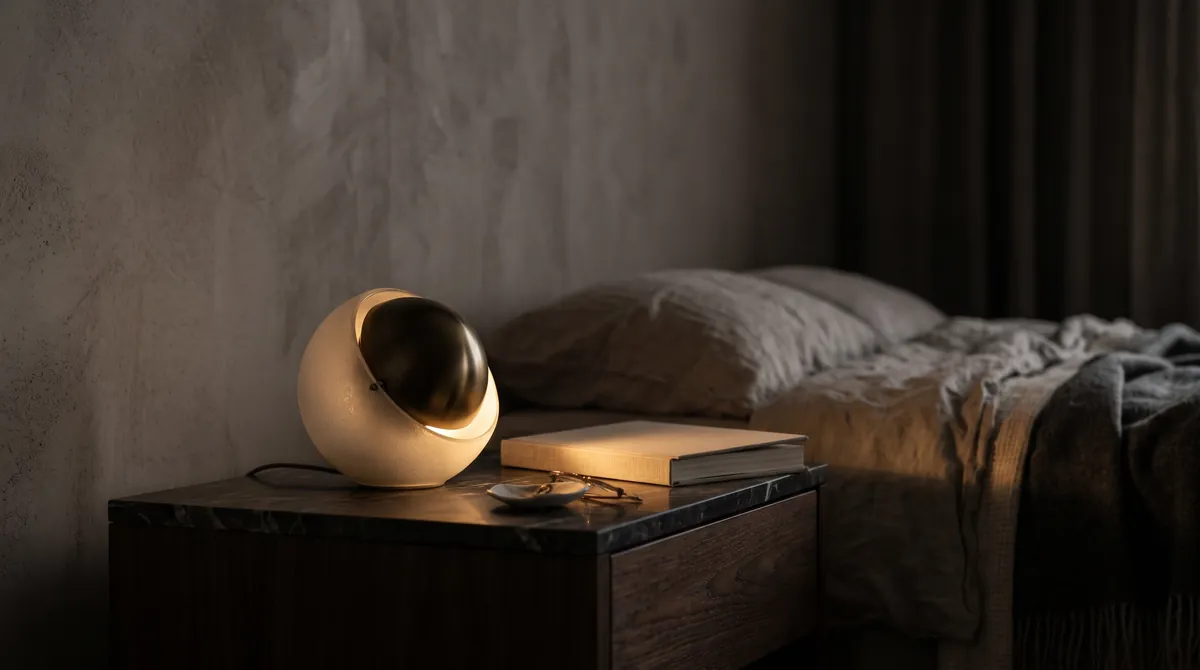
- Small on a bedside table, a bookshelf or a deep window sill, where the glass version makes a gentle night light.
- A pair of metal Atollos on either side of a bed or a fireplace, for a symmetrical, architectural look.
Dark walls suit the lamp especially well. Against deep blue, green or charcoal, the white glass version glows like a small moon, while a black metal Atollo almost disappears until it is switched on and its pool of light reveals the shape. On a pale wall, the gold or black metal versions give more contrast.
Why a 1977 lamp still feels current
Many lamps of the 1970s now look like period pieces. Atollo does not, because it borrows nothing from fashion. Its forms are the ones you learn in a geometry lesson, and its idea is the oldest one in lighting: a shade above a source, a glow below. Magistretti simply removed everything that was not necessary.
That is also why it fits so many interiors. It sits comfortably in a minimal apartment, beside antique furniture in a villa or on the desk of an architect’s studio. Few lamps manage to be both a sculpture and an everyday object. Atollo has managed it for almost fifty years.
glaminia is independent and does not sell lamps or recommend dealers. Images are AI generated illustrations, not photographs of specific products. Have fixed electrical work done by a qualified electrician.