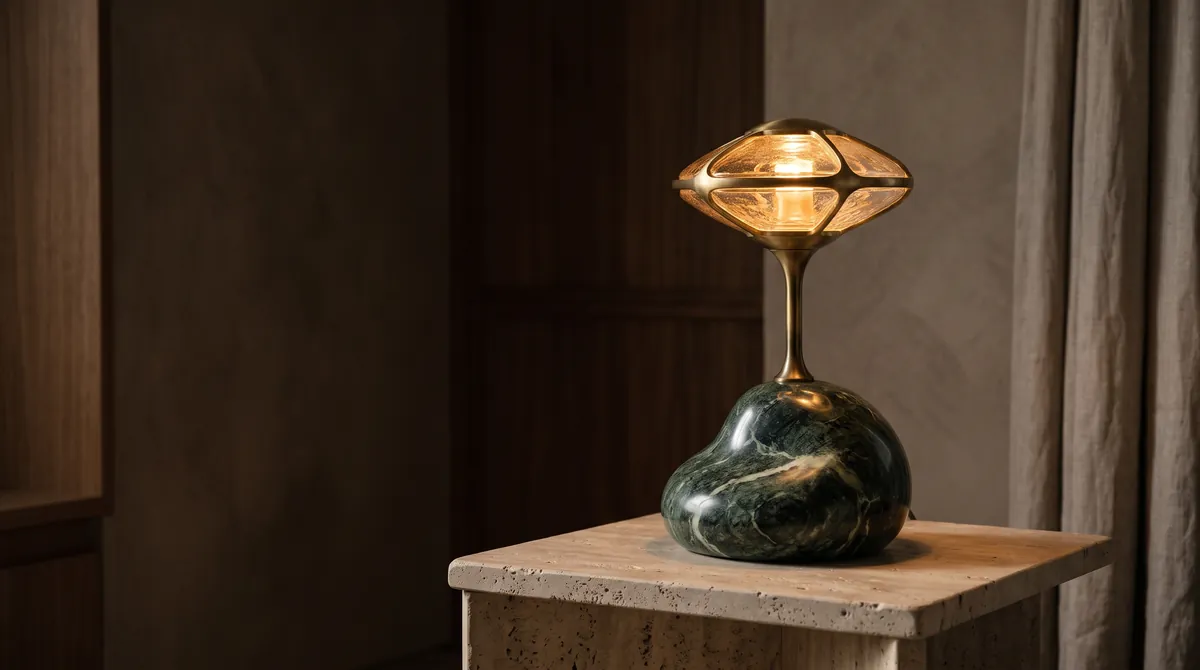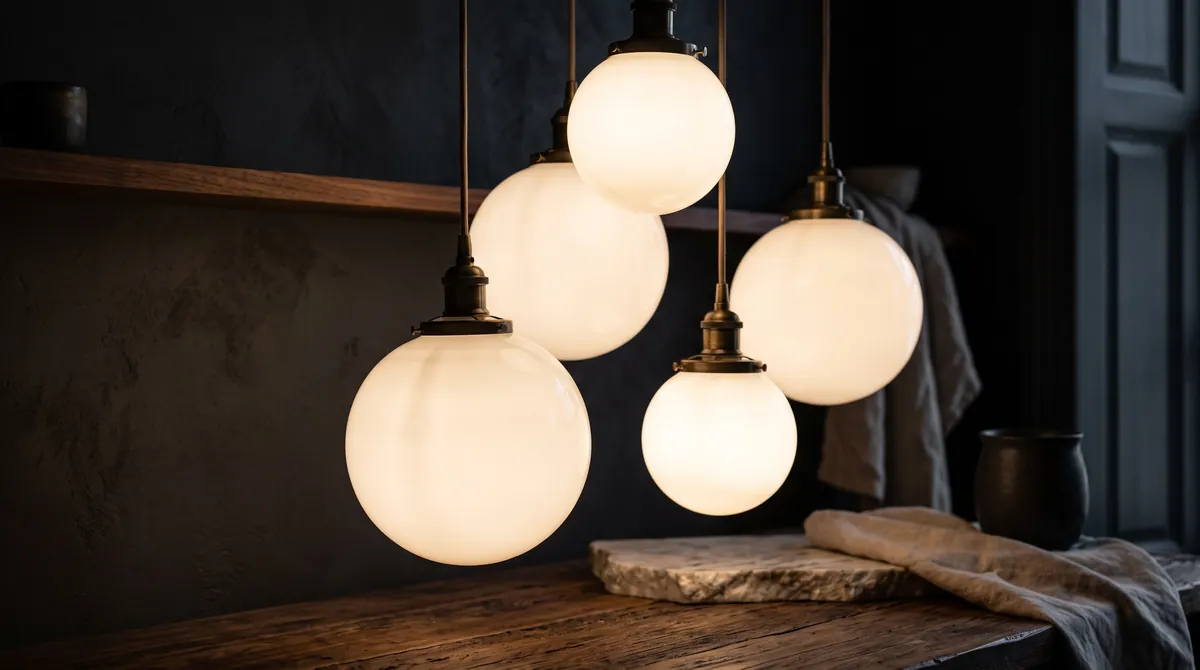

Opal glass: the milky glow behind many classics
Switch on an opal glass shade and the bulb disappears into a soft, even glow. How milky glass is made, why it diffuses so well, and how to choose and clean it.
Switch on a lamp with an shade and something quiet happens. The bulb disappears, and the whole shade becomes the light: a soft, even, milky glow with no bright spot at its centre. This simple effect has made opal glass one of the most loved materials in lighting, from Bauhaus table lamps to the glass spheres of contemporary designers.
What opal glass is
Opal glass is glass that has been made milky white, either throughout its body or in a thin layer. Glassmakers add small amounts of mineral compounds to the batch of raw materials. As the molten glass cools, these form countless tiny particles or crystals inside it. Because they bend light differently from the surrounding glass, they scatter it in every direction.
The result ranges from a faint, cloudy translucence to a dense white that lets light through but hides everything behind it. White milk glass was first made in Venice in the sixteenth century as a translucent rival to porcelain, and in the nineteenth century, when white glass became popular for lamps and tableware, makers were already calling it “opal glass”.
Why it spreads light so well
In lighting terms, opal glass is a : a material that takes the concentrated light of a small source and spreads it over a larger surface. A bare LED or filament is tiny and intensely bright, which is what causes glare. Spread the same light over a globe 30 cm (12 inches) across and its brightness per square centimetre drops dramatically. Your eye reads the shade as a calm, luminous object rather than a point that dazzles.
Good opal glass does this without hot spots, the brighter patches that appear when the bulb shows through. The denser the opal, the more even the glow, but the more light it absorbs. Designers balance the two: a thin opal layer lets more light out, a dense one gives the softest surface. Opal also sends light in all directions, so a globe pendant brightens the ceiling and walls as well as the table below.
The bulb disappears, and the whole shade becomes the light.
Mouth-blown, pressed and cased
Most fine opal shades are . A glassblower gathers molten glass on a pipe, blows it, often into a mould, and shapes it while it is still soft. Mouth-blown glass has slight variations in wall thickness and the occasional tiny bubble, which are signs of handwork rather than flaws. It allows smooth curves and thin, light walls.
Pressed glass is formed by pushing molten glass into a mould with a plunger. It suits simpler shapes, thicker walls and crisp details such as ribs or rims, and it was widely used for industrial and everyday fittings. Machine-blown glass sits between the two: consistent and economical for large series.
Many shades are made of , also called flashed glass, in which a layer of opal is fused with one or more layers of clear glass. Some makers enclose the opal between clear layers, which gives a deep, glossy surface and a very even glow. Others use a thin opal skin on clear glass to let more light through. The cut edge of a shade often reveals the layers.
Glossy or satin finish
Opal glass comes with two main surfaces, and they change the character of a lamp more than you might expect.
- Glossy: smooth and shiny, with reflections of the room on the surface when the lamp is off. It looks crisp and slightly classic, and it is the easiest to clean.
- Satin, also called matt or frosted: the surface is acid-etched or sandblasted. It looks soft and velvety, hides reflections and diffuses a little more, but holds fingerprints and grease.
- Cased gloss: a clear outer layer over the white gives a glossy skin with a deep, soft glow underneath.
Opal globes from the Bauhaus to today
The opal globe runs through modern design history. In the early twentieth century, simple opal globes hung in schools and offices because they turned bare bulbs into even, glare-free light. At the Bauhaus, Wilhelm Wagenfeld and Carl Jakob Jucker designed their table lamp in 1923 and 1924 with a clear glass base, a metal stem and an opal glass dome that hides the bulb completely.
Later designers kept returning to the material. Vico Magistretti’s Atollo of 1977, built from a cylinder, a cone and a hemisphere, also exists in opal glass. Michael Anastassiades’ IC Lights for Flos (2014) balance an opal sphere on a slender bar, and many minimalist pendants today are little more than a perfect white globe on a thin cable. LEDs have made opal even more useful: they run far cooler than incandescent bulbs, so shades can be smaller, fully closed and close to the source.
Choosing bulbs and cleaning opal glass
Inside an opal shade, the bulb still matters. A frosted or opal-coated LED bulb spreads light more evenly than a clear filament bulb and helps avoid hot spots. Position matters too: a bulb near the centre of a globe gives the most uniform glow. Warm white light around 2,700 K (, the unit of colour temperature) gives opal a creamy tone, while cooler light makes it look whiter and more technical.
Switch the lamp off and let it cool before cleaning. Wash removable shades by hand in lukewarm water with a drop of mild washing-up liquid, rinse and dry with a lint-free cloth. Avoid abrasive pads and powders, especially on satin glass, where they polish shiny patches into the surface. Wear cotton gloves to handle satin shades, and remember the inside of globes, where dust and insects collect.
glaminia is independent and does not sell lamps or recommend dealers. Images are AI generated illustrations, not photographs of specific products. Have fixed electrical work done by a qualified electrician.