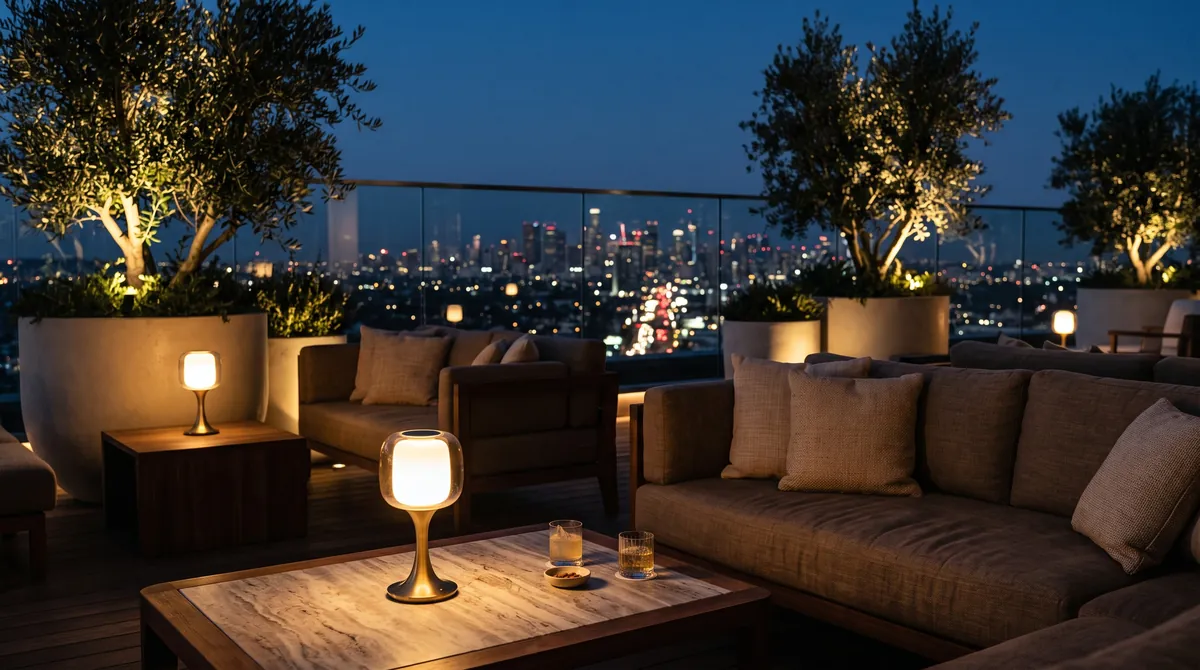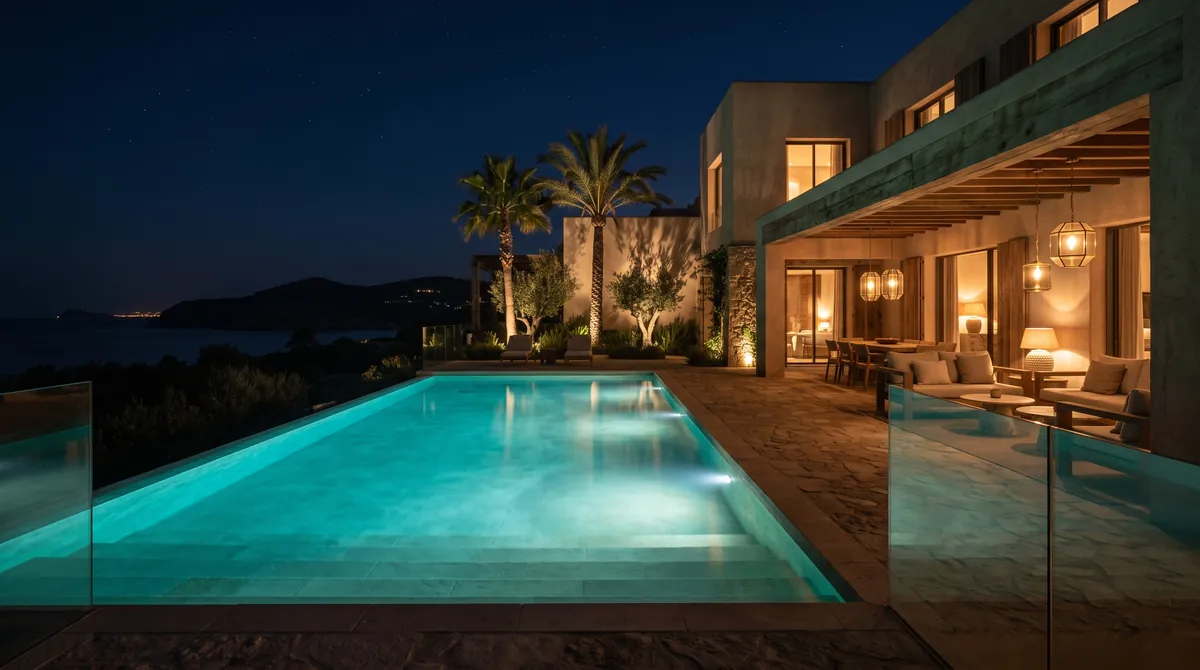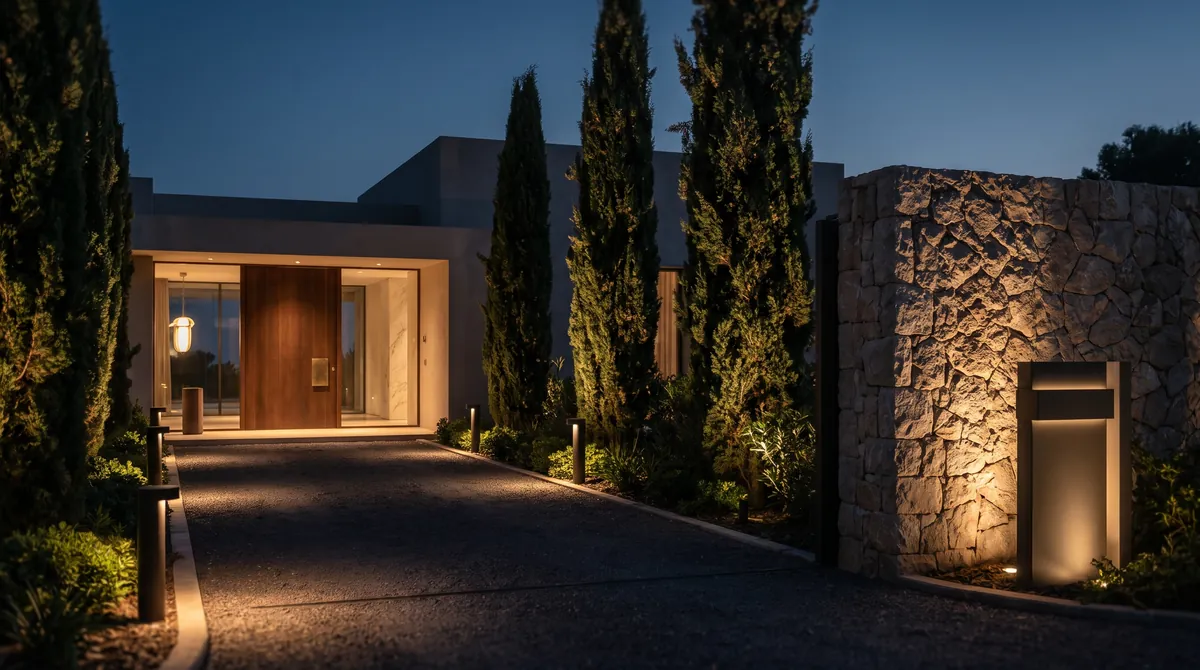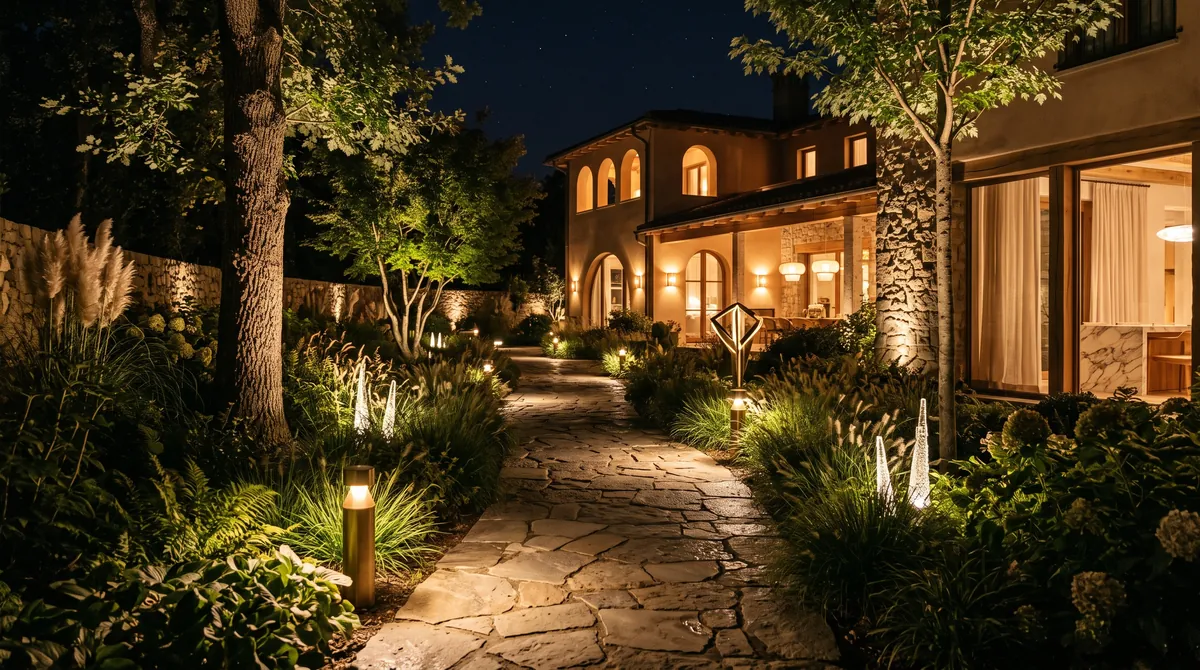

Garden lighting design: how to light a garden at night
By night a garden is read in light and shadow, and you decide what it says. Focal points, depth, a few well chosen techniques and a respect for the dark turn a plot into a picture.
By day a garden is read in colour and greenery. At night it is read in light and shadow, and you decide what it says. A few well placed lights can turn a lawn, two trees and an old wall into a deep, layered picture seen from the sofa, while too many lights flatten everything into a pale, restless stage. Good garden lighting design is mostly a matter of restraint.
Design from the window outwards
For much of the year, and on most evenings in a northern climate, you will see your garden from indoors. So start inside: stand at the main window or the terrace doors and decide what you want to look at. One strong focal point at the far end, a large tree, a sculpture or a lit wall, pulls the eye through the darkness and makes the garden appear larger than it is.
Then build depth in three planes: a soft glow close to the house, such as the terrace or a planter, something in the middle distance, perhaps a drift of grasses or a pool of light on the lawn, and the focal point at the back. Leaving dark gaps between these planes is what creates the sense of depth. Light everything evenly and the garden collapses into one flat surface.
Design ideas for a garden at night
Design ideas
- 01
Moonlight from a tall tree
Fix two or three small downlights high in a mature tree, angled down through the branches. The light falls in dappled patterns on the lawn or path below, much like moonlight.
- 02
One uplit specimen tree
A single tree lit from its base with one or two narrow beam spotlights becomes the backbone of the night garden. Olive, cork oak and multi stem birch show their bark and branching beautifully.
- 03
Backlit grasses
Place a low, wide beam light behind a drift of grasses or lavender, so the plants glow as silhouettes against the dark instead of looking flat and lit from the front.
- 04
A grazed garden wall
A row of small ground lights set close to an old brick or dry stone wall brings out every joint and stone and gives the garden a warm boundary.
- 05
Shadow play on render
A spotlight in front of a sculptural plant, an agave, a palm or a Japanese maple, throws its large shadow onto a pale rendered wall behind it.
- 06
A dark mirror of water
Light the trees and objects around a still pond or water bowl, not the water itself. The dark surface reflects them like a mirror.
- 07
Soft pools on the lawn
A few low downlights at the edge of a lawn cast separate, gently overlapping pools of light that suggest its shape without flooding it.
Techniques: up, down and across
Most garden schemes combine a handful of techniques. places the light at ground level pointing up, ideal for trees, columns and tall shrubs. mounts it high and points it down, which feels natural because it echoes the moon and sends less light into the sky. sets the light very close to a textured surface so that it skims across it and casts tiny shadows in every crack.
The , the width of the cone of light measured in degrees, matters as much as brightness. Narrow beams of 10 to 25 degrees suit slim trees and columns, wider beams broad canopies and hedges. Path and step lighting is the quiet partner of all three: low, shielded fittings that light the ground rather than anyone’s eyes.
| Feature | Technique | Rule of thumb |
|---|---|---|
| Small tree or shrub | One uplight | 200 to 400 lumens, narrow to medium beam |
| Large mature tree | Two or three uplights, or downlights in the canopy | 400 to 1,000 lumens per fitting |
| Textured wall | Grazing from below | Fittings 15 to 30 cm (6 to 12 inches) from the wall |
| Path or steps | Low, shielded lights | Under 100 lumens per fitting |
Starting points for warm white LED fittings. Dark rural gardens need less light, bright urban gardens a little more.
How much light, and what colour
Outdoors, darkness does half the work, so you need far less light than you think. The figure tells you how much light a fitting gives out, and in a garden modest numbers go a long way. Start low and choose dimmable fittings: adding brightness later is easy, while a garden lit like a petrol station forecourt is hard to undo.
Choose warm white of 2,700 to 3,000 K for stone, wood and most planting. The Kelvin figure describes light colour: the lower the number, the warmer and more golden the light. A slightly cooler white can make silver or deep green foliage look fresh, but use it sparingly and never mix colour temperatures at random across one view. Coloured light rarely flatters plants.
Light pollution and wildlife
A garden at night is far from empty. Moths, bats, hedgehogs, birds and frogs rely on the dark, and bright, all night lighting can disturb their feeding and movement. The kindest garden light is aimed only where it is needed, shielded so that nothing shines up into the sky, warm in colour and switched off when nobody is looking.
- Point light down or onto a specific object, never into open sky or across the boundary.
- Use warm or amber light, which contains less of the blue part of the spectrum that disturbs many insects and bats.
- Leave hedges, wild corners and pond edges dark as corridors for wildlife.
- Put the system on a timer or an astronomical clock, which follows the changing sunset, and switch off late in the evening.
Plan cables and controls early
Garden lighting is far easier to install before the landscaping is finished. Ask a qualified electrician to lay armoured cable or empty ducts along paths and beds while the ground is open, with spare capacity and a few extra connection points for later ideas. Outdoor circuits need protection by a residual current device, and every fitting needs an IP rating, a code for protection against dust and water, suited to its position. Lights in the ground or in water need the highest ratings.
Low voltage systems are popular in gardens because the fittings are easy to move as plants grow, but the transformer and mains connection still belong to the electrician. Group the lights into zones, such as terrace, middle garden and focal points, so you can choose a quiet scene for a weekday and a fuller one for guests.
Leaving dark gaps between the planes is what creates the sense of depth.
glaminia is independent and does not sell lamps or recommend dealers. Images are AI generated illustrations, not photographs of specific products. Have fixed electrical work done by a qualified electrician.