
Driveway and entrance lighting for villas: a warm welcome
The approach is the first scene of any evening at a villa. Lit gate pillars, softly marked drive edges, uplit trees and a glowing front door guide guests home without glare or floodlights.
The approach to a house is the first scene of the evening. Guests turn in at the gate, follow the drive, find the door and form an impression before anyone has said hello. Light can make that journey calm and gracious, or confusing and harsh. The aim is a clear, welcoming route from the road to the front door, with just enough drama along the way to make arriving feel like an occasion.
Think like a guest arriving at night
Walk and drive the route at dusk and note what a visitor needs to see: the gate and its intercom, the house number, the edges of the drive, any bend or kerb, the parking area, the steps and finally the door. These are your essential lights. Everything else, trees, walls and the facade, is atmosphere, and should support the route rather than compete with it.
Keep the brightness fairly even along the way. The eye adapts slowly, and passing from a dark lane into a blaze of floodlight and back into darkness is uncomfortable and actually reduces what you can see. A series of moderate, shielded lights works far better than one powerful lamp on the corner of the house.
Design ideas for drive and entrance
Design ideas
- 01
Lit gate pillars
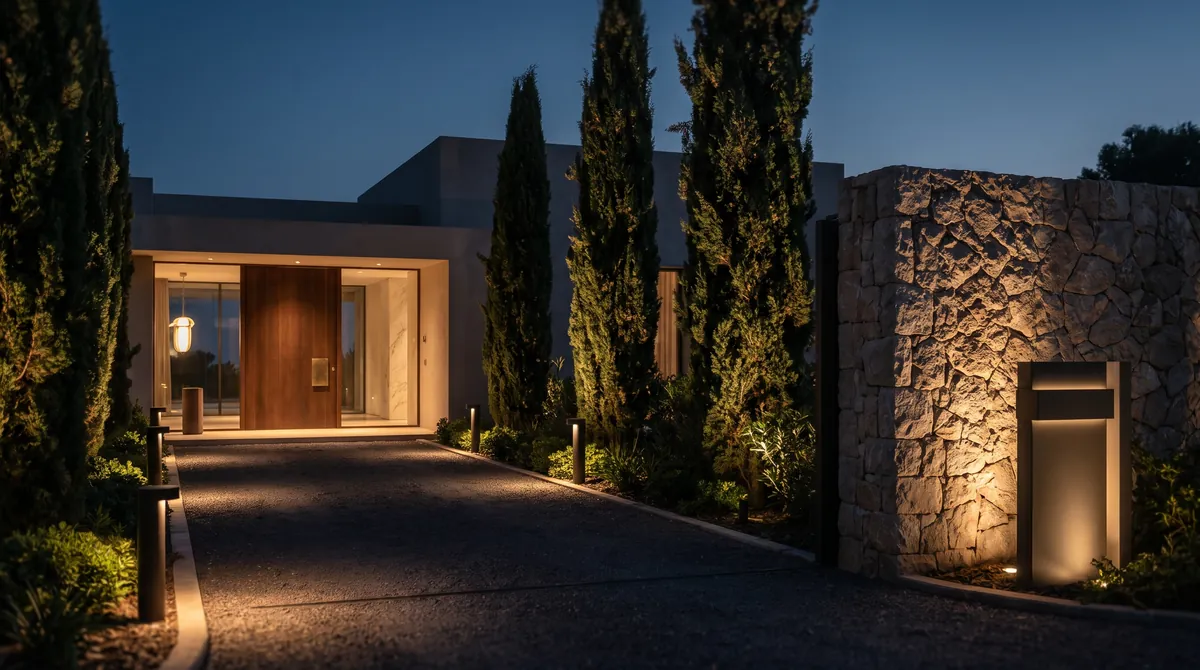
Lanterns or slim up and down lights on the gate pillars mark the entrance from the road and frame the gate. Choose a shielded design so that drivers are not dazzled.
- 02
An illuminated house number
A backlit or softly grazed house number by the gate helps guests, couriers and emergency services find you after dark.
- 03
Low bollards on one side
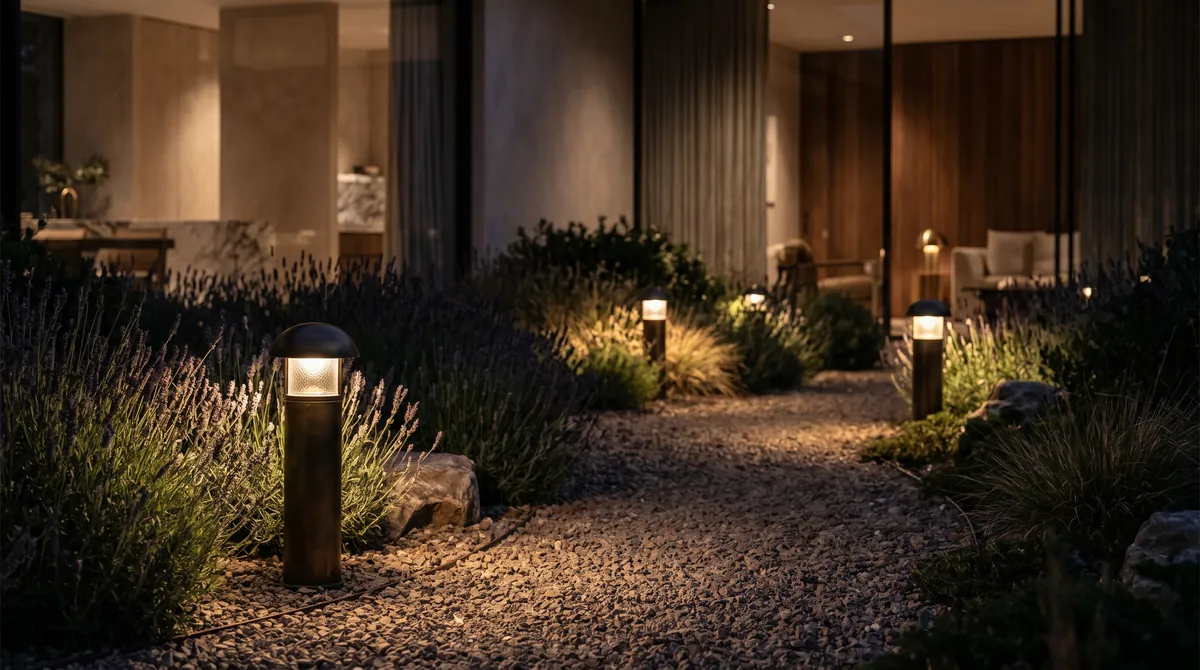
Short, shielded bollards along one edge of the drive and at bends mark the way without lighting up the whole plot.
- 04
An avenue of uplit trees
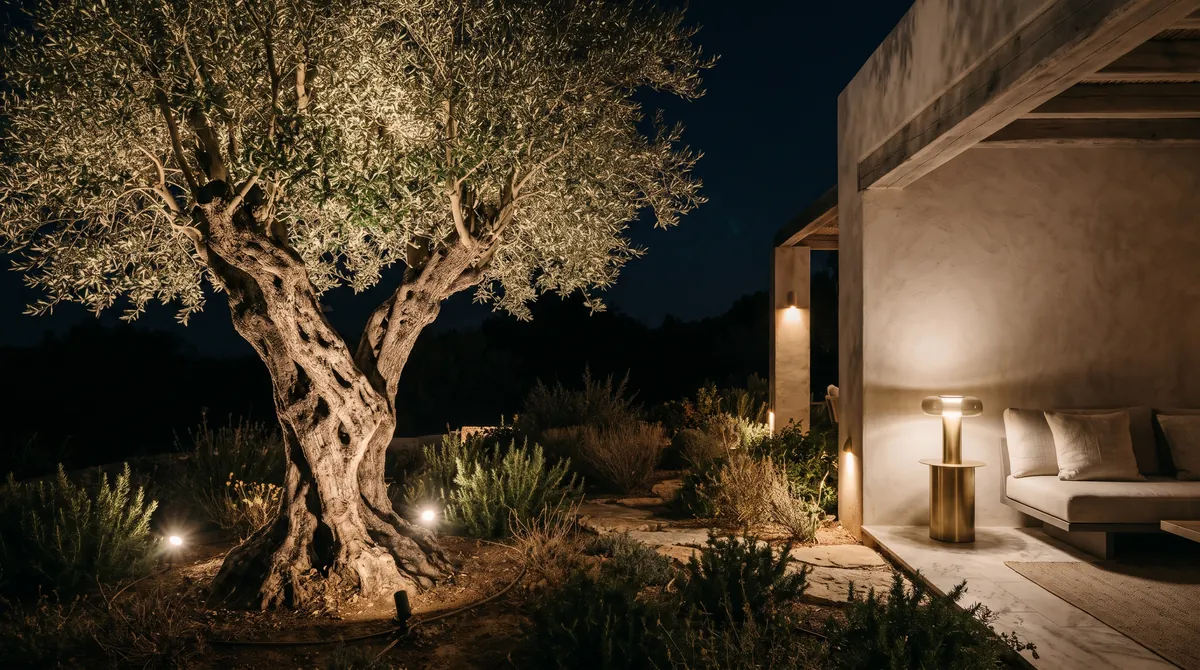
Uplighting a row of cypresses, olives or birches along the drive creates a ceremonial approach, a classic for Mediterranean villas and country houses alike.
- 05
A grazed entrance wall
A natural stone wall beside the gate or the front steps, grazed from below, reveals its texture and sets a warm, solid tone for the arrival.
- 06
Ground lights at the parking court
Recessed ground lights rated to be driven over, set at the corners of the parking area, mark its outline without any fitting standing in the way of cars.
- 07
A glowing front door
A pair of wall lights either side of the door, or a downlight in the canopy above, lights the faces of visitors and the keyhole and makes the entrance the destination of the route.
Security without glare
Many owners want the drive lit for security, but very bright floodlights often achieve the opposite. They create hard shadows in which someone can stand unseen, they dazzle anyone looking out from the house or in from the road, and they irritate the neighbours. Even, lower level light that shows the whole approach is better for both security and appearance.
is light that is too bright in your field of view, usually from a visible lamp, and it makes seeing harder rather than easier. Choose fittings that hide the light source, point the light downwards and keep it within your plot. fittings, which emit no light above the horizontal, also keep the night sky dark.
- Prefer several low, shielded lights to one floodlight.
- Aim light at the ground, a wall or a tree, never along the drive towards arriving drivers.
- Keep light within your own boundary and away from neighbours’ windows.
- Light the faces of visitors at the door, so that you or a door camera can see who is there.
Motion sensors and timers
A good scheme combines a quiet base layer with lights that respond. Low bollards and the door lights can run on a timer or a dusk sensor through the early evening, while brighter lights at the gate or the parking court switch on with a when someone arrives. Set sensors to a short run time, often a minute or two, and aim them carefully so that passing cars, cats and swaying branches do not trigger them all night.
Late at night most of the approach can go dark. Leave one or two orientation lights, the house number and the door, and let the sensors handle the rest. This saves energy and is kinder to moths, bats and the dark sky.
Warm light and cables planned early
For an approach that feels welcoming, choose warm white of 2,700 to 3,000 K. The figure describes light colour: lower numbers give a warmer, more golden light that flatters stone, render, gravel and planting. Cool white around an entrance tends to look institutional, like a car park.
Drives are often laid long before anyone thinks about lighting, and then dug up again. Ask a qualified electrician to plan the routes of cables and empty ducts while the drive and walls are being built, including power for the gate motor, intercom and camera. Every fitting needs an , the code for protection against dust and water, that suits its position, and ground lights in a drive must also be strong enough to carry a car.
Even, lower level light that shows the whole approach is better for both security and appearance.
glaminia is independent and does not sell lamps or recommend dealers. Images are AI generated illustrations, not photographs of specific products. Have fixed electrical work done by a qualified electrician.