Facade lighting: how to make a house glow at night
After dark a house can vanish into the night or come forward as architecture. Grazing light on stone, calm wall washing and neighbour friendly beams make a facade glow without spilling into windows or sky.
Seen from the garden or the street at night, a house can disappear into darkness or come forward as a piece of architecture. Facade lighting decides which. Done well, it reveals the texture of stone, the depth of a loggia and the rhythm of the windows, and it makes a villa look inhabited and calm. Done badly, it flattens the building, shines into bedrooms and sends a pale glow into the sky.
Read the architecture first
Before choosing any fittings, look at the house as a sculpture. What gives it character? It may be a rough stone wall, a row of columns, a deep doorway, a bold chimney, a tall slot window or a plain white wall with a single tree in front. Facade lighting should strengthen those features, not cover the whole surface with an even coat of light.
Light only parts of the facade and leave others in shadow. The contrast between lit and unlit areas is what gives a building depth after dark. A facade lit edge to edge at equal brightness looks like a stage set, and one lit by a single floodlight on the lawn looks like a building site at night.
Design ideas for the facade
Design ideas
- 01
Grazing on textured stone
Linear lights or small spots set close to the foot of a stone or brick wall, aimed almost parallel to it, reveal every joint and irregularity in warm light.
- 02
Up and down lights at the entrance
A pair of wall lights sending narrow beams both up and down frames the front door with two vertical stripes, a clean, modern look on rendered walls.
- 03
Lit columns and pilasters
Small uplights at the base of columns, pillars or pilasters pick out the vertical rhythm of a classical or colonial facade.
- 04
A glowing loggia
Soft indirect light on the ceiling of a loggia, porch or covered terrace makes the depth of the facade legible from far away.
- 05
A tree in silhouette
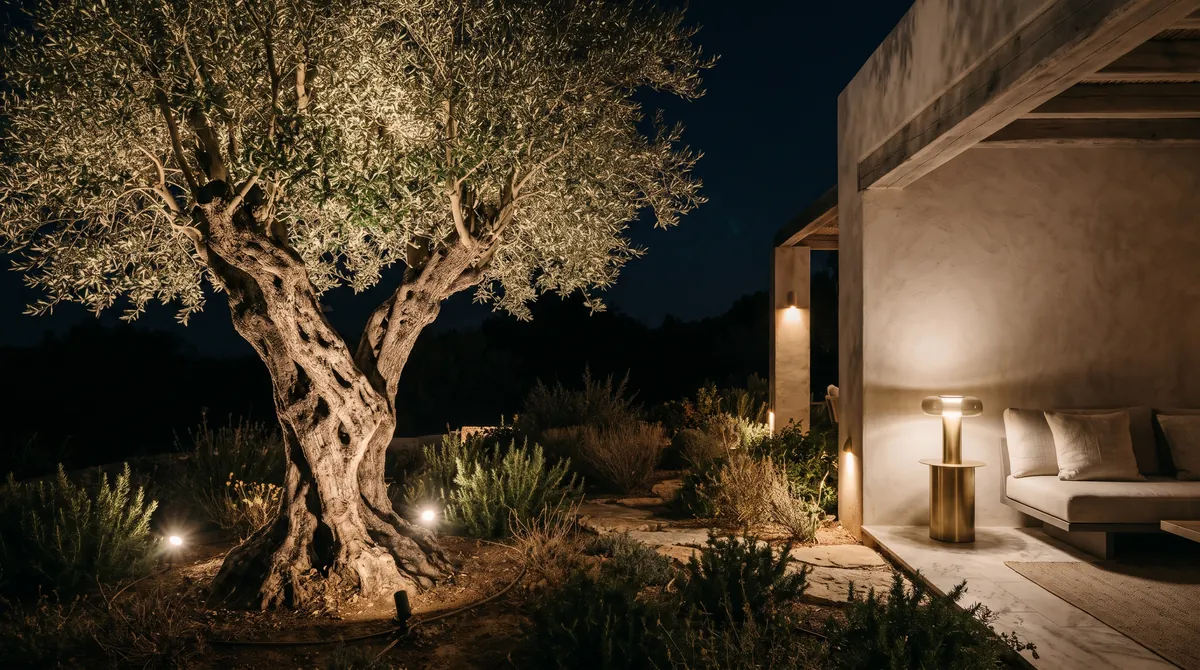
Wash a white rendered wall softly and leave the tree in front of it unlit. The tree becomes a graphic silhouette against the glowing wall.
- 06
A calm wash on plain walls
A wall washer gives a quiet, even glow to a plain garden wing, a garage block or a long boundary wall.
- 07
Light from the windows
Warm interior lamps left on in a few chosen rooms, with curtains half drawn, are part of facade lighting too, and often its most welcoming part.
Techniques: grazing, washing and wall lights
Three techniques cover most facades. places the light very close to a textured surface so that it skims across it, the classic way to light stone, brick and timber cladding. Washing uses a , a fitting with a wide, even beam, placed further away so that smooth light covers a plain surface. Wall mounted up and down lights emit narrow beams along the wall and create a vertical rhythm, especially around doors and corners.
- Stone, brick and timber: grazing from below or from above.
- Smooth render and concrete: washing or up and down lights.
- Columns, pilasters and chimneys: narrow uplights.
- Loggias and porches: soft indirect light on the ceiling.
The , the width of the cone of light in degrees, decides the effect. Narrow beams of about 10 to 20 degrees draw crisp stripes, while wide beams wash a broad area. Keep fittings small and in a finish close to the wall colour, so that by day they almost disappear.
Keep light out of windows and the sky
The most common mistakes are light shining into your own bedrooms and light spilling past the roof into the sky. Plan the beams so that they stop below window sills or at the eaves, use shielded fittings and, where possible, light downwards from the eaves rather than upwards from the ground. Light that lands on the wall is useful; light that misses it is only .
Neighbour friendly lighting also means modest brightness. A facade does not need to be seen from the next valley. Dimmable fittings let you fine tune the level on site, and a timer that switches the facade off at a set hour keeps the night dark for people and wildlife alike.
Colour temperature and materials
Warm white of 2,700 to 3,000 K suits most houses, especially stone in honey, sand or ochre tones, brick, terracotta and timber. The Kelvin figure describes light colour: lower numbers mean warmer, more golden light. Cool white can work on grey slate, white concrete or a strictly modern facade, but avoid mixing colour temperatures on one building. A (CRI) of 90 or above, a measure of how naturally light shows colours, keeps stone and render looking true.
Facade fittings face rain, sun, frost and, by the sea, salt. They need a suitable , the code that describes protection against dust and water, typically IP65 or higher on exposed walls and for lights recessed into the ground. Brass, stainless steel and well coated aluminium last longest.
Plan with an electrician
Facade lighting is best planned during a renovation or new build, when cables can run inside the walls or behind the cladding instead of across them. Ask a qualified electrician to design the circuits, protect them with a residual current device and place junction boxes where they can be reached for maintenance. A night test with temporary lights before the final fixing is time well spent.
Light that lands on the wall is useful; light that misses it is only light pollution.
glaminia is independent and does not sell lamps or recommend dealers. Images are AI generated illustrations, not photographs of specific products. Have fixed electrical work done by a qualified electrician.