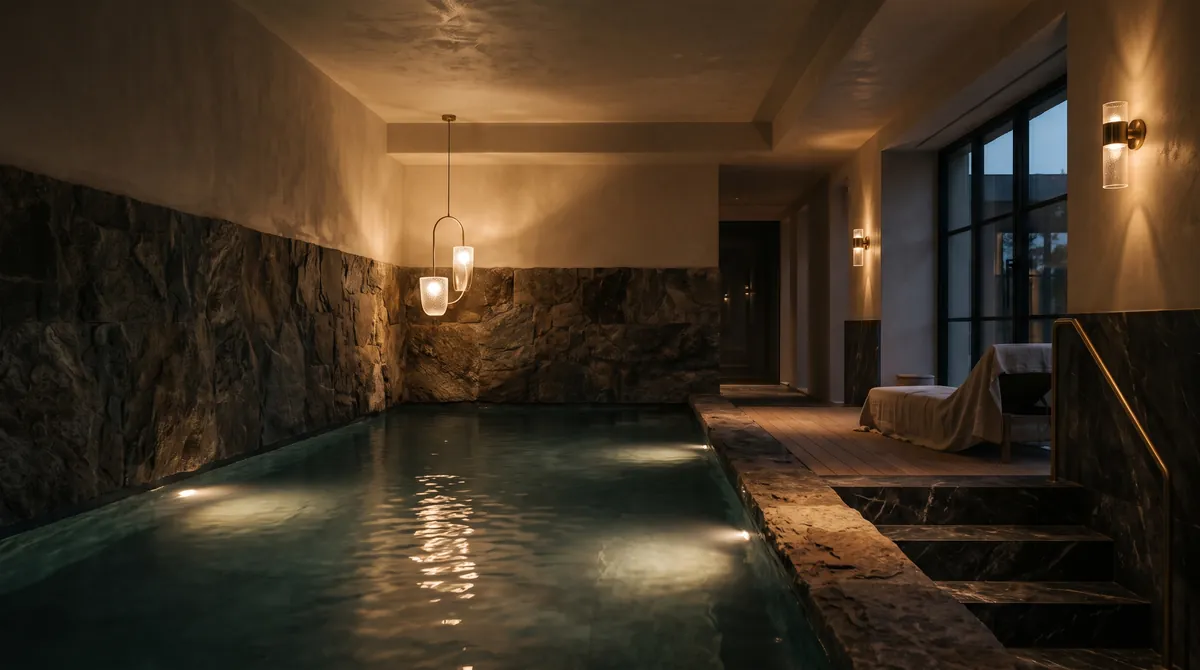

Indoor pool and spa lighting for villas
Water, steam and stone ask for a special kind of light. Ideas for underwater lights, indirect ceiling and wall light, reflections and calm spa scenes, planned by specialists from the start.
An indoor pool and spa is the most atmospheric room a villa can have, and the most demanding to light. Water reflects every fitting, steam and chlorinated air attack materials, and the electrical rules are stricter than anywhere else in the house. Yet light is what turns a swimming hall into a sanctuary: reflections dancing on stone, a glowing pool at dusk, a sauna bathed in amber.
Underwater light: the pool as a lantern
Underwater lights are the heart of pool lighting. Set into the pool walls below the water line, they make the whole basin glow and give the water its luminous colour. Place them on the side facing away from the main viewpoint, so you look at lit water rather than into the lights, and space them evenly to avoid bright patches and dark corners.
These fittings are made for permanent immersion and carry the highest protection ratings. They usually run at , with their power supplies placed outside the wet zones. Neutral to cool white makes the water look clear and blue, warmer white gives a softer, more golden mood, and colour changing light is often most beautiful in subtle shades.
Design ideas
- 01
Reflections on the ceiling
Underwater lights and a calm, smooth ceiling let the moving water cast rippling patterns of light overhead, the most magical effect an indoor pool can offer.
- 02
Grazed stone walls
Linear uplights at the base of travertine or slate walls graze the surface, bring out its texture and double their glow in the water.
- 03
A cove above the water
Indirect light from a cove along the edge of the ceiling lights the hall softly, with no fittings over the pool where they would reflect as glare and be hard to service.
- 04
Glowing steps and edges
Discreet light lines along the pool steps and the front of a lounge bench mark the edges safely and draw elegant lines in the dark.
- 05
Amber sauna light
Heat resistant lights placed low behind a backrest or under the benches give the sauna a warm amber glow, without any of it shining into the eyes.
- 06
A starry steam room
Fibre optic points in the steam room ceiling bring a night sky into the mist, with the light source kept safely outside the room.
- 07
The garden as backdrop
Lit trees and planting beyond the glass walls of the pool hall turn black windows into a living picture and remove the mirror effect at night.
Indirect light and reflections
Water is a mirror. Every downlight above a pool appears twice: once in the ceiling and once as a bright dot on the water, often right in your eyes as you swim on your back. That is why designers prefer indirect light for indoor pools: coves, uplights, wall washers and concealed lines that bounce light off ceilings and walls.
Fittings directly above the water are also a maintenance problem, because changing them may require scaffolding over the pool. Keep them along the edges, where they can be reached from the deck. Matte, textured surfaces such as limestone, lime plaster and wood soften the light; polished stone and glass add sparkle but multiply reflections.
Water is a mirror: every downlight above a pool appears twice.
Protection ratings, humidity and specialists
Pool and spa areas are divided into zones, and each zone sets its own requirements for the electrical equipment it may contain. The (Ingress Protection: two digits, the first for dust and solids, the second for water) shows how well a fitting resists water, from occasional splashes to permanent immersion. Close to and inside the pool, only fittings designed and rated for that exact position may be used.
Humidity and chlorinated or saline air corrode ordinary metals. Fittings should be made of materials suited to pool environments, such as marine grade stainless steel, coated aluminium or appropriate plastics, with sealed housings that keep moisture away from the electronics. Saunas add heat, so their lights must be rated for high temperatures, and steam room lights must be fully sealed.
- Planning by a lighting designer or engineer with pool and spa experience.
- Installation and testing only by a qualified electrician familiar with the rules for pools, saunas and wet rooms.
- Pool lights coordinated with the pool builder, because niches and cable routes go into the structure before it is tiled.
- Drivers and transformers placed outside the wet zones, in a dry and accessible room.
- Regular inspection, because seals and cables age in warm, humid air.
Sauna, steam room and relaxation areas
The classic sauna solution is a few small, heat resistant lights placed low, behind backrests or under the benches, which give a soft glow without shining into the eyes. are popular in both saunas and steam rooms: only light travels into the hot, wet room, while the light source sits outside.
In relaxation areas, think like a fine hotel spa. Very warm light of 2,200 to 2,700 K ( measures how warm or cool white light looks, lower values are warmer), low wall lights, lit niches with stones or plants and a dimmer on every circuit create the calm you want after a swim.
Scenes for swimming and relaxing
Light scenes let one room play several roles. A control panel at the entrance and perhaps a second one in the relaxation area make it easy to switch between them.
| Scene | Lights on | Mood |
|---|---|---|
| Swim | Underwater lights, cove, step lights | Bright, clear, neutral white |
| Relax | Dimmed underwater lights, wall grazing, lounge lights | Warm and soft |
| Evening view | Underwater lights, garden lights outside | Dark hall, glowing pool |
| Cleaning | All fittings at full level | Bright and functional |
| Night | Step and edge lines at a low level | Orientation only |
Example scenes. Your lighting planner adapts levels and colour temperatures to the room.
glaminia is independent and does not sell lamps or recommend dealers. Images are AI generated illustrations, not photographs of specific products. Have fixed electrical work done by a qualified electrician.


