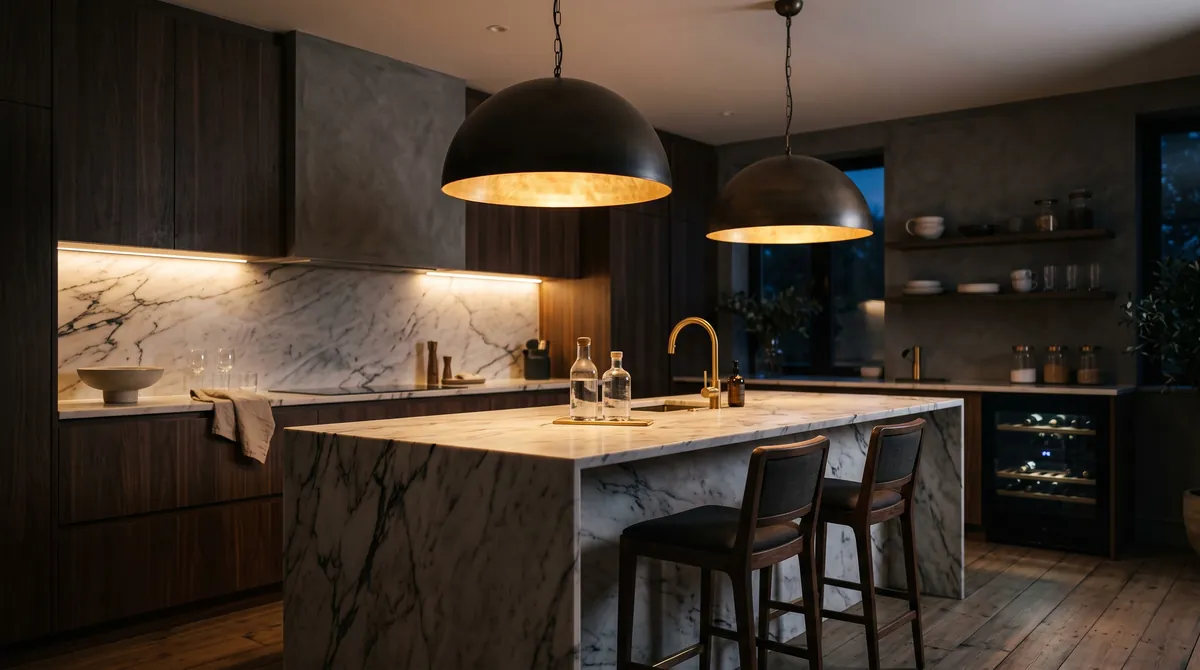
Dining room lighting: pendants, height and spacing
One large pendant or a row of small ones, how wide, how low and how far apart: the rules of thumb that make light over a dining table flattering, glare free and right for long dinners.
The dining table is where light becomes social. It falls on food, glasses and faces, and it marks the table as the centre of an evening. Get the pendant right and everyone looks well and the room feels intimate. Hang it too high, too small or too bright, and even a beautiful dinner feels like a waiting room.
One large pendant or several small ones
The shape of the table usually answers the question. A round or square table calls for one pendant centred above it, which echoes the form and gathers people around a single point of light. A long rectangular or oval table works better with two or three pendants in a row, or with one that runs along its length.
There are good exceptions. A cluster of small glass globes at slightly different heights can work over a round table in a double height space, and a single oversized dome can anchor a long table in a minimalist room. What matters is that the light covers the whole tabletop, not just the middle.
For size, start from the table, not the room. A single pendant should measure roughly half to two thirds of the table width. Over a 100 cm (40 inch) wide table that means a shade of about 50 to 65 cm (20 to 26 inches). With several pendants, the row as a whole should end at least 15 to 30 cm (6 to 12 inches) inside each end of the table, so the light stays over the table and not over the chairs.
Seven ideas for memorable dining light
Pick one idea for the pendant itself and one for the room around it.
Design ideas
- 01
A row of hand-blown glass
Hang three smoked or amber glass pendants in a line over a long table, each with a frosted bulb inside. The glass glows softly at dinner and reads like sculpture by day.
- 02
A pendant that hides the bulb
Choose a shade that shields the light source completely, such as the layered shades of Poul Henningsen’s PH5. You see a soft glow, never the lamp itself, even from a low seat.
- 03
A linear fitting for long tables
A slim suspended profile with direct light down and a little indirect light up lights a table of three metres (ten feet) evenly. The upward share softens shadows on faces and brightens the ceiling.
- 04
Candle level on a dimmer
Store a very low dimmer scene for late dinners so candles on the table carry the mood. Warm dimming LEDs at 2,200 K blend with candlelight without clashing.
- 05
Sideboard glow
Place a pair of small table lamps or a picture light over a sideboard to add a second, lower layer of light. It frames the table and keeps the edges of the room from falling into darkness.
- 06
A soft ceiling around the pendant
In a high room, wash the ceiling gently from a cove or wall lights so the pendant hangs within a warm glow instead of a black void.
- 07
An offset hook for flexibility
Where the table may move one day, hang the pendant from a ceiling hook offset from the outlet, with the cable swagged across. It lets you shift the light later without new wiring.
Hanging height and spacing
The most common mistake over a dining table is hanging the pendant too high. The light should sit low enough to shield the bulb from seated diners and to hold the table as a room within the room.
- Height above the tabletop: about 65 to 80 cm (26 to 32 inches) from the table surface to the lower edge of the shade. Closed shades that hide the bulb can hang lower, open or clear glass a little higher.
- Sightlines: people facing each other must still see one another. Very wide shades should hang a few centimetres higher than narrow ones.
- Spacing in a row: leave at least one shade diameter between pendants, roughly 60 to 90 cm (24 to 35 inches) from centre to centre for medium sizes.
- High ceilings: keep the same distance to the table and simply use a longer cable. The ceiling height changes the drop, not the distance to the tabletop.
- Seat count: a table for ten or more usually needs three pendants or a linear fitting, as a single pendant leaves the end seats in shadow.
| Table | Pendants | Shade diameter |
|---|---|---|
| Round, 110 to 130 cm (43 to 51 in) | One | 55 to 85 cm (22 to 33 in) |
| Rectangular, 180 to 220 cm (71 to 87 in) | Two or three | 30 to 45 cm (12 to 18 in) each |
| Rectangular, over 250 cm (98 in) | Three or a linear fitting | 35 to 50 cm (14 to 20 in) each |
Rules of thumb for tables about 90 to 110 cm (35 to 43 inches) wide. Visually heavy shades can be a little smaller.
Glare, light colour and dimming
is the harsh brightness of a visible light source, and it is the enemy of a good dinner. Open glass globes with clear bulbs look pretty in a showroom but sparkle straight into everyone’s eyes. Prefer shades that are opaque at the sides, frosted or , or bulbs with a frosted or mirrored crown.
Light colour should be warm: 2,700 K for everyday meals, down to 2,200 K for festive evenings. A colour rendering index () of 90 or higher makes food look appetising and skin tones natural. Above all, the dining pendant must be dimmable. The same table hosts homework at five and a candlelit dinner at nine.
Materials and the light they give
Spun aluminium and steel shades send light straight down onto the table and leave the ceiling dark, which feels intimate. Opal glass glows all around and lights faces from the side as well. Ceramic, rattan and pleated fabric give a warm, textured light suited to country houses and Mediterranean villas. Clear or smoked glass is the most dramatic, but only with a carefully chosen, low brightness bulb.
Think about cleaning, too. A dining pendant gathers dust and cooking vapour, especially in an open kitchen. Smooth glass and metal are easy to wipe, while fabric and woven shades need regular care with a soft brush.
Mistakes to avoid
- Pendants hung a metre (40 inches) or more above the table, which light the room but not the meal.
- A pendant centred on the room instead of on the table.
- Ceiling spots aimed straight down onto diners’ heads.
- Cool white light above 3,500 K, which makes food look pale.
- No dimmer, or a dimmer that makes LED bulbs flicker or hum.
Light over the dining table needs a little planning and repays it every evening. Get height, size and glare right, add a dimmer and a second soft layer, and the table becomes the place where evenings begin and end.
glaminia is independent and does not sell lamps or recommend dealers. Images are AI generated illustrations, not photographs of specific products. Have fixed electrical work done by a qualified electrician.