
Bathroom lighting ideas: mirror light, safety and spa mood
Even, shadow free light at the mirror, safe fittings near water and warm, dimmable light for a long bath: how to plan a bathroom that works at seven in the morning and feels like a spa at night.
No room switches roles as sharply as the bathroom. In the morning it is a workplace for shaving, make-up and contact lenses, and it needs clear, honest light on the face. In the evening it can be a private spa, lit by candles and a soft glow from a niche. Good bathroom lighting plans for both, and it treats water and electricity with the respect they demand.
Mirror light comes first
The most important light in a bathroom is the one that falls on your face. A single downlight above the mirror is the classic error: it lights the top of your head and casts shadows under your eyes, nose and chin. What you want is light from the front and the sides, at face height, the way a make-up artist would set it up.
There are two good ways to achieve it. Vertical lights on either side of the mirror, such as slim wall lights or light bars, place the light at eye level, roughly 150 to 170 cm (59 to 67 inches) above the floor and about 70 to 100 cm (28 to 39 inches) apart. Alternatively, a backlit or edge-lit mirror surrounds the face with a soft halo and suits compact bathrooms or a minimalist look.
For mirror light, choose a colour rendering index () of 90 or higher, so skin tones and make-up look as they do in daylight, and a colour temperature of about 3,000 K. Fittings with let you shift between a crisp morning setting and a warmer evening one.
Seven ideas for a bathroom with spa mood
Design ideas
- 01
A halo around a round mirror
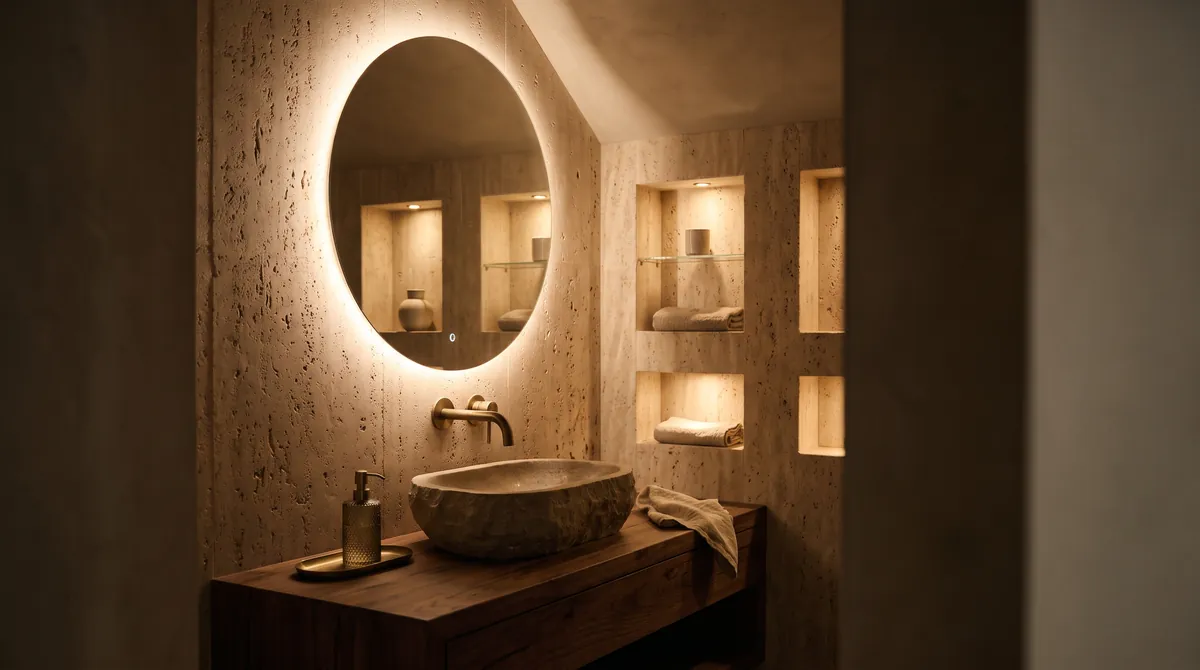
A backlit round mirror on a travertine or plaster wall throws a soft ring of light onto the surface behind it. It lights the face evenly and turns the mirror into the centrepiece of the room.
- 02
Lit niches in the shower
Integrate a warm light line at the top of a shower niche so it grazes down over stone and bottles. It gives enough light for an evening shower and looks beautiful from the bath.
- 03
Grazing light on stone walls
Place a concealed light line in the ceiling joint close to a wall of marble, travertine or textured tiles. The low angle brings out the relief and colour of natural stone.
- 04
A floating vanity
A dim light line under a wall-hung vanity or stone basin unit makes it appear to float and doubles as a gentle night light.
- 05
A candle-warm bath scene
Put a dimmable cove or niche light near the bath on its own circuit, set to 2,200 K or lower, so the room glows like candlelight while you bathe.
- 06
Sensor night light
Low-level orientation lights near the floor, triggered by a motion sensor at night, guide you without the shock of full brightness.
- 07
One decorative wall light
In a larger bathroom, a single sculptural wall light in glass or ceramic, rated for its position, adds a warmth and character that purely technical fittings lack.
Bathroom zones and IP ratings, in general terms
Water and electricity call for care. Most countries divide a bathroom into zones around the bath, shower and basin, and each zone has its own rules for which fittings are allowed. Measurements and required ratings differ from country to country, so treat what follows as an overview, not as installation advice.
- Inside the bath or shower tray: the strictest zone. Only fittings made specifically for it, typically watertight and running on , are allowed here.
- Directly above the bath or shower: the space up to a defined height. Fittings must be protected against water from all directions, and against jets where there is a shower head.
- Next to the bath, shower and basin: a band around the wet areas where splashes are likely. Fittings need at least splash protection.
- Outside the zones: the rest of the room. Ordinary fittings may be allowed, but steam and humidity still favour products made for bathrooms.
Protection is shown by the (ingress protection), a code of two digits. The first digit refers to dust and solid objects, the second to water. As a rough guide, IP44 means protection against splashing water from any direction, IP65 against water jets and IP67 against temporary immersion. Your electrician will tell you which rating each position needs where you live.
Fixed lights, mirror lighting, sensors and dimmers in a bathroom must always be installed by a qualified electrician. It is the one room where doing it yourself is never a good idea.
Warm light, dimming and scenes
Beyond the mirror, bathroom light should be warm and soft. Use 2,700 K for general light and 2,200 K or lower for niches, coves and the bath. Dimming is essential: what feels right at seven in the morning is far too bright at midnight.
Three scenes cover almost every need: “morning” with bright mirror light and general light, “evening” with niches and a dimmed cove, and “night” with only the floor-level orientation light. A simple wall-mounted scene switch, placed outside the wet zones, is often easier to use with wet hands than an app.
| Position | Purpose | Colour temperature |
|---|---|---|
| Mirror, sides or backlit | Even light on the face | About 3,000 K, CRI 90 or more |
| Ceiling or cove | General light | 2,700 K, dimmable |
| Niches and bath | Mood and relaxation | 2,200 K or lower |
| Near the floor | Night orientation | Warm amber, very low |
Materials and fittings that last
Choose fittings made for humid rooms, with sealed housings and corrosion resistant finishes. Glass, porcelain, powder-coated aluminium and solid brass cope well with steam. Opal glass diffusers soften the light and hide the LED inside. For light lines in showers and niches, use profiles with a sealed cover and keep them accessible for maintenance.
Common mistakes
- A single downlight above the mirror, casting shadows on the face.
- Cool white light everywhere, which makes the bathroom feel clinical.
- Glossy tiles that reflect every bare light source as a bright dot.
- No dimming, so night visits mean full brightness.
- Fittings chosen for looks alone, without the right IP rating for their position.
Plan the mirror first, the spa mood second, and leave the safety to an electrician. The result is a bathroom that prepares you for the day and helps you let it go again in the evening.
glaminia is independent and does not sell lamps or recommend dealers. Images are AI generated illustrations, not photographs of specific products. Have fixed electrical work done by a qualified electrician.