Villa entrance hall lighting: the first impression
The entrance hall sets the tone for the whole house. How to scale a chandelier for a double height space, light the stairs and art, link it to the drive and plan welcome scenes you can maintain.
The entrance hall is the first room every guest sees and the last one they leave. In a villa it is often the most generous space in the house, with a double height ceiling, a sweeping staircase and tall glass doors to the garden. Its light has to do several things at once: make a statement, guide people in, show off architecture and art, and still feel welcoming at midnight when you come home alone.
The statement piece and its scale
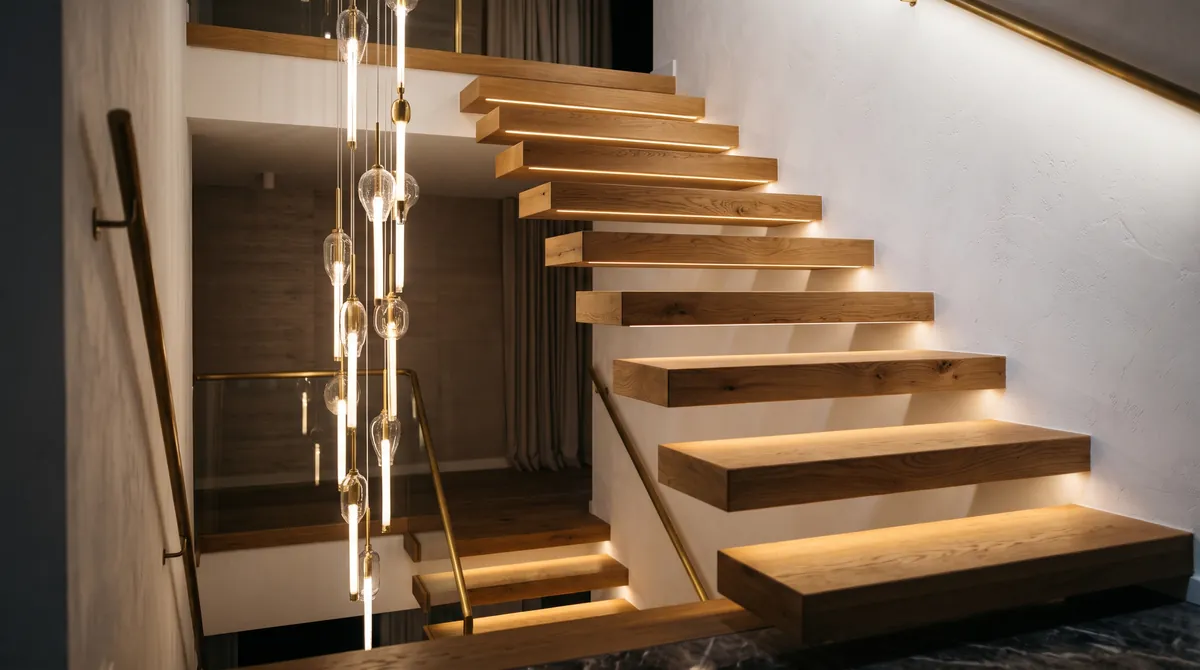
Most grand halls are built around one central fitting: a chandelier, a cluster of glass spheres or a group of pendants at staggered heights. Its job is less to light the floor than to give the volume a focus and to sparkle when you look up from the door or down from the gallery.
Scale is where entrance halls most often go wrong, usually with a fitting that is too small. A classic rule of thumb: add the length and width of the hall in metres and multiply by about 8 for a sensible diameter in centimetres. A hall of 6 by 5 metres (about 20 by 16 feet) suggests a fitting of roughly 90 cm (35 inches). For height, allow about 20 to 25 cm of fitting per metre of ceiling height (2.5 to 3 inches per foot), so a 6 metre (20 foot) hall can take a piece 1.2 to 1.5 metres (4 to 5 feet) tall.
Where people walk underneath, keep the lowest point at least 2.1 metres (7 feet) above the floor. In a double height space it often looks best at around the level of the upper floor, so it can be admired from both levels. Make sure it does not block the view through a tall window or from the front door to the garden.
Seven ideas for an unforgettable entrance
Design ideas
- 01
A cloud of glass spheres
Suspend dozens of hand-blown glass globes at different heights in the stairwell void, each with a warm, low output LED. The cluster fills the volume like a constellation and reads well from every floor.
- 02
A sculptural icon
Choose one recognisable design piece in a large size, such as Poul Henningsen’s PH Artichoke with its overlapping leaves. It hides the light source and glows warmly from every angle.
- 03
Wall lights in a rhythm
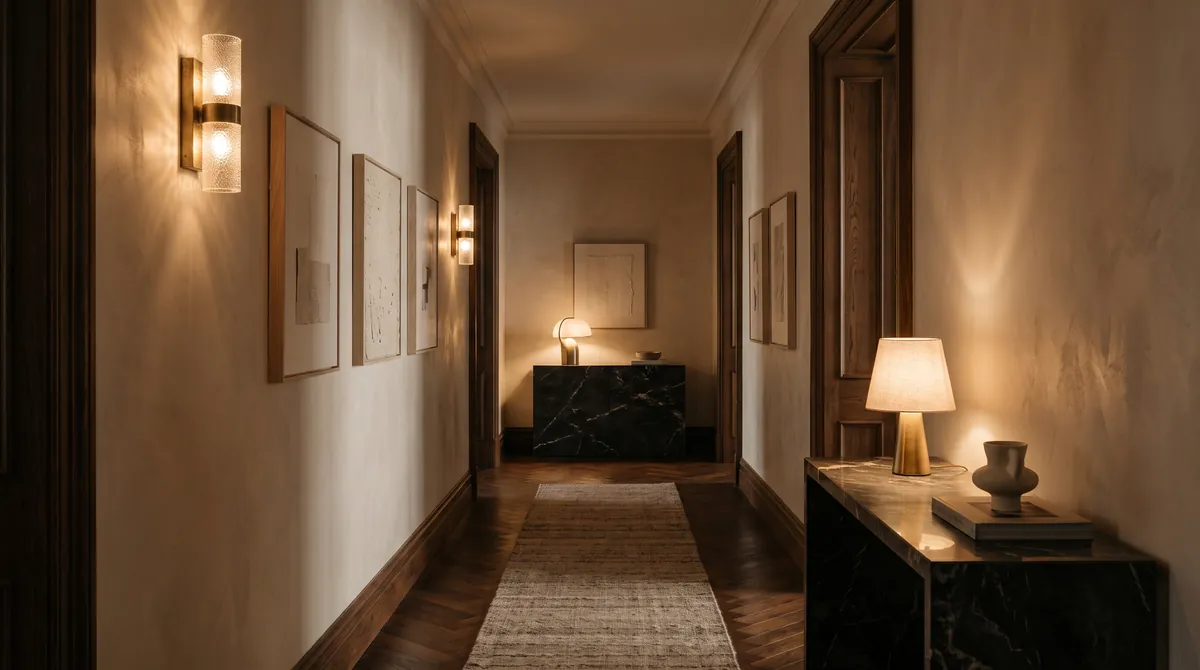
Repeat identical wall lights along the hall and up the staircase wall at a steady interval, about 170 to 190 cm (67 to 75 inches) above the floor or the line of the stair. The rhythm guides the eye and adds human scale to a tall room.
- 04
Light along the stair
Integrate warm light lines under the handrail or in the wall beside the treads of a curved stone staircase. It makes the stair safe at night and traces its sculptural sweep.
- 05
Art in its own light
Light a large painting or sculpture with a narrow-beam spotlight from the gallery or ceiling, so it becomes the first thing visitors see through the door.
- 06
Glowing glass doors
Light the terrace or garden just beyond tall glass doors so they do not turn into black mirrors at night. The view extends the hall into the landscape.
- 07
A welcome scene from the drive
Link the hall to the gate, drive and entrance canopy so one button or an arrival sensor brings up a soft path of light from the car to the front door and into the hall.
Layers around the chandelier
A chandelier alone rarely lights a hall well. It can glare when you look up the stairs, and it leaves corners and walls in shadow. Add layers around it.
- Wall lights at about eye level give the hall a warm, human scale and light faces when you greet guests.
- on art, a console or a sculpture creates a focal point visible from the door.
- Indirect light from coves or uplights on columns and walls reveals the architecture and the height of the space.
- Stair light from step lights or a handrail profile keeps the staircase safe without relying on the central fitting.
- Orientation light at low level for the night, so nobody needs to switch on the chandelier at three in the morning.
Scenes, dimming and the approach
An entrance hall is used in very different moments: a sunny afternoon, a dinner party arriving, a late return home. Programmed scenes handle this better than a row of switches. A typical set includes “welcome” with chandelier, wall lights and art at medium level, “party” with everything brighter and the chandelier at full sparkle, and “night” with only wall lights and stair orientation at a low glow.
The hall also links inside and outside. Light on the drive, the entrance steps and the front door should flow into the hall in the same warm colour, so arrival feels like one continuous movement. Sensors at the gate or a schedule linked to sunset can bring up the outdoor path automatically. All of this, from wiring to control systems, is work for a qualified electrician, ideally with a lighting designer.
Plan for maintenance from the start
The higher the fitting, the more important it is to think about cleaning and access before installation. A glass chandelier in a 7 metre (23 foot) void needs dusting, and even long-life LEDs eventually fail.
- Consider a motorised , which lowers the fitting to the floor for cleaning and repairs.
- Choose LED light sources with a long rated life and, where possible, replaceable modules.
- Check that wall lights on the stair can be reached safely from the steps or a gallery.
- Keep a record of light sources and drivers, the small power units that run LEDs, so replacements match in colour.
Mistakes to avoid
- A chandelier too small for the volume, which looks lost.
- A fitting hung so high that it lights only the ceiling, or so low that it blocks the view.
- Recessed downlights in a double height ceiling, which give harsh, distant light and are hard to reach.
- Glass doors that turn black at night because the garden beyond is dark.
An entrance hall lit with care tells guests what kind of house they have entered before anyone says a word. Scale, layers and scenes do the quiet work, and the statement piece gets the applause.
glaminia is independent and does not sell lamps or recommend dealers. Images are AI generated illustrations, not photographs of specific products. Have fixed electrical work done by a qualified electrician.