
Hallway and corridor lighting ideas
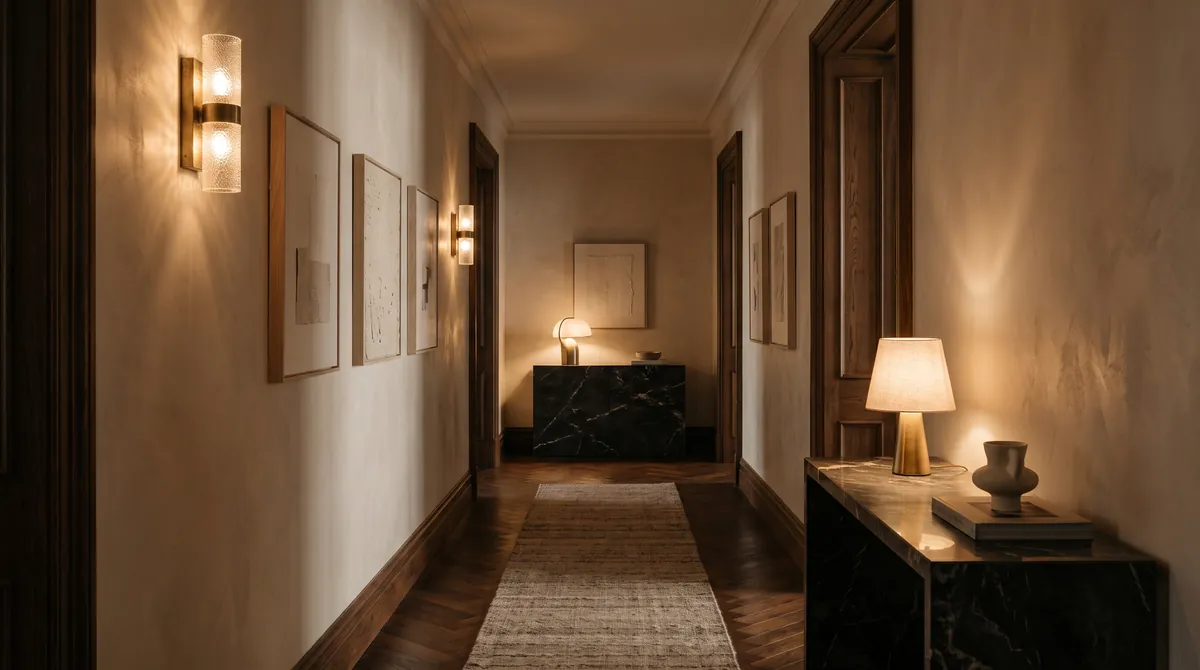
A corridor can feel like a tunnel or like a gallery. Wall washing, a steady rhythm of ceiling lights, lit art, a lamp at the end and gentle night light make narrow spaces wider and warmer.
Hallways and corridors are the spaces we pass through dozens of times a day and rarely think about. Yet they shape how a home feels. A dark, narrow passage makes every room beyond it feel smaller, while a well-lit corridor becomes a gallery, a quiet link between living and sleeping areas. A few precise lighting decisions change these spaces completely.
Light the walls, not the floor
The single most effective idea in a corridor is : lighting the walls evenly from top to bottom with fittings placed close to them. Our sense of space depends a great deal on how bright the vertical surfaces are. Bright walls make a narrow corridor feel wider, while a row of downlights down the middle lights the floor and leaves the walls dim, which creates the dreaded .
Wall washers are fittings with an asymmetric reflector that spreads light across the wall instead of throwing a circle onto the floor. In a wider hall, place them about a quarter to a third of the ceiling height away from the wall, so roughly 60 to 80 cm (24 to 31 inches) in a room 2.5 metres (8 feet) high, and space them about the same distance apart. In a narrow corridor, wash just one wall, or use a continuous light line along the ceiling edge.
That linear option works beautifully in a , a slim recess where wall meets ceiling. Light from such a slot grazes the wall from very close and reveals the texture of plaster, timber or stone. Matt, light-coloured walls reflect it most softly.
Seven ideas for hallways and corridors
Design ideas
- 01
One wall washed, one in shadow
In a narrow corridor, wash only the wall with art or a beautiful finish and leave the opposite wall in soft shadow. The contrast gives depth and avoids a flat, evenly bright tube.
- 02
A lamp at the end of the corridor
Place a console with a table lamp or a lit artwork at the far end of a long corridor. A bright focal point draws the eye forward and makes the passage feel shorter and more inviting.
- 03
A rhythm of pendants
In a wide or high hallway, hang a row of identical small pendants or surface lights at equal intervals along the centre line. The repetition turns a passage into an architectural sequence.
- 04
A corridor gallery
Light each painting with an adjustable spot aimed at around 30 degrees from vertical, or with slim picture lights. The corridor becomes a private gallery you walk through every day.
- 05
Low-level night path
Recess small warm lights into the wall about 20 to 30 cm (8 to 12 inches) above the floor every couple of metres, controlled by a sensor at night. They mark the way to the bathroom or the children’s rooms without waking the house.
- 06
A line at skirting level
A continuous LED line set into the skirting draws the length of the corridor in light close to the floor and gives a soft, low glow for evenings.
- 07
A mirror that doubles the light
Hang a large mirror opposite a wall light or at the end of a corridor. It reflects light and space back into the passage and helps most in hallways without daylight.
Rhythm, spacing and heights
Corridors are linear, so repetition is your friend. An even rhythm of fittings looks calm and deliberate, while random positions look like an afterthought.
- Ceiling lights: in a corridor about 2.5 metres (8 feet) high, space downlights or surface lights roughly 1.2 to 1.8 metres (4 to 6 feet) apart, starting about half that distance from the end walls.
- Alignment: line up fittings with doors, art and architectural features rather than with a strict ceiling grid.
- Wall lights: around 160 to 175 cm (63 to 69 inches) above the floor, at a regular interval, and ideally no deeper than about 10 cm (4 inches) so nobody brushes against them in a narrow passage.
- Pendants: keep the lowest point at least 2.1 metres (7 feet) above the floor in any passage.
- Picture lights and spots: aim at about 30 degrees from vertical to avoid reflections on glass and long shadows below frames.
Night light, sensors and switching
Hallways are crossed at night more than any other space. A permanent low night level or sensor-controlled orientation light makes these trips safe without the shock of full brightness. Choose sensors that fade light in gently, and keep night light low and warm, around 2,200 K or amber.
Switching should follow the way you move. In a long corridor, switches at both ends, and beside the doors that open onto it, save walking in the dark. Smart controls can also link corridor light to the time of day: brighter in the afternoon, softer in the evening, almost off at night. New circuits, sensors and switches are work for a qualified electrician.
Colour, materials and mistakes
Corridors connect rooms, so their light should match: 2,700 K is usually right, with a colour rendering index () of 90 or more where art hangs, so paintings keep their true colours. Matt, light walls reflect light softly, whereas glossy paint shows every fitting as a hot spot. Dark timber floors and deep wall colours absorb more light, so plan a little more output in dark-toned corridors.
- A single row of downlights down the middle, creating a tunnel effect.
- Randomly placed fittings that ignore doors and art.
- Bulky wall lights that crowd a narrow passage.
- Bright, cool light at night when someone heads to the bathroom.
- A dark end wall, which makes the corridor feel endless.
Bright walls make a narrow corridor feel wider.
With the walls lit, a steady rhythm overhead and a glowing destination at the end, even a windowless corridor feels generous. It stops being a space you merely pass through and becomes one you enjoy.
glaminia is independent and does not sell lamps or recommend dealers. Images are AI generated illustrations, not photographs of specific products. Have fixed electrical work done by a qualified electrician.