
Garage lighting ideas: from workshop to car gallery
A garage can be a bright, safe workshop or a private gallery for a classic car. Ideas for linear LED lighting, colour rendering, wall washing, sensors and damp proof fittings.
Few rooms in a house change character with light as much as the garage. Under a single bare bulb it is a place to hurry through. With well planned light it becomes a bright, safe workshop or, in a villa with a classic or luxury car, a private gallery you want to show guests after dinner. Both versions start with the same basics: plenty of even light, good colour rendering and fittings made for the conditions.
The practical garage: bright and even
A garage needs more light than most living spaces. You park, load luggage, find tools and check tyres, often at night and in a hurry. Aim for around 300 across the floor for general use (lux measures how much light reaches a surface) and 500 lux or more over a workbench. Even distribution matters as much as brightness: bright patches with dark gaps between them make it harder to spot a step, a cable or a child’s bicycle.
Linear LED fittings are the workhorse here. Run them in rows along the length of the parking bays, between the cars rather than directly above the roofs, so light falls down the sides where you open doors and walk. LEDs reach full brightness instantly, even in a cold garage in winter, something the old fluorescent tubes never managed.
The gallery garage: light for a collection
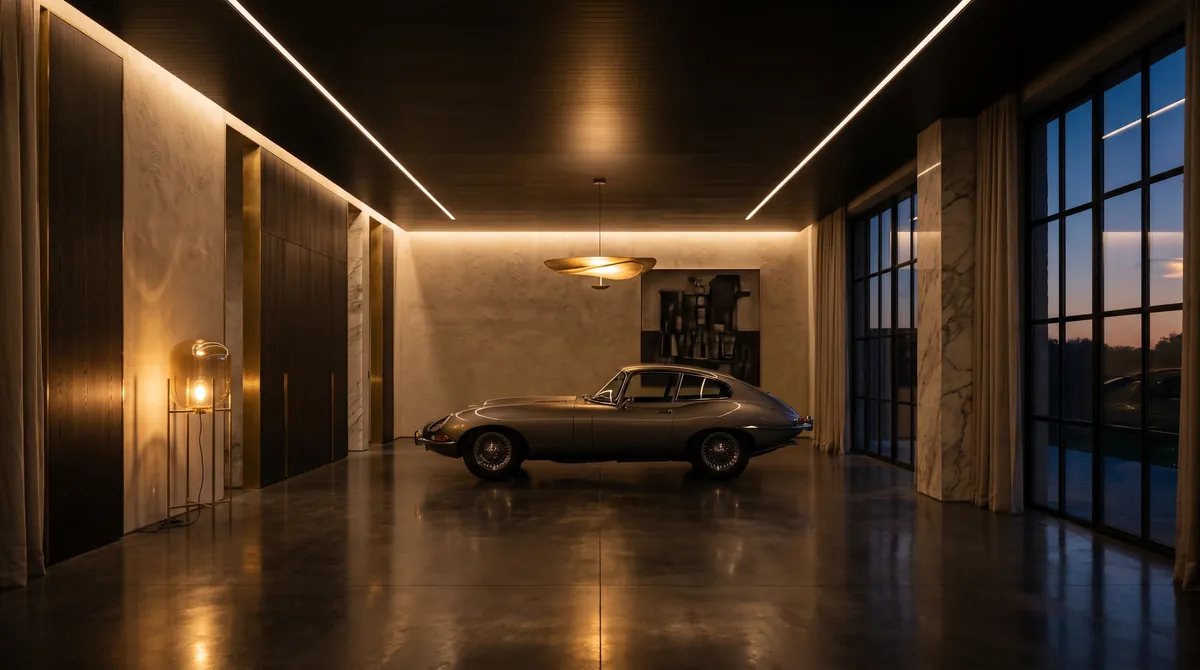
For a classic or luxury car, the garage becomes an exhibition room, and the lighting principles come from museums and showrooms. The aim is to reveal the shape of the body: its curves, its chrome and the depth of the paint. Glossy paint acts like a curved mirror, so every small, bright spot reflects as a dazzling dot, while a long, soft line of light reflects as an elegant highlight that follows the body.
(lighting a wall evenly from top to bottom) creates a calm, bright backdrop against which the car stands out in silhouette. Light lines in the ceiling, set parallel to the car or in a graphic pattern, draw graceful reflections along bonnet and roof. Polished concrete or resin floors double the effect by reflecting the light back up.
Design ideas
- 01
Light lines that follow the car
Recessed linear profiles set into the ceiling parallel to the car’s length draw long, clean reflections along bonnet, roof and boot.
- 02
A washed feature wall
Wall washers along one wall in matte charcoal or warm white turn it into a stage and show the profile of the car against it.
- 03
A floating plinth
A concealed LED strip under the edge of a raised plinth or along the base of the walls makes the car appear to float and helps orientation at night.
- 04
A backlit display wall
Shelves with integrated LED light for helmets, models, trophies or vintage tools turn a side wall into a small private museum.
- 05
A glazed view from the house
A glass wall between garage and living room or wine room, with the garage dimmed to a gallery scene in the evening, makes the car part of the interior.
- 06
Detailing light on demand
A separate circuit of bright, high CRI linear lights at around 5,000 K switches on only for cleaning and inspecting the paint.
- 07
A lit approach
Wall lights beside the door, a soft line of light at the threshold and low path lights guide the car in safely and give the facade a welcoming glow.
Colour rendering and colour temperature
Paint colour is subtle. A dark green can look black and a silver can look flat under poor light. Choose LEDs with a colour rendering index () of 90 or more; CRI describes, on a scale up to 100, how faithfully light shows colours compared with daylight.
Colour temperature, measured in Kelvin (K), describes how warm or cool the light looks. For a working garage, neutral white around 4,000 K keeps you alert and shows details well. A gallery garage often looks better at 3,000 to 3,500 K, which warms leather, wood and chrome. Paint is often inspected under cooler light of around 5,000 to 6,500 K, so a separate, switchable layer is worth considering if you care for the car yourself.
| Use | Light level | Colour temperature | CRI |
|---|---|---|---|
| Parking and general | About 300 lux | 4,000 K | 80 or higher |
| Workbench | 500 lux or more | 4,000 K | 90 or higher |
| Gallery scene | Dimmed, accent led | 3,000 to 3,500 K | 90 or higher |
| Paint inspection | Very bright, local | 5,000 to 6,500 K | 90 or higher |
Guide values. The lighting planner adapts them to the room, its surfaces and the cars.
Sensors, scenes and switching
- Motion sensors at the door from the house and at the side door, so you never walk into darkness with your hands full.
- Light that switches on automatically when the garage door opens.
- A gallery scene that switches off the work light and dims the accents for viewing.
- Low orientation light at a few per cent through the night where the garage connects to the house.
- A timer or presence sensor, so lights never stay on all night by mistake.
Damp, dust and safety
Garages are not living rooms. Wet tyres bring in water, winter salt and dust settle everywhere, and temperatures swing with the seasons. Fittings should carry a suitable (Ingress Protection: two digits, the first for dust and solids, the second for water). In a heated, dry garage a moderate rating may be enough. In an unheated garage, near the door or where cars are washed, choose fittings with greater protection against dust and splashing water.
Electrical work in a garage follows its own rules, especially in damp areas and where electric cars are charged. Planning and installation belong in the hands of a qualified electrician.
Common mistakes
A single central fitting that leaves the edges of the garage dark. Small downlights that reflect as dots in the paint. Cheap strips with low colour rendering that make a special colour look dull. Fittings without adequate protection that fail after one wet winter. Avoid these, and a garage lit with care rewards you every time you come home.
glaminia is independent and does not sell lamps or recommend dealers. Images are AI generated illustrations, not photographs of specific products. Have fixed electrical work done by a qualified electrician.