
Home cinema lighting: dark, dimmed and dramatic
A great home cinema is mostly dark, but never black. Ideas for cove and step lights, starry ceilings, wall sconces and scenes that keep every bit of stray light off the screen.
A home cinema is the one room where the best lighting is the light you hardly notice. Once the film starts, the screen should be the only bright thing in view. Yet a room in total darkness feels cold, makes it hard to find your seat and turns the walk to the bar into a hazard. Good cinema lighting is about control: rich atmosphere before the film, almost nothing during it and a gentle return afterwards.
The first rule: no light on the screen
Any light that reaches the screen washes out contrast and turns black into grey. This is especially true of projection screens, which reflect everything that falls on them. Plan every fitting with the screen in mind: downlights at the front of the room, sconces close to the screen wall and pale surfaces nearby all scatter light back onto the image.
Dark, matte finishes help as much as the lighting itself. Deep blue, charcoal or aubergine walls, velvet curtains and a dark ceiling, at least in the front third of the room, absorb the light the screen throws back into the room. With a large television instead of a projector, a soft (an LED strip that gently lights the wall behind the screen) reduces the contrast between a bright picture and a dark room, which many viewers find more comfortable.
Design ideas
- 01
A cove that breathes
A concealed LED strip in a ceiling cove around the room washes the ceiling with warm light on arrival and fades slowly to a faint glow as the film begins.
- 02
A starry ceiling
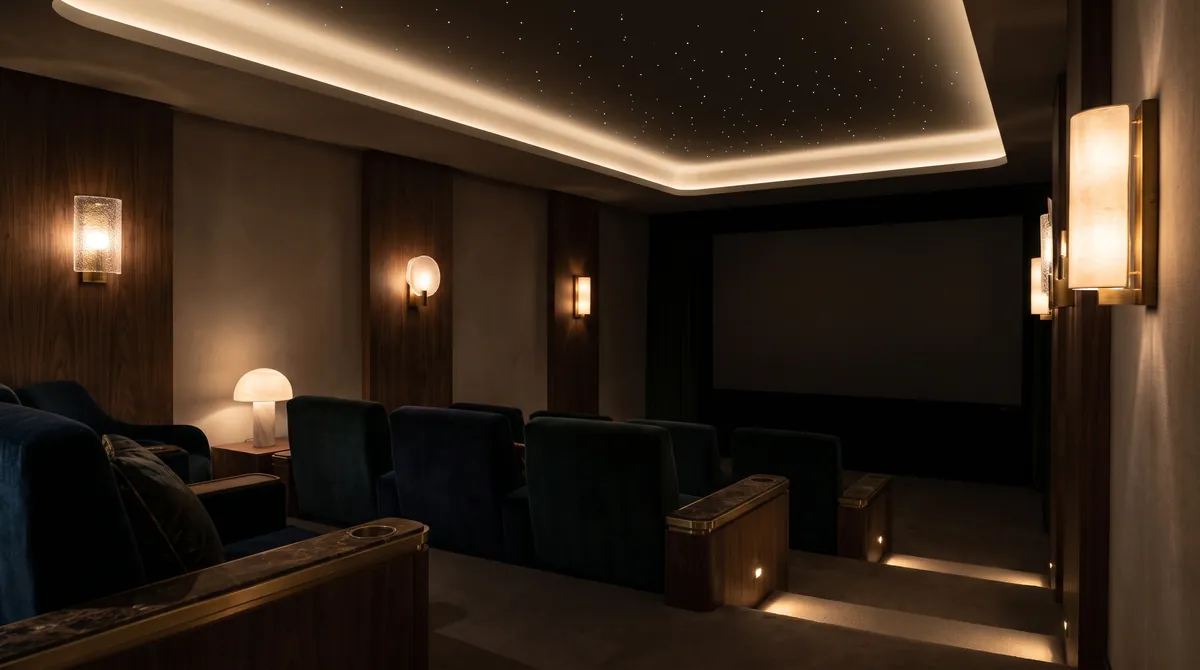
Hundreds of tiny fibre optic points set into a dark acoustic ceiling create a night sky; some systems add a slow twinkle or the odd shooting star.
- 03
Step lights in the risers
Small recessed lights in each step of a tiered floor mark the edges at a few per cent brightness, aimed down so they never catch the eye from the seats.
- 04
Sconces that glow, not shine
Wall lights with opaque fronts that throw light up and down the wall bring back the mood of the old picture palace without lighting the screen.
- 05
A lit back bar
A small bar or drinks cabinet at the back with dimmable shelf lighting stays usable during the film, because it sits behind the audience.
- 06
Glowing seat bases
A discreet LED line under the front edge of each sofa or recliner helps guests find their seats and adds a lounge atmosphere.
- 07
Curtain uplights
Small uplights at the foot of a velvet curtain along the side walls bring out the folds of the fabric in the pre-show scene.
Layers you can dim
A cinema needs several independent lighting layers, each dimmable down to very low levels. Cheap LED dimming often flickers or switches off abruptly at the bottom end, exactly where a cinema spends most of its time. Choose fittings and drivers (the power supplies for LEDs) that dim smoothly to 1 per cent or below, and ask to see them demonstrated in a dark room.
- Ambient light: or indirect ceiling light for arrival and intervals.
- Accent light: sconces, curtain uplights and lit artwork or film posters.
- Orientation light: step lights, aisle lights and seat bases, the only layer that stays on during the film.
- Task light: the bar, the equipment cupboard and a cleaning setting at full brightness.
Warm colour temperatures of 2,200 to 2,700 K feel the most cinematic; (K) is the measure of how warm or cool white light looks, and lower values are warmer. Colour changing LEDs can add a theme for a party or a children’s afternoon screening, but use them with restraint. A deep amber or soft red usually works better than saturated blue or purple.
Scenes for before, during and after
The magic of a private cinema lies in the transitions. A single keypad or remote should recall a handful of scenes:
| Scene | What is on | Level |
|---|---|---|
| Welcome | Cove, sconces, star ceiling, step lights, bar | 60 to 100 per cent |
| Pre-show | Star ceiling, dimmed sconces, step lights | About 20 to 30 per cent |
| Film | Step and seat base lights only | 1 to 5 per cent |
| Pause | Cove and bar fade up slowly | About 30 per cent |
| End | Slow fade back to the welcome scene | Over 10 to 20 seconds |
Example values. Fine tune them in the finished room with the screen running.
Slow fades of several seconds make the difference between a room that feels like a theatre and one where someone simply hit a switch. With a home automation system, the film scene can start when playback begins and the pause scene when it stops.
Starry ceilings done well
A star ceiling is the signature of many private cinemas. Most use : thin glass or plastic fibres carry light from a single light source to hundreds of points in the ceiling. The fibres carry no electricity and stay cool, so only the light source needs power. Mix fibre diameters for a natural sky with a few bright stars among many faint ones, and keep the brightest points away from the area right above the screen.
Place the light source where it can be reached for maintenance, such as a cupboard or service void, and make sure its fan is quiet or outside the room. A humming box above the seats spoils the very silence you built the cinema for.
In a home cinema, the best lighting is the light you hardly notice.
Safety and practical points
Even in darkness, guests must be able to leave the room safely. Keep step and aisle lights on throughout the film, mark the door subtly and consider a low level light near the exit that stays on if the main system fails. Sound insulation, ventilation and lighting share the same ceiling and wall cavities, so coordinate them early. All fixed wiring, dimmers and control systems should be installed by a qualified electrician.
glaminia is independent and does not sell lamps or recommend dealers. Images are AI generated illustrations, not photographs of specific products. Have fixed electrical work done by a qualified electrician.