
Home library lighting: books, reading chairs and shelves
A home library should invite you to browse in the evening and read for hours. Ideas for lighting shelves, reading chairs and high walls of books, with warm light that spares paper and bindings.
A home library is one of the most personal rooms a house can have. Walls of books, a deep chair, perhaps a desk and a ladder: it is a room for slow evenings. Its lighting has three tasks. It should show the books as a beautiful whole, help you find a title on the top shelf and give you perfect light for reading, all while sparing the paper, leather and cloth that make a collection precious.
Lighting the shelves
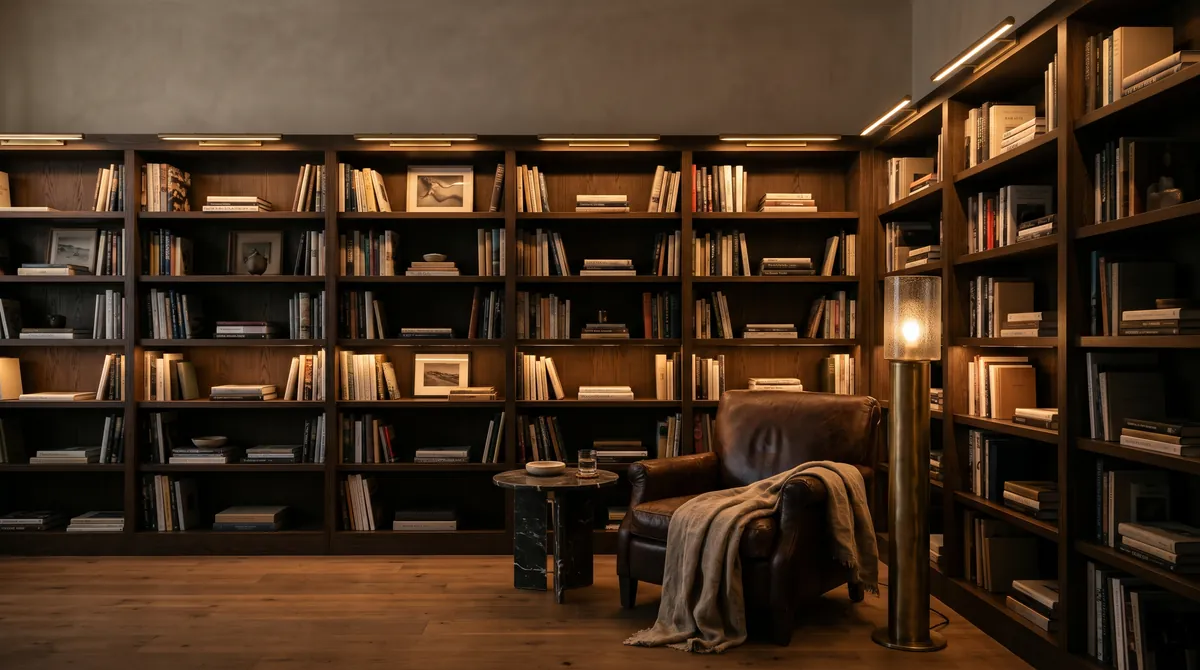
The shelves are the architecture of a library, and lighting them turns a wall of spines into a warm, glowing surface. There are three main approaches, and they combine well.
- LED profiles under each shelf: slim aluminium channels holding an LED strip behind a diffuser, fixed under the front edge of each shelf and aimed back at the spines. They give even light from top to bottom.
- Vertical profiles in the uprights: light strips set into the sides of each bay, which light the books from the side and keep the shelves themselves clean.
- Picture lights over the shelves: classic brass arms mounted above each bay or on the uprights, which throw light down over the spines and add a traditional character.
Dark wood shelves need more light than you expect, because dark surfaces absorb it. White or pale oak shelves need far less. Either way, keep the light sources hidden from the reading chair and from the room, so you see glowing books rather than bright lines.
Design ideas
- 01
Brass picture lights on every bay
Slim brass shelf lights on dark wood uprights, one per bay, give a library the air of a private club and light the spines evenly.
- 02
A glowing gallery level
In a double height library, a concealed LED strip under the gallery balustrade washes the lower shelves and marks the edge of the upper walkway.
- 03
Light on the ladder rail
A slim LED line integrated just above the ladder rail lights the top shelves exactly where you search for a title.
- 04
A reading chair island
A leather wing chair, a side table and a floor lamp with an adjustable arm form a small island of warm light in an otherwise softly lit room.
- 05
A green glass desk lamp
A classic banker’s lamp or a modern lamp with a deep shade on the library desk creates a focused pool of light and a sense of quiet.
- 06
Lit display niches
A few deeper niches between the books, lit from above, present sculptures, globes or rare editions like small exhibits.
- 07
A ceiling that recedes
Indirect light from the top of the bookcases onto a dark ceiling makes the room feel taller and wraps the shelves in a gentle glow.
Light for reading
The reading chair needs its own lamp, and its position matters. Light should come from beside and slightly behind you, over the shoulder, so it falls on the page without glare and without your head casting a shadow. As a rule of thumb, the lower edge of a floor lamp shade sits between shoulder and eye height when you are seated, typically around 100 to 110 cm (39 to 43 inches) above the floor.
Choose a lamp with an adjustable head or arm, so you can direct the light onto the book, and a shade that hides the source. For reading, warm white of 2,700 to 3,000 K feels comfortable; (K) measures how warm or cool white light looks. Be generous with the amount: older eyes need noticeably more light than younger ones, and a dimmable lamp lets every reader find the right level.
Protecting books from light
Light, heat and humidity all age books. Ultraviolet () radiation fades spines and yellows paper, and even visible light slowly bleaches coloured cloth and leather over the years. Modern LEDs emit practically no UV and little heat at the light, which makes them far kinder to books than old halogen lamps or direct sun.
Daylight remains the greater risk. Keep valuable books out of direct sun, use UV filtering film or blinds on sunny windows and dim the shelf lighting when nobody is in the room. Rare editions and fine bindings are best kept in glass fronted cabinets with lighting that switches on only when you open them.
Colour, mood and materials
A library should feel warm and calm. Warm white of 2,700 K brings out leather bindings, mahogany, walnut and old paper. Good colour rendering, meaning a (colour rendering index) of 90 or more, makes the reds, greens and golds of the spines look rich rather than dull.
Brass, bronze and darkly patinated metals suit the classic library; opal glass and linen shades add softness. In a contemporary library with white shelves and polished plaster, matte black profiles and minimal lamps keep the attention on the books.
Lighting the shelves turns a wall of spines into a warm, glowing surface.
Desks, ladders and high shelves
Where there is a desk, give it a lamp of its own: a banker’s lamp, an architect’s lamp or a slim LED arm, placed on the side opposite your writing hand and shielded so it lights the paper, not your eyes. High shelves and ladders deserve attention too. A light line above the ladder rail, picture lights at the top of the bookcases or a gentle uplight make it safe to climb and easy to read titles at the top.
In a double height room, plan how every fitting will be reached for maintenance. A light that needs scaffolding to change its driver will simply stay broken. Fixed wiring in built-in joinery should be planned with the cabinet maker and installed by a qualified electrician.
glaminia is independent and does not sell lamps or recommend dealers. Images are AI generated illustrations, not photographs of specific products. Have fixed electrical work done by a qualified electrician.