
Walk-in wardrobe lighting: see colours, feel the luxury
A dressing room should show navy as navy and black as black, and still feel like a private boutique. Ideas for shelf and rail lighting, mirrors, drawers and a statement pendant.
A walk-in wardrobe is a small room with a big job. It has to tell you whether that jacket is navy or black and whether the shoes match the belt, and it should feel like a private boutique while doing it. The answer is light that sits inside the furniture, renders colours truthfully and switches itself on when you need it.
Light inside the furniture
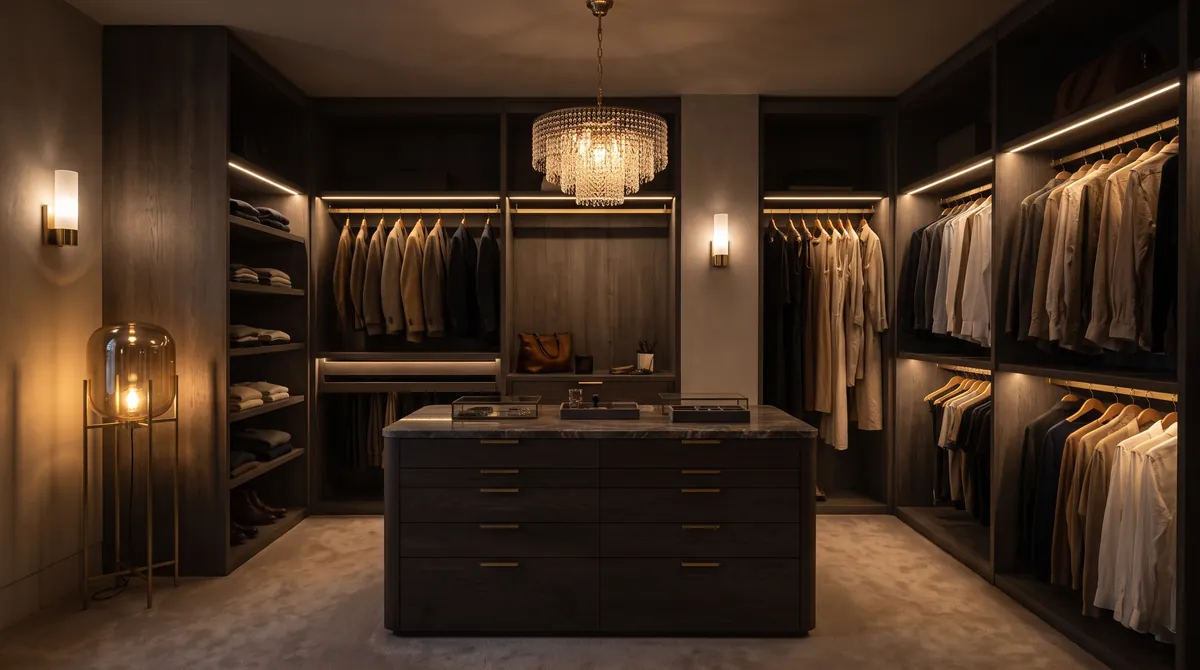
Ceiling downlights alone light the tops of the shelves and leave the clothes beneath in shadow, and your own body blocks much of the rest. Lighting built into the joinery works far better: slim LED profiles (aluminium channels that hold an LED strip behind a ) recessed into the front edges of shelves, into the uprights or above each hanging rail.
A profile mounted just in front of the rail and angled slightly back lights the fronts of hanging clothes rather than their shoulders. Shelf lighting works best from the front edge, shining back and down, so folded knitwear is lit across its full depth. Vertical profiles in the side panels give even light from top to bottom and suit tall cabinets.
Design ideas
- 01
Glowing rails
Hanging rails with an integrated LED channel cast light straight down onto the garments and turn every open section into a softly lit display.
- 02
A backlit shoe wall
Open shoe shelves with a warm LED line along the back edge and a frosted back panel make each pair stand out like an object in a gallery.
- 03
Glass fronted cabinets
Clear or bronze tinted glass doors with interior lighting show watches, handbags and scarves while keeping out the dust, ideal for the most precious pieces.
- 04
An island with lit drawers
Shallow drawers in a central island, each with an LED strip that switches on as it opens, make jewellery and accessories easy to find.
- 05
A chandelier as the jewel
A small crystal or glass chandelier above the island adds sparkle and a sense of occasion, while the practical light comes from the joinery.
- 06
A mirror framed by light
A full length mirror with vertical light strips on both sides lights the body evenly from head to toe, without shadows under the chin.
- 07
A velvet seat in a pool of light
An upholstered bench beneath a small pendant or wall light creates a calm spot to sit, put on shoes and pause for a moment.
Colour rendering: the decisive figure
In a wardrobe, the colour rendering index () matters more than in almost any other room. CRI describes, on a scale up to 100, how faithfully a light source shows colours compared with natural light. Below about 80, navy, black and dark green begin to blur together. For a dressing room, choose LEDs with a CRI of at least 90.
Ask also for the value, which measures how well saturated red is rendered. A high R9 makes skin tones, leather and red fabrics look rich instead of brownish. Colour temperature, measured in Kelvin (K), should suit the rest of the house: 3,000 K feels warm and flattering, while 3,500 to 4,000 K comes closer to daylight for judging colours before you leave home.
| Area | Light source | Colour temperature | CRI |
|---|---|---|---|
| Hanging rails | LED profile in or in front of the rail | 3,000 to 3,500 K | 90 or higher |
| Shelves and shoes | LED profile at the front edge or back | 3,000 K | 90 or higher |
| Drawers | Short LED strip with sensor | 3,000 K | 90 or higher |
| Mirror | Vertical strips or wall lights | 3,000 to 4,000 K | 90 or higher |
| General and accent | Pendant, chandelier, downlights | 2,700 to 3,000 K | 90 preferred |
Guide values. Keep the colour temperature consistent within each area.
Mirror light that flatters
Light for the mirror must fall on you, not on the glass. Light only from above throws shadows under the eyes and chin. Light from both sides of the mirror, roughly at face height, gives the even, soft light you know from a good theatre dressing room.
For a full length mirror, vertical strips or a pair of tall wall lights on either side light the whole figure. A dimmer helps here: bright for the final check before an evening out, softer for a slow morning.
Sensors, switches and scenes
Nobody wants to search for a switch with an armful of shirts. Door contacts in cabinets, a motion sensor in the room and small sensors in drawers turn light on when needed and off when you leave. A gentle fade in and out feels far more refined than an instant jump to full brightness.
- A motion sensor with a generous run on time, so the lights stay on while you stand still in front of the mirror.
- Door contacts or proximity sensors for closed cabinets.
- Drawer sensors with a soft start.
- A night scene at about 10 per cent for early mornings while a partner is still asleep.
- A “boutique” scene that lights only the open displays and the chandelier when you show the room to guests.
Heat, fabrics and materials
Old halogen lamps produced a lot of heat and some ultraviolet radiation, both unkind to fabrics, leather and closed cabinets. Modern LEDs emit almost no UV and very little heat at the light itself, which makes them the right choice for joinery. Their drivers (the small power supplies that LEDs need) still get warm, so they belong where air circulates and where they can be reached for maintenance, never buried behind fixed panels.
Materials change the light too. Pale oak and lacquered surfaces reflect a lot and make a small room bright. Dark walnut, smoked glass and velvet absorb light and need more fittings for the same effect, but feel intimate and rich. Brass profiles and bronze glass add their own warmth to the light.
Common mistakes
The most frequent mistake is relying on ceiling spots, which leave clothes in the shadow of the shelves and of your own body. Close behind come low CRI strips that make colours look dull, bright LED dots reflected in polished shelves and sensors with run on times so short that the lights go out while you are still choosing. Avoid all four and even a compact dressing room feels like a suite.
glaminia is independent and does not sell lamps or recommend dealers. Images are AI generated illustrations, not photographs of specific products. Have fixed electrical work done by a qualified electrician.