
Kitchen lighting ideas: bright where you work, warm where you sit
A kitchen needs two kinds of light: clear, shadow free light for chopping and cooking, and softer, warmer light for eating and talking. How to plan both, from under cabinet strips to island pendants.
The kitchen is the hardest working room in a home and, in many villas and apartments, also its social heart. In the morning it needs crisp, practical light. In the evening, when guests gather around the island with a glass of wine, the same room should feel as warm as the living room next door. The answer is not a compromise between the two but separate, switchable layers of light.
Why the ceiling light is not enough
The classic mistake is a grid of downlights in the ceiling and nothing else. As you stand at the worktop, your head and shoulders sit between the ceiling light and your hands, so you work in your own shadow. Wall cabinets make it worse, because they block light from above exactly where you chop.
So kitchen light starts where the work happens. on worktops, the hob and the sink comes first, ideally from directly above the surface and slightly in front of you. General light fills the room for moving around and cleaning. Mood light from pendants, shelves or plinth lines takes over in the evening. Each layer on its own circuit and dimmer gives you the freedom to move from cooking to dinner.
For worktops, aim for bright, even light, around 300 to 500 on the surface, a range lighting designers commonly plan for in home kitchens. Lux describes how much light actually reaches the surface, rather than how much the lamp gives out.
Seven kitchen lighting ideas
Design ideas
- 01
Under cabinet light at the front
Mount slim LED profiles towards the front of the underside of wall cabinets, angled slightly towards the wall, so the worktop is lit evenly without reflections in polished stone.
- 02
Pendants that define the island
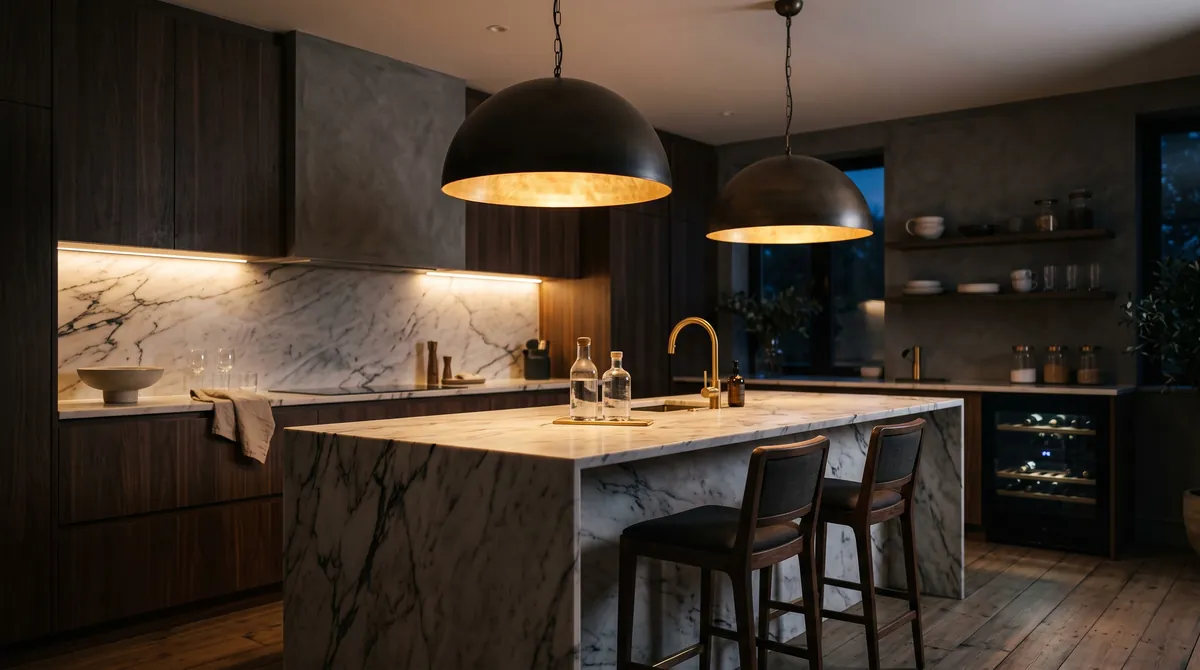
Hang two or three pendants in a row over the island to mark it as a place to gather. Dome shades in metal or opal glass keep the light on the counter and out of the eyes of people on stools.
- 03
A lit splashback
A light line integrated at the top of a marble or glass splashback grazes down the stone and turns its veining into a feature. It doubles as a soft evening light when the rest of the kitchen is off.
- 04
Glowing glass cabinets
Light glass-fronted cabinets or open shelves from the sides with vertical profiles, so glasses and ceramics glow in the evening. Choose the same colour temperature as the pendants for a calm overall picture.
- 05
Plinth lighting for night
A warm, dim light line in the recessed plinth below the base units makes the cabinetry appear to float and is enough to fetch a glass of water at night.
- 06
Light inside drawers and larders
Small LED strips inside deep drawers, pantry cupboards and the larder make contents easy to find. They switch on when opened and off when closed.
- 07
A cove above wall cabinets
If wall cabinets stop short of the ceiling, place a warm light line on top of them aimed upwards. It gives soft indirect general light that is kind on the eyes in the evening.
Island pendants: height, number and size
Pendants over an island carry most of the design weight in a modern kitchen, so get the proportions right.
- Height: the lower edge of the shade about 75 to 90 cm (30 to 35 inches) above the worktop. Lower than that and they block views across the island, higher and they glare into the eyes of anyone standing.
- Number: two pendants for an island up to about 2 metres (6.5 feet), three for longer islands, or one for a calm architectural look.
- Spacing: around 60 to 80 cm (24 to 31 inches) between pendant centres for medium shades, with at least 15 cm (6 inches) between the outer shades and the ends of the island.
- Size: the row of pendants should span roughly two thirds of the island length, which keeps the counter lit without crowding the ends.
- Useful light: island pendants should send real light down onto the surface. Purely decorative pieces need help from downlights.
Colour rendering, colour temperature and materials
Food is unforgiving under poor light. The colour rendering index () measures on a scale up to 100 how naturally a light shows colours. In a kitchen, choose CRI 90 or higher, so tomatoes look red, herbs look green and you can judge whether meat is cooked.
For colour temperature, 3,000 K is a good working light that still feels homely, while 2,700 K suits pendants and mood lights over an island used for dining. Keep worktop and pendants in a similar range so the kitchen does not look patchy. Very cool light above 4,000 K makes even a beautiful kitchen feel clinical.
Choose materials that cope with heat, steam and grease. Glass, enamel, powder-coated metal and ceramic are easy to wipe. Fabric shades and open weaves gather grease and belong over a dining table well away from the hob. Recessed lights near the hob must be suitable for that position, and every fixed light in a kitchen is a job for a qualified electrician.
Open kitchens and separate zones
In an open plan space, the kitchen shares its light with dining and living areas. When cooking ends, the kitchen should be able to fade into the background. Plan at least three switchable zones: worktops, island and general light. A control system or smart dimmers can store a scene called “dinner” that dims the kitchen and brightens the dining table at one touch.
Visual calm helps too. Line up downlights with cabinet fronts and the island, not only with the ceiling grid, and choose one family of fittings for the whole open space.
Common kitchen lighting mistakes
- Downlights only, placed so that you work in your own shadow.
- Under cabinet strips mounted at the back near the wall, which leave the front of the worktop dim and glare in shiny splashbacks.
- Island pendants hung too high, or too small for the island.
- Cool and warm white mixed in one open space.
- LED strips with a low CRI, which make food look dull.
A well-lit kitchen feels effortless. You notice only that cooking is easier, that the food looks good and that guests drift towards the island and stay there.
glaminia is independent and does not sell lamps or recommend dealers. Images are AI generated illustrations, not photographs of specific products. Have fixed electrical work done by a qualified electrician.