
Art Deco lighting: glamour in glass and metal
Geometric glass, chrome and brass: how the lighting of the 1920s and 1930s brought glamour to liners, hotels and homes, and how to use Deco style lighting today.
Art Deco lighting is the light of cocktail bars, ocean liners and cinema foyers. It is geometric yet glamorous, modern yet openly luxurious, and it tends to glow rather than shine. A century after its heyday, a sconce or a stepped chrome lamp still brings instant atmosphere to a room.
A style named after an exhibition
The style emerged in Paris in the 1910s and flourished internationally through the 1920s and into the 1930s. Its name refers to the great Paris exhibition of 1925, the Exposition internationale des Arts décoratifs et industriels modernes. The short form “Art Deco” only became common much later, popularised by the historian Bevis Hillier’s book of 1968.
By then electric light had become ordinary in cities, and designers no longer felt obliged to disguise it as a candle or gas flame. They could design for the bulb itself: hide it behind glass, bounce it off ceilings, shape it into bands, bowls and fans. Light became part of the architecture.
Shapes: steps, fans and sunbursts
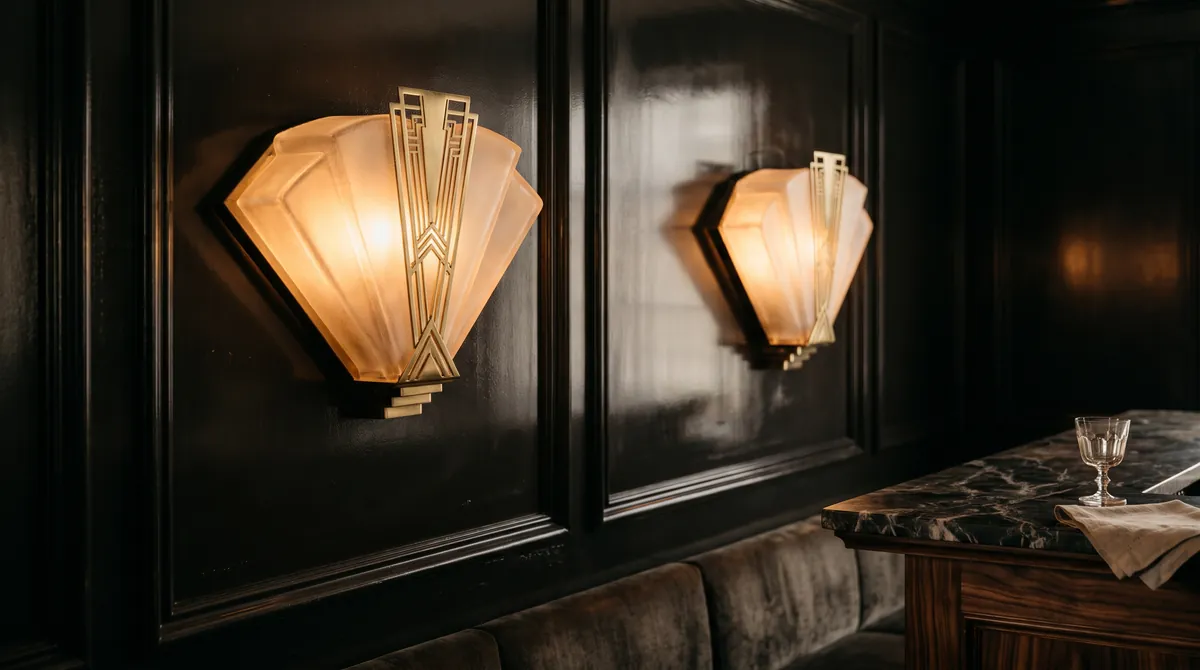
Deco forms are geometric and rhythmic. Typical motifs include stepped profiles that echo skyscrapers, sunbursts, chevrons, zigzags and the fan or shell shape found on so many wall lights. Symmetry is almost a rule: lamps come in pairs, sconces flank mirrors and fireplaces, and ceiling bowls hang dead centre.
In the 1930s a sleeker variant known as took over, inspired by airships, cars and ocean liners. Lamps became rounder and smoother, with horizontal bands, polished curves and far less ornament.
Glass: frosted, moulded and pressed
Glass is the heart of Deco lighting. Frosted glass, its surface roughened by acid etching or sandblasting, softens the bulb into an even glow. , shaped in a mould, and pressed glass made it possible to produce relief patterns in series: flowers, figures, birds and geometric ribs. When lit, the raised parts catch the light while the hollows stay darker, so the decoration seems to float.
René Lalique (1860 to 1945) is the name most associated with this art. Trained as a jeweller, he turned to glass in the early twentieth century, beginning with perfume bottles for François Coty from 1907. His workshops produced lamps, ceiling bowls and illuminated panels, and he created walls of lighted glass and glowing glass columns for the dining room and grand salon of the ocean liner Normandie, which entered service in 1935.
Glass and metal also met in sculpture. The French ironworker Edgar Brandt worked with the Daum glassworks of Nancy on lamps and chandeliers, among them his Cobra table lamp of 1925, in which a metal snake rises from the base to hold a translucent glass shade.
Art Deco light frames a room rather than flooding it: pairs of glowing glass, strict symmetry and warm metal.
Metals and the classic Deco fittings
Deco lighting celebrated metal as much as glass. Chrome plating, new in the period, gave a mirror bright surface that did not tarnish. Nickel offered a softer silver tone, while brass and bronze added warmth and a sense of luxury. Black lacquer, polished wood and marble bases supplied contrast. These materials came together in a handful of typical fittings:
- Fan and shell sconces: half round or fan shaped frosted glass shades on a metal back plate, sending light up the wall.
- Ceiling bowls: shallow frosted or moulded glass dishes hung on chains or rods.
- Torchères: tall floor lamps that throw their light upwards onto the ceiling.
- Stepped table lamps: tiered bodies of metal or glass, often in chrome and black.
- Figural lamps: sculpted figures, often dancers or animals, holding a glass globe or shade.
Using Deco style lighting today
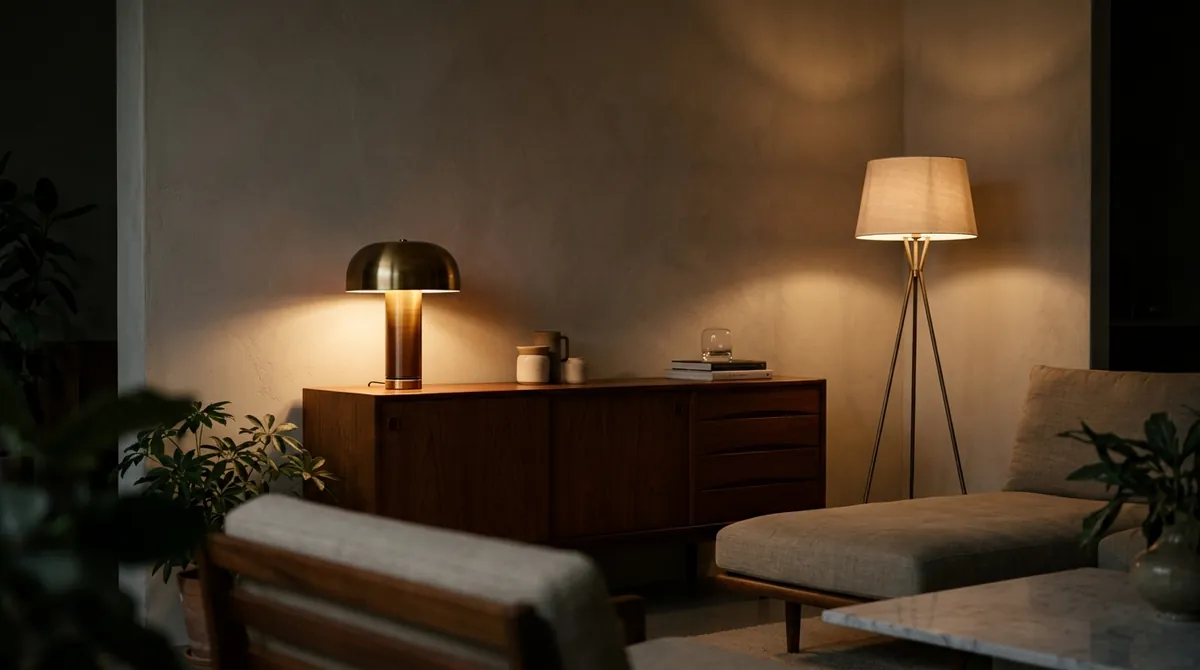
Deco light works best when it frames a room rather than flooding it. Wall sconces in pairs, either side of a mirror, a bed, a fireplace or a bar cabinet, give the characteristic symmetrical glow. Add a ceiling bowl or a geometric pendant for general light and one or two table lamps for warmth at seating height.
Choose warm light. Colour temperature is measured in (K), and lower values mean warmer light: 2,700 K is a classic warm white, and in bars and dining rooms you can go down to 2,200 K. Dimmers are essential to the mood. Installing them on fixed wiring, like mounting hardwired sconces, is a job for a qualified electrician.
Mix rather than recreate. A pair of brass and frosted glass sconces looks wonderful on a dark painted wall above contemporary furniture, and a chrome Deco table lamp is crisp on a modern desk. Deep green, ink blue, black lacquer and warm wood are classic backgrounds, but Deco glass also glows beautifully against soft neutral plaster.
Original lamps from the period deserve care: handle old glass gently and have the wiring checked and renewed by an electrician before daily use. Newly made fittings in Deco style come with modern wiring and LED compatibility, which makes them a practical choice for rooms you use every day.
glaminia is independent and does not sell lamps or recommend dealers. Images are AI generated illustrations, not photographs of specific products. Have fixed electrical work done by a qualified electrician.