Gino Sarfatti: the inventor of Italian lighting design
From a small Milan company founded in 1939, Gino Sarfatti designed several hundred lamps and taught the world to see the light source itself as the heart of a design.
Before Italian lighting had its stars, it had a laboratory. In Milan in 1939, a young man from Venice named Gino Sarfatti founded Arteluce and began to treat the lamp as a problem to be solved rather than an ornament to be sold. Over the next three decades he designed several hundred models, gave each one a number instead of a name, and shaped the way the world still pictures an Italian lamp: lean, precise, a little playful, and built around the light source itself.
From Venice to Milan
Sarfatti was born in Venice in 1912, in a city where glass chandeliers were part of everyday life. He studied engineering at the University of Genoa with an eye on aeronautics, but family circumstances cut his studies short, and in 1935 he moved to Milan.
There he turned to lighting, and in February 1939 he founded Arteluce, a company that made lamps and some furniture. The timing could hardly have been worse. Persecution under the racial laws forced him to take refuge in Switzerland during the war, while the business continued under a proxy.
Arteluce reopened in 1946 and grew quickly in the years of reconstruction. From 1949 its production was concentrated in a single workshop on Via Bellinzona in Milan, and that same year brought its first commission for a ship, the start of a long line of work for interiors far beyond the private home.
A laboratory of light
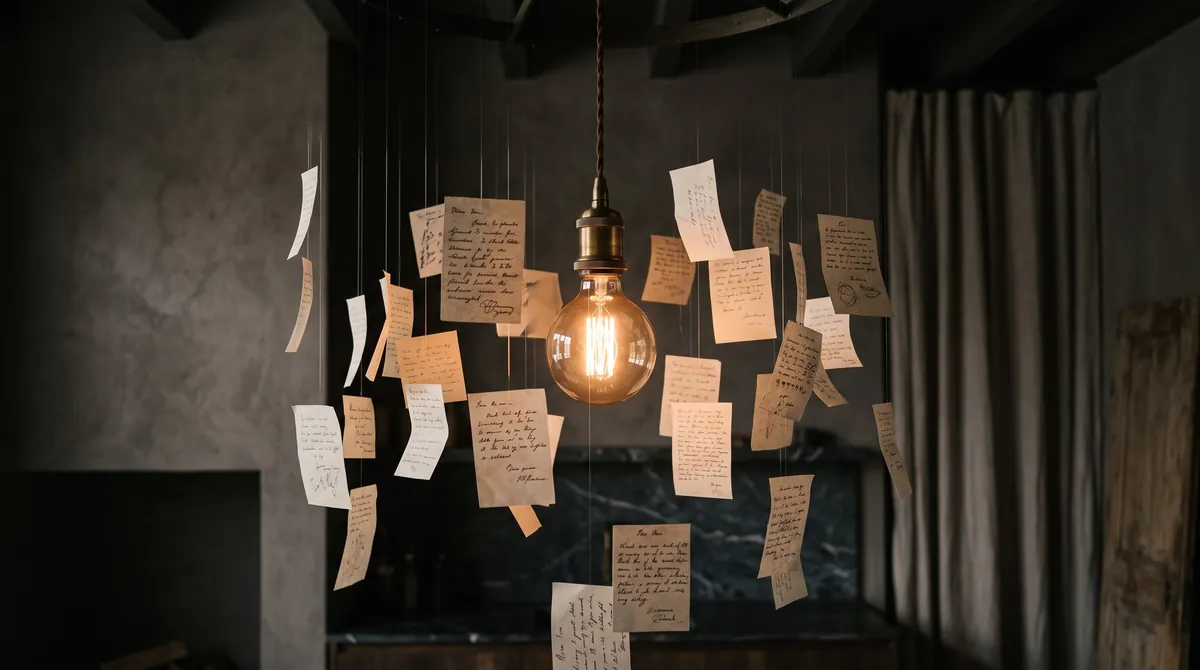
What set Sarfatti apart was an engineer’s curiosity. He treated every new bulb, tube and material as a design opportunity. Where most manufacturers hid a behind a shade, he made it the subject of the lamp. His model 1063 floor lamp of 1954 is little more than a slim painted metal stem carrying a bare fluorescent tube, standing more than two metres tall: an object so direct that it still looks contemporary.
He worked the same way with structure. Arms, counterweights, joints and rods were not disguised, they were the decoration. His lamps were classified by a simple system of numbers, with each range reserved for one family: the 500s for table lamps, the 1000s for floor lamps, the 2000s for suspended lamps. A model number told you what an object was, not how to feel about it.
- Exposed light sources, from bare bulbs to fluorescent tubes, treated as part of the composition
- Painted metal and brass in clear, confident colours
- Visible mechanics: counterweights, joints and rods that let you adjust the light
- Reflectors and screens that bounce light softly instead of aiming it at your eyes
- Numbers instead of names, grouped by type of lamp
The 548 table lamp of 1951 shows the idea at its best. A small spotlight points upwards at a curved screen, which acts as a reflector and a at the same time. The result is a mix of reflected and diffused light, soft enough for a desk, a sideboard or a reading corner.
The 2097 and the reinvention of the chandelier
If one Sarfatti design has become a household image, it is the 2097 chandelier of 1958. It takes the Venetian chandelier of his childhood and strips it to the bone: a central steel stem, a crown of curved brass arms and a bare bulb at the end of each one. There is no glass, no crystal and no drapery, only the rhythm of lines and points of light.
The effect in a room is surprisingly warm. With clear bulbs, the 2097 throws a sparkle across ceilings and walls that recalls candlelight, while its open structure keeps it visually light, even in its larger versions. Flos produces it today in several sizes, with LED bulbs as an option.
Sarfatti took the Venetian chandelier of his childhood and kept only what mattered: the lines and the light.
Prizes, a famous shop and a quiet exit
Recognition came early. Sarfatti won the , Italy’s best known design award, in 1954 for the model 559 and again in 1955 for the model 1055. In 1962 Arteluce moved its Milan shop to Via della Spiga, into a space designed by the architect Vittoriano Viganò, and the showroom became a meeting point for architects and designers.
Arteluce lit homes, shops, offices and ships. One of Sarfatti’s last projects was the lighting of the Teatro Regio in Turin, including a large installation known as la nuvola, the cloud. In December 1973 he sold the company, and Arteluce passed to Flos in the same year. He retired to Lake Como, where he lived until his death in 1985.
Collectors, reissues and an enduring influence
Original Arteluce pieces are sought after by collectors and museums, and the numbering system makes them easier to identify than many vintage lamps. Since the 2010s his designs have also returned to production. Flos makes the 2097 and other models, while Astep, the company founded by his grandson Alessandro Sarfatti, has reissued designs such as the 548 table lamp.
His influence runs deeper than any single object. Sarfatti showed that a lighting company could work like a research studio, that technology could be beautiful in itself, and that a lamp could be honest about how it works. His son Riccardo Sarfatti went on to co-found the lighting company Luceplan, and much of the experimental spirit of later Italian lighting can be traced back to Arteluce.
Living with a Sarfatti lamp
Because his designs show their light sources so openly, they reward a little care in placement. A bare bulb at eye level can dazzle, while the same bulb seen from below or reflected off a screen feels generous and lively. Think about where people sit and look before you choose a model.
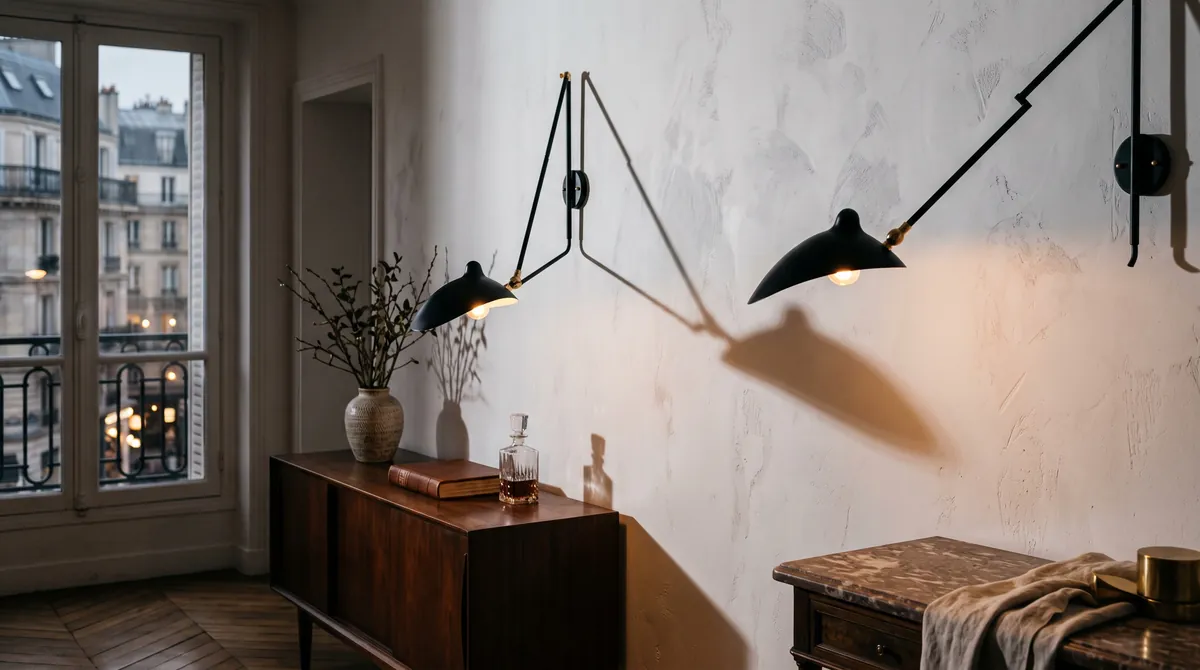
Sarfatti lamps also mix well with very different interiors. A 2097 suits a Milanese apartment with herringbone parquet as naturally as a white loft, and a 548 adds a spot of colour to a dark wooden desk. Their clarity lets them sit beside antiques without looking out of place.
glaminia is independent and does not sell lamps or recommend dealers. Images are AI generated illustrations, not photographs of specific products. Have fixed electrical work done by a qualified electrician.