
Ingo Maurer: the poet of light
He turned a bare bulb into a monument, gave another one feathered wings and hung paper notes around a pendant. Ingo Maurer changed what a lamp could be.
Ingo Maurer never seemed very interested in lamps as furniture. What fascinated him was light itself: how it floats, flickers, surprises and makes people smile. Working from Munich for more than five decades, he turned a bare bulb into a monument, gave another one feathered wings and surrounded a pendant with a flurry of paper notes. He came to be known as the poet of light, and few nicknames in design have been so well earned.
From Lake Constance to Pop
Maurer was born in 1932 on the island of Reichenau in Lake Constance, the son of a fisherman. He trained as a typesetter and then studied graphic design in Munich. In 1960 he left for the United States and worked as a freelance graphic designer in New York and San Francisco.
Back in Germany in the early 1960s, he set up his own company in Munich, Design M, which later became Ingo Maurer GmbH. His first lamp, in 1966, was simply called Bulb: an oversized glass light bulb with an ordinary bulb glowing inside it, set on a chrome plated base. It looked like a piece of Pop Art, and in 1969 the Museum of Modern Art in New York added it to its design collection.
Bulb set the tone for everything that followed. Maurer took the most familiar object in lighting, the incandescent bulb, and made you look at it again. His humour was never a joke for its own sake; it was a way of drawing attention to the beauty of light.
Wires, halogen and a new kind of freedom
In 1984 Maurer launched YaYaHo, a system that changed the way designers thought about lighting a room. Two thin metal cables are stretched horizontally across a space, and small lights can be attached and moved along them. There is no heavy fitting, only fine lines in the air and bright points of light that you can rearrange as you like.
The secret is : the cables carry a much lower voltage than mains electricity, supplied through a , which is what makes such slender, bare conductors possible. YaYaHo was an immediate success and inspired countless cable systems. It has never really left the stage, and the company presented a redesign at Milan Design Week in 2026.
- The bare bulb as hero, celebrated rather than hidden
- Humour and surprise, from feathered wings to smashed porcelain
- Light, fragile materials such as paper, feathers and fine wire
- New technology explored early, from halogen to and
- Light as atmosphere and experience, not only as illumination
Feathers, paper and broken porcelain
Many of Maurer’s best loved pieces play with fragility. Lucellino is a bare bulb with a pair of wings made of goose feathers, as if it might fly off the wall at any moment. Birds Birds Birds gathers a whole flock of such winged bulbs into a single hanging piece.
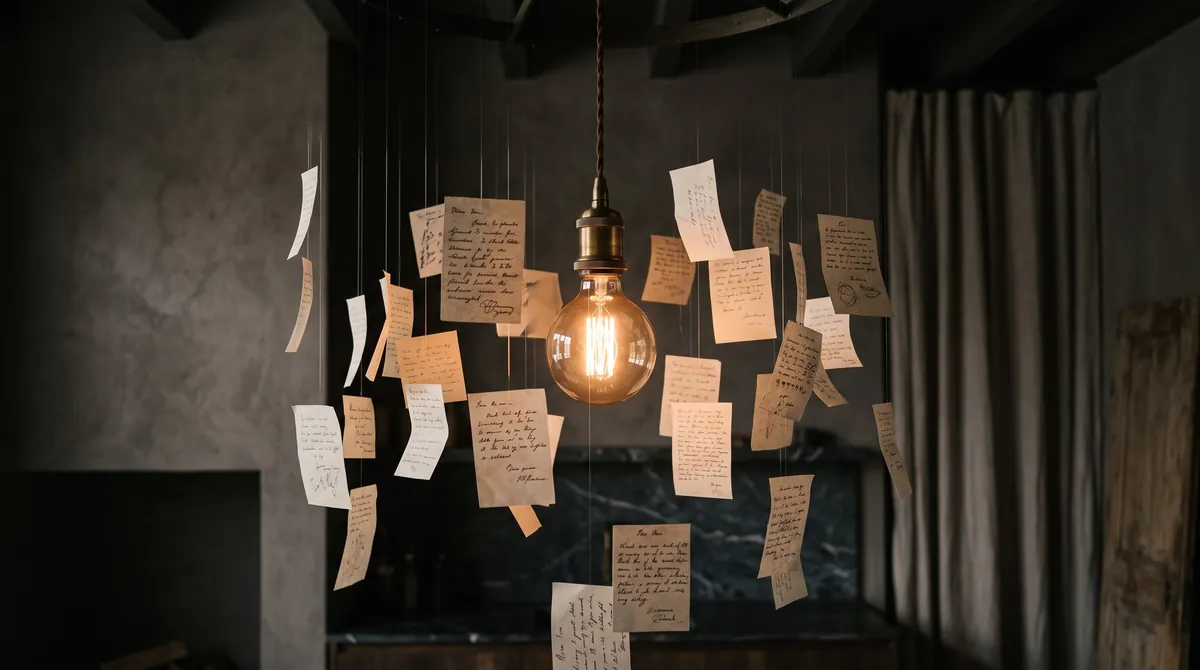
Zettel’z, from 1997, is a pendant surrounded by sheets of Japanese paper clipped to a crown of thin wires. Some sheets are printed, others are left blank so that you can add your own notes, which makes every lamp a little different. Porca Miseria, from 1994, goes further still: a suspension lamp made of porcelain shards, frozen around the light as if caught in the moment a stack of plates exploded.
These are not easy objects. They ask you to accept something delicate, imperfect or absurd in the middle of a room. That is exactly their charm: they make light feel personal, even intimate.
Maurer took the most familiar object in lighting and made you look at it again.
Light in public: stations and installations
Maurer also worked on the scale of the city. In Munich he created the lighting for the Westfriedhof underground station, opened in 1998, where huge dome shaped lights bathe the platform in coloured light. For the renovation of the Münchner Freiheit station, which reopened in December 2009, he developed a lighting concept that turns a busy transit space into something close to a stage set.
His studio produced installations for exhibitions, shops and buildings around the world and took on lighting commissions for interiors. In 2011 he received the Compasso d’Oro for his career, and his work featured in major exhibitions, among them a travelling show organised by the Vitra Design Museum in 2002 and “Provoking Magic” at the Cooper Hewitt in New York in 2007.
An early explorer of new light sources
For all his poetry, Maurer was quick to test new technology. Bellissima Brutta, from 1996, was his first object to use LEDs, small electronic light sources that give off very little heat. In 2006 he began experimenting with OLEDs, thin flat panels that glow across their whole surface.
He approached each technology the way he had approached the bulb: with curiosity rather than reverence. Halogen gave him tiny, brilliant points of light, LEDs allowed lamps to become almost weightless, and he used both to create effects that felt playful rather than technical.
The legacy of a light poet
Ingo Maurer died in Munich in October 2019 at the age of 87. His company, still based in Munich, continues to produce his designs and to develop new projects, from installations to limited editions.
What he changed is simple to describe and hard to repeat. He proved that a lamp could be a story, a joke, a poem or a small piece of theatre, and still light a room beautifully. Many designers today work with humour, narrative and fragile materials; Maurer showed them that it was possible.
glaminia is independent and does not sell lamps or recommend dealers. Images are AI generated illustrations, not photographs of specific products. Have fixed electrical work done by a qualified electrician.