
Paavo Tynell: the man who made Finland glow in brass
Paavo Tynell turned sheets of brass into lamps that sparkle with perforated patterns. This is how a tinsmith’s apprentice became Finland’s great lighting designer.
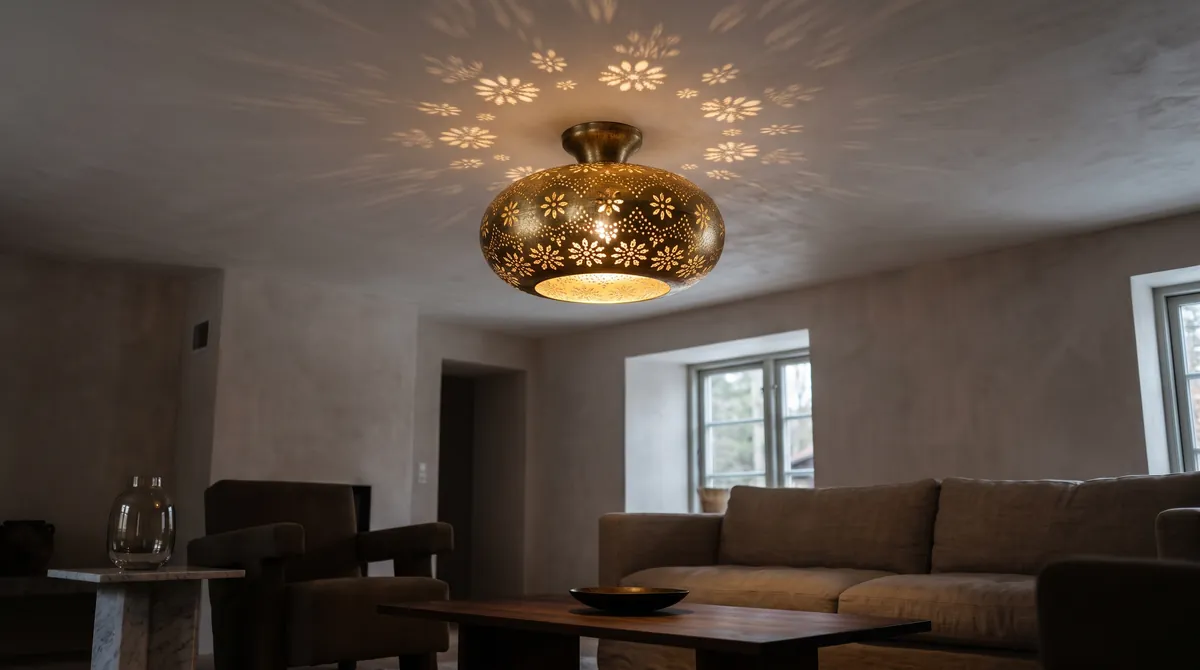
Switch on a Paavo Tynell lamp and the ceiling comes alive. Light slips through tiny perforations in polished brass, scattering points and patterns across the room like frost on a window. For several decades of the twentieth century, Tynell’s lamps hung in Finland’s parliament, hotels, churches and cinemas, and they helped define what Finnish lighting could be.
From tinsmith to designer
Paavo Tynell was born in Helsinki in 1890 and died in Tuusula in 1973. He began as an apprentice and studied in the evenings at the Central School of Applied Arts in Helsinki, today part of Aalto University. He proved so able that the school soon made him a teacher, and he taught metalwork there from 1917 to 1923.
That background in sheet metal explains a great deal. Tynell understood brass not as a precious material to be cast into ornaments, but as a sheet to be cut, folded, punched and shaped. His lamps are, in a sense, very sophisticated tinwork.
Taito and the brass workshop
At the end of the 1910s Tynell co-founded the metal workshop Taito in Helsinki with the designer Eric O. W. Ehrström, the sculptor Emil Wikström and the goldsmith Frans Nykänen, with the industrialist Gösta Serlachius as investor. Tynell became its main designer and managing director, a role he kept until the company was wound up in 1953.
Taito started as an art metal workshop, but light soon took over. Its first catalogue devoted entirely to light fittings appeared in 1932, and Tynell went on to design chandeliers, pendants, wall lights and floor lamps in brass and glass.
Perforated brass, stars and snowflakes
The signature of a Tynell lamp is . Small holes punched into a brass shade or reflector let light escape in fine points, so the lamp glows from within and throws a delicate pattern onto walls and ceilings. In some designs the holes form stars, flowers or crystalline shapes, and one well-known pendant from around 1950 is simply called Snowflake.
Glass plays a supporting role. Opal or frosted glass softens the bulb, while brass frames, leaves and rods carry the decoration. The combination feels festive without being heavy, a Nordic answer to the crystal chandelier.
- Perforated shades: punched patterns that scatter light like stars.
- Polished brass: warm, reflective and worked with a craftsman’s precision.
- Glass diffusers: opal or frosted glass that hides the bulb.
- Natural motifs: flowers, leaves and snowflake forms.
Lighting for Finland’s public buildings
Tynell’s lamps were made for architecture as much as for homes. He designed lighting for Parliament House in Helsinki (1931), the Lasipalatsi building (1936), the Hotel Vaakuna (1952) and Meilahti Church (1954), among many other buildings. Architects including Alvar Aalto worked with him on interiors and lighting.
His reach extended well beyond Finland. He designed lighting for the office of the Secretary-General of the United Nations in New York, and his lamps sold widely in the United States, especially in the 1950s. After Taito closed and his work with the Finnish firm Idman ended, he designed lamps in the 1960s for the American manufacturers Litecraft and Lightolier.
Reissues and collectors
Original Tynell lamps from the Taito years are sought after by collectors, who value the hand finishing, the quality of the brass and the link with particular Finnish buildings. Many models are known simply by model numbers rather than by names.
In 2018 the Danish company Gubi began producing a collection of Tynell designs again. The range includes the 9602 floor lamp, a design from the 1930s with a rattan-wrapped stem, a brass base and a conical shade, and the pendant known by its model number 1965, with its pattern of triangular perforations.
Why Tynell still matters
Tynell worked at a time when Finnish design was finding its own voice, and brass gave him a material that was both modern and warm. Where many functional lamps of the period were plain and strictly technical, his pieces kept a sense of ornament without slipping into historical pastiche. The decoration comes alive only when the lamp is lit, because the pattern is made by the light itself.
Light slips through the brass in fine points, and the whole room shares the pattern.
Tynell’s lamps remain unusually joyful objects. They prove that modern design in the North did not have to be austere: it could sparkle, play with shadow and still be honest about its material. That combination is why his designs are back in production, and why collectors around the world still seek out the originals.
glaminia is independent and does not sell lamps or recommend dealers. Images are AI generated illustrations, not photographs of specific products. Have fixed electrical work done by a qualified electrician.