
Ceiling lights: flush, semi-flush and statement designs
The light on the ceiling sets the tone for the whole room. How to choose flush and semi-flush designs, size them for your ceiling, tame glare and turn a plain fitting into sculpture.
Look up in most rooms and you find the light that works hardest and receives the least thought. The ceiling light is the first switch by the door and the fitting that decides whether a room feels flat or calm. Chosen well, it can be the quietest object in the room or its most sculptural one, and under a low ceiling it is often the only sensible source of general light.
Flush, semi-flush and the rest of the family
A flush ceiling light sits directly against the plaster. It is the natural answer for ceilings below about 2.4 m (8 feet), for hallways, children’s rooms and walk-in wardrobes, anywhere a hanging lamp would meet a forehead. A semi-flush design hangs 15 to 40 cm (6 to 16 inches) below the ceiling on a short stem or rods, so part of the light travels upwards and brightens the ceiling itself.
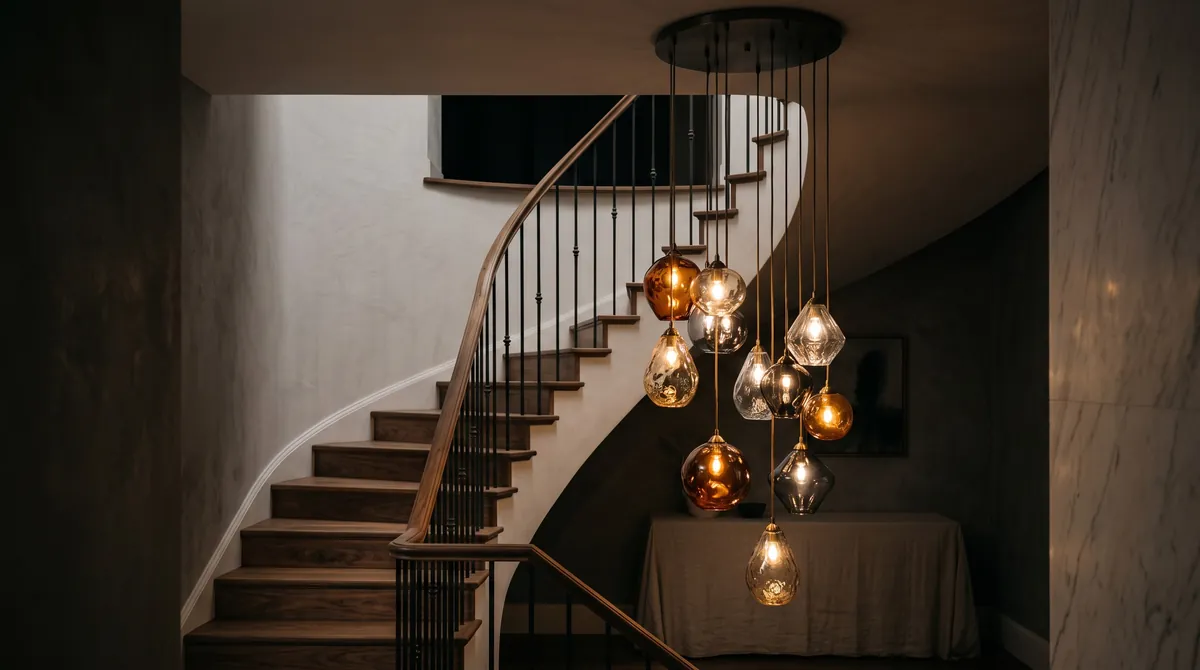
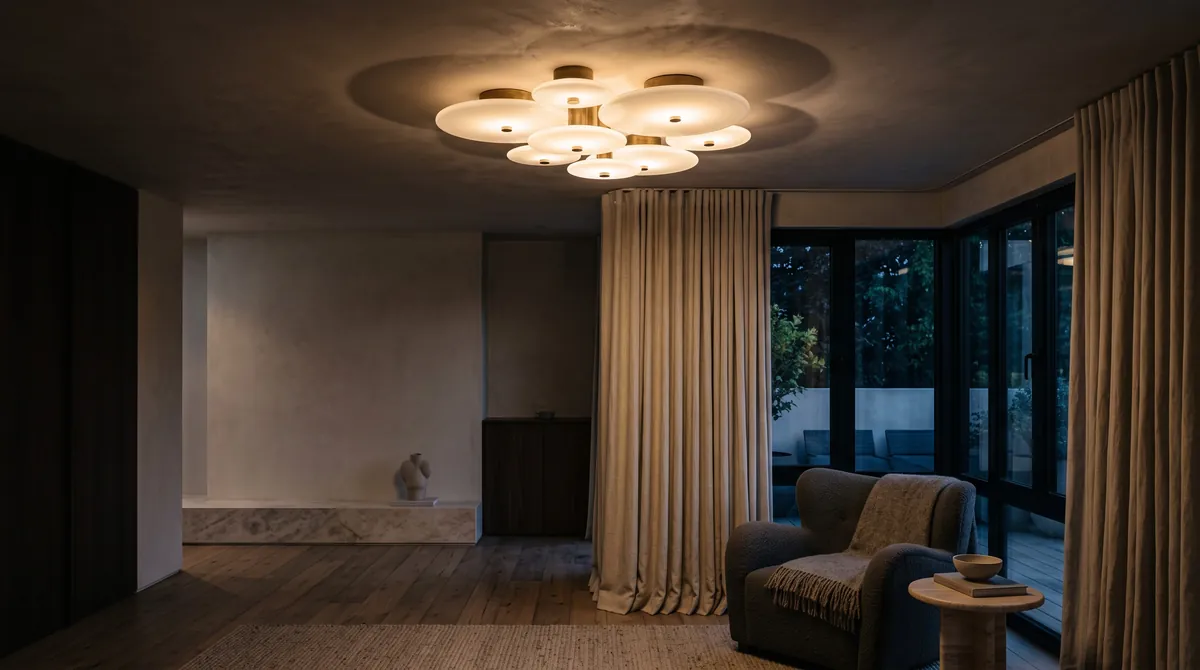
Between these and the full pendant sit the hybrids: discs that float a few centimetres off the surface and throw a halo onto the plaster, shallow domes, and sculptural pieces of layered glass, folded metal or pleated fabric. All stay close to the ceiling and light the room from above.
| Type | Ceiling height | Light | Typical rooms |
|---|---|---|---|
| Flush disc or dome | Below 2.4 m (8 ft) | Even, mostly downward | Hallways, bathrooms, children’s rooms |
| Semi-flush | 2.4 to 2.7 m (8 to 9 ft) | Down and up, brighter ceiling | Bedrooms, studies, dining areas |
| Floating halo disc | Any | Soft glow with a lit rim | Living rooms, kitchens |
| Sculptural piece | From 2.5 m (8 ft 2 in) | Decorative, often diffused | Entrances, living and dining rooms |
| Surface spot or track | Any | Directional, adjustable | Kitchens, art walls, renovations |
Rules of thumb. Keep about 2.1 m (7 feet) of clear headroom under any fitting where people walk.
Low ceilings, diffusers and glare
The great risk with any ceiling light is glare: a bright point overhead that catches your eye whenever you lift your head. Under a low ceiling the source is closer to your line of sight, so it matters even more. The cure is a good , the translucent layer of opal glass, acrylic, fabric or paper that spreads light over a larger surface and softens it. A large, evenly glowing diffuser feels calm; a small one with a visible hot spot never does.
LED technology helps, because the light source is shallow and runs cool. The best fittings hide the LEDs at the edge and guide the light across the diffuser, or bounce it off an inner reflector first. Both give an even surface without visible dots.
- Choose opal or etched glass rather than clear glass in rooms below 2.4 m.
- A shallow dome or disc, 5 to 12 cm (2 to 5 inches) deep, saves headroom and still hides the source.
- Fittings that send some light upwards make a low ceiling feel higher and lighter.
- Avoid bare bulbs and narrow spots as the only light in a low room.
Design ideas
- 01
Layered opal glass, low ceiling
Choose a flush fitting of stacked opal glass discs at 2,700 K for a low living room. Each layer glows at a slightly different strength, so the ceiling gains depth without losing headroom.
- 02
A halo above the bed
Fix a floating disc that throws a soft ring of light onto the ceiling over the bed, dimmed low at night. The bedroom gets a calm glow instead of a hard overhead light.
- 03
Sculpture in the entrance hall
Give a villa entrance one sculptural ceiling piece in folded brass or pleated fabric, centred on the front door. It frames the arrival and reads as art in daylight too.
- 04
Paper and linen by the sea
In a summer house with whitewashed ceilings, use a semi-flush shade of paper or linen. The fibres glow warm and make the light as relaxed as the rooms.
- 05
Discs along a corridor
Run three or four identical flush discs along a penthouse corridor, evenly spaced and on one dimmer. The repetition turns a passage into a quiet gallery.
- 06
A lantern under a slope
Under a sloping attic or vaulted ceiling, mount a semi-flush glass lantern on an angled canopy so it hangs true. It gives the room a traditional centre without a long drop.
Size, height and placement
For a single central fitting there is an easy starting point. Add the length and width of the room in metres and multiply by eight: the result is a sensible diameter in centimetres. A room of 5 by 4 m (16 by 13 feet) suggests about 70 to 75 cm (28 to 30 inches). The imperial version is simpler still: length plus width in feet gives the diameter in inches.
Treat this as a guide. Flush fittings read smaller than pendants because you see them from below, so you can go a little larger. In long rooms, two or three smaller fittings along the axis look better than one oversized disc. Centre the light on the room, or on the furniture if there is a clear focus such as a dining table or a bed. With semi-flush designs, check the drop: above beds and tables a longer stem is fine, in a doorway it is not.
Materials, colour temperature and dimming
Material decides how a ceiling light looks when it is off as well as on. Opal glass gives the most even glow, alabaster adds a veined, honeyed translucence and brass turns golden at low levels. Powder-coated aluminium in white or grey keeps a fitting quiet against plaster, while fabric and paper soften everything.
Colour temperature, measured in (K), describes how warm or cool white light appears. For living rooms and bedrooms, 2,700 K feels like evening light and flatters skin. Kitchens, bathrooms and studies can take 3,000 K, still warm but crisper; above 4,000 K most homes look clinical. Look also for a colour rendering index, or , of 90 or above: it measures how faithfully a light shows colours, from skin tones to oak.
Brightness is measured in lumens, the total amount of light a source gives out. A central ceiling light rarely needs to be very bright when other lamps share the work, so dimming matters more than raw output. Many LED fittings offer dim-to-warm, gliding from about 3,000 K at full power to around 1,800 K when turned low, much like an old incandescent bulb.
One voice among several
Even the finest ceiling light should rarely work alone. Light from directly above flattens faces and leaves corners grey. Designers think in layers: the ceiling fitting gives a soft general level, wall lights and floor lamps add light at eye level, table lamps create intimate pools and accent lights pick out art. Once the ceiling light is one voice among several, it is free to be decorative rather than merely functional.
Installation and safety
A ceiling light is fixed wiring, so installation, new circuits and dimmers are a job for a qualified electrician. Heavy pieces in glass or alabaster may need a fixing into a joist or a mounting plate rather than a plasterboard plug. In bathrooms, fittings need a suitable , the code that shows how well a light is protected against dust and water, and your electrician will know which zones apply. Ask too whether LED driver and dimmer are compatible, because a mismatched pair is the usual cause of flicker and hum.
glaminia is independent and does not sell lamps or recommend dealers. Images are AI generated illustrations, not photographs of specific products. Have fixed electrical work done by a qualified electrician.