
Floor lamps: reading, arc and uplighter designs
No new wiring, no drilling, and light exactly where you need it. A guide to reading lamps, arcs, uplighters and tripods, with heights, placement beside sofas and chairs, and design ideas.
The floor lamp is the most flexible light in the house. It needs no new wiring, it moves when the furniture moves, and it brings light to eye level, where a room feels most human. It can be a modest reading companion beside an armchair or a piece of sculpture, as Achille and Pier Giacomo Castiglioni proved with the Arco, whose marble base and sweeping steel arc carry light over a table without any ceiling outlet.
The main types
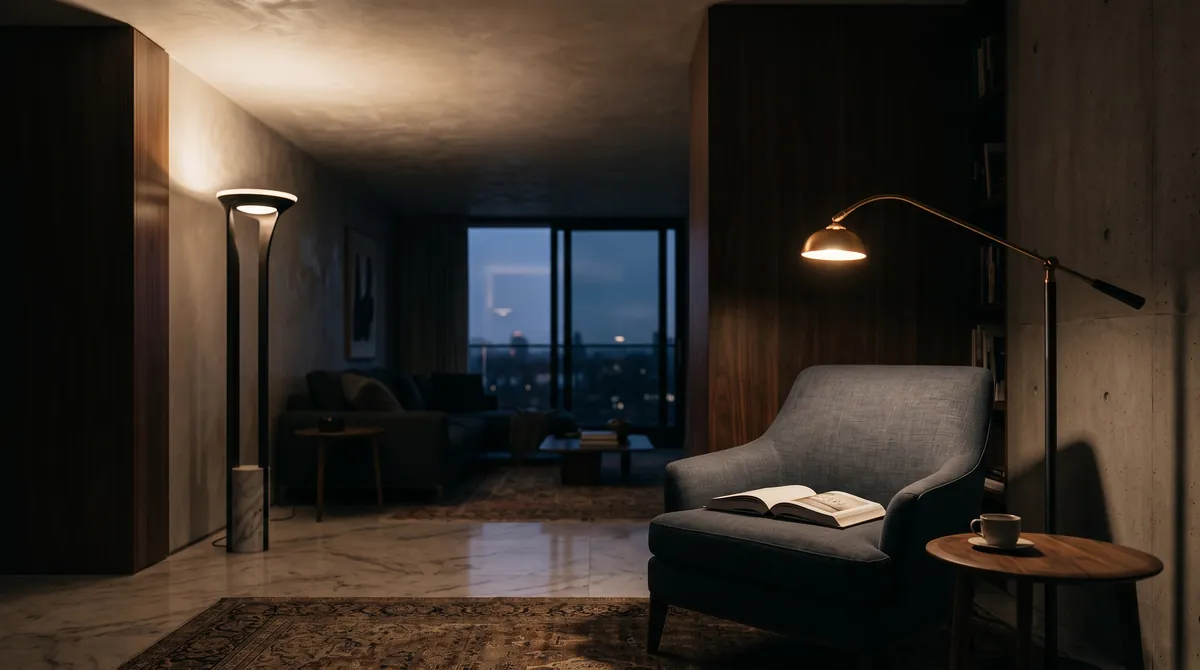
A reading lamp directs light downwards and slightly forwards, onto a book, a lap or a piece of needlework. Many have an adjustable arm or a tilting head, so you can set the beam precisely. An arc lamp uses a long curved arm and a heavy base to bring light over a sofa or coffee table from the side, the classic answer when there is no ceiling outlet where you need one.
An , also called a , sends its light onto the ceiling, which reflects it back as a soft, almost shadowless glow. It makes a room feel larger and lights it without glare. The Castiglionis’ Toio, built around a car headlight on a telescopic stem, is its witty mid-century version. Tripod lamps, with three legs and usually a fabric shade, give broad, diffuse light and a strong silhouette, while column lamps glow all round like a table lamp on a tall stem.
| Type | Light direction | Typical height | Best place |
|---|---|---|---|
| Reading lamp | Down and forwards | 130 to 160 cm (51 to 63 in) | Beside an armchair or sofa end |
| Arc lamp | Down from above, wide pool | 180 to 240 cm (71 to 94 in) | Over a sofa or coffee table |
| Uplighter | Up to the ceiling, indirect | 175 to 190 cm (69 to 75 in) | Corners, beside large seating |
| Tripod with shade | All round, diffuse | 140 to 170 cm (55 to 67 in) | Living rooms, bedrooms |
| Column lamp | All round, soft | 150 to 180 cm (59 to 71 in) | Beside sofas, in pairs, corners |
Heights vary widely between designs; these are typical ranges.
Height and placement beside sofas and chairs
For reading, the bottom edge of the shade should sit at roughly shoulder height when you are seated, about 100 to 125 cm (39 to 49 inches) from the floor. Place the lamp beside the chair and slightly behind you, so the light falls over your shoulder onto the page and the shade hides the source. If you write by hand, put it on the side opposite your writing hand to avoid shadows.
An arc lamp works best with its shade above the middle of the seating group or coffee table: high enough that nobody standing up knocks it, low enough that a seated person sees the glow rather than the bulb. Uplighters need height, with the bowl above eye level at around 1.8 m (6 feet) or more, and a pale ceiling, because a dark one swallows the light instead of reflecting it.
Corners are the natural home of floor lamps. A lit corner pushes the walls outwards and makes a room feel larger and more welcoming, especially after dark, when the windows turn black.
Design ideas
- 01
Uplighter and reader together
In a lounge, place an uplighter in one corner to wash the ceiling and a slender reading lamp beside the armchair opposite. Together they give soft background light and a focused pool, with no overhead fitting at all.
- 02
An arc over the sofa
Swing a marble-based arc lamp over a deep sofa in a villa living room so the shade hangs above the centre of the coffee table. It creates a lit island for conversation in a large open space.
- 03
A paper column for sleep
Stand a tall paper or linen column lamp in a bedroom corner, dimmed to around 2,200 K. It glows like a lantern and makes the room feel calm at night.
- 04
Leaf shadows from below
Hide a small floor uplight behind a large indoor olive tree or palm. The leaves throw shadows across the ceiling and walls, like a garden at night.
- 05
Twin tripods by the fireplace
Flank a fireplace or a tall window with a pair of tripod lamps with fabric shades. The symmetry gives a formal room balance and warm light at eye level on both sides.
- 06
A sculpture between windows
Stand one floor lamp with a striking silhouette alone against a plain wall between two windows. By day it reads as sculpture, by night as light.
Stability, cables and safety
A floor lamp must stand firmly. Arc lamps rely on a heavy base of marble, concrete or steel to balance the long arm, and it should be heavy enough that the lamp cannot tip if a child or a dog pulls the cable. Tripods are naturally stable, but their legs take up floor space and can catch feet in narrow passages.
Cables are the weak point of free-standing lamps. Plan sockets where you want lamps, ideally a floor socket under a sofa that stands in the middle of the room, or switched sockets so that every lamp comes on from the door. Floor sockets and switched circuits are fixed installations for a qualified electrician; plugging in a lamp is not.
- Use a socket close to the lamp rather than long extension leads.
- Never run cables under rugs, where they can wear or overheat unseen.
- Check that the base is heavy enough for the reach of the arm.
- Choose a foot switch or cable dimmer you can reach without bending.
Light colour, dimming and materials
For living rooms and bedrooms, 2,700 K gives a warm, flattering light. (K) is the scale of how warm or cool white light looks, and reading lamps can go to 3,000 K for slightly crisper contrast. Look for a colour rendering index, or , of 90 or above, so fabrics, books and skin look true. Brightness is measured in lumens: about 450 to 800 lumens suits a reading lamp, while an uplighter lighting a whole room may need 1,500 or more.
A dimmer turns a floor lamp from task light into mood light, and many designs have one on the cable or in the head. The shade changes everything: fabric and paper give a soft all-round glow, metal heads direct the light precisely, and opal glass sits between the two. Keep the uplighter low in the evening and save full output for tidying up.
glaminia is independent and does not sell lamps or recommend dealers. Images are AI generated illustrations, not photographs of specific products. Have fixed electrical work done by a qualified electrician.