
Table lamps: the most personal light in a room
A table lamp sits within reach, glows at eye level and says more about you than any other light. How to balance shade and base, choose the right height, use pairs and pick materials.
Of all lights, the table lamp is the most personal. You choose it like a vase or a chair, you touch it every day, and it gives light at the height of your face, which is why rooms lit by table lamps feel so warm in the evening. A good one works on three levels: as an object in daylight, as a source of soft glow and as a precise light for reading.
Shade, base and proportion
The classic table lamp is a base and a shade, and the relationship between the two decides whether it looks right. As a rule of thumb, the shade should be about two thirds of the height of the base, and its diameter roughly equal to the base’s height. It should also cover the lamp holder and the , the metal frame that carries the shade, so you never see hardware from a seat.
Shade shapes change the light. A , straight-sided and open at both ends, gives an even glow above and below. A tapered shade throws more light down onto the table. Pleated shades add texture and a gentle rhythm of light and shadow, while opaque shades lined in white or gold send all the light out of the top and bottom in two clean pools.
Then there are lamps without a separate shade. The , a dome on a slender stem, is one of the great forms of modern design: think of Vico Magistretti’s Atollo, Gae Aulenti’s Pipistrello or Verner Panton’s Panthella. Their domes cast light downwards and glow softly, so the lamp itself becomes the event.
Heights, light direction and placement
Measure the lamp together with the furniture it stands on. Beside a sofa or armchair, the bottom of the shade should be roughly at eye level when you sit, about 100 to 110 cm (39 to 43 inches) from the floor, so you see the glow but not the bulb. On a bedside table, aim for the bottom of the shade at about chin height when you sit up in bed. Consoles and sideboards are seen while standing, so they take taller lamps.
| Place | Lamp height | Rule of thumb |
|---|---|---|
| Side table by a sofa | 60 to 75 cm (24 to 30 in) | Shade bottom at eye level when seated |
| Bedside table | 45 to 65 cm (18 to 26 in) | Shade bottom at chin height in bed |
| Console or sideboard | 70 to 90 cm (28 to 35 in) | Tall enough to balance art or a mirror |
| Desk | 40 to 60 cm (16 to 24 in), adjustable | Light from the side opposite your writing hand |
| Shelf or windowsill | 25 to 45 cm (10 to 18 in) | Small, glowing, cordless where possible |
Beside a sofa, table and lamp together often measure around 145 to 165 cm (57 to 65 inches).
Think about where the light should go. For reading, a shade open at the bottom with the lamp near its lower edge works best. For atmosphere, a translucent shade that glows all over is more beautiful. A lamp in front of a mirror doubles its glow; one against a dark wall makes a small, intimate island of light.
Design ideas
- 01
A pair on a long console
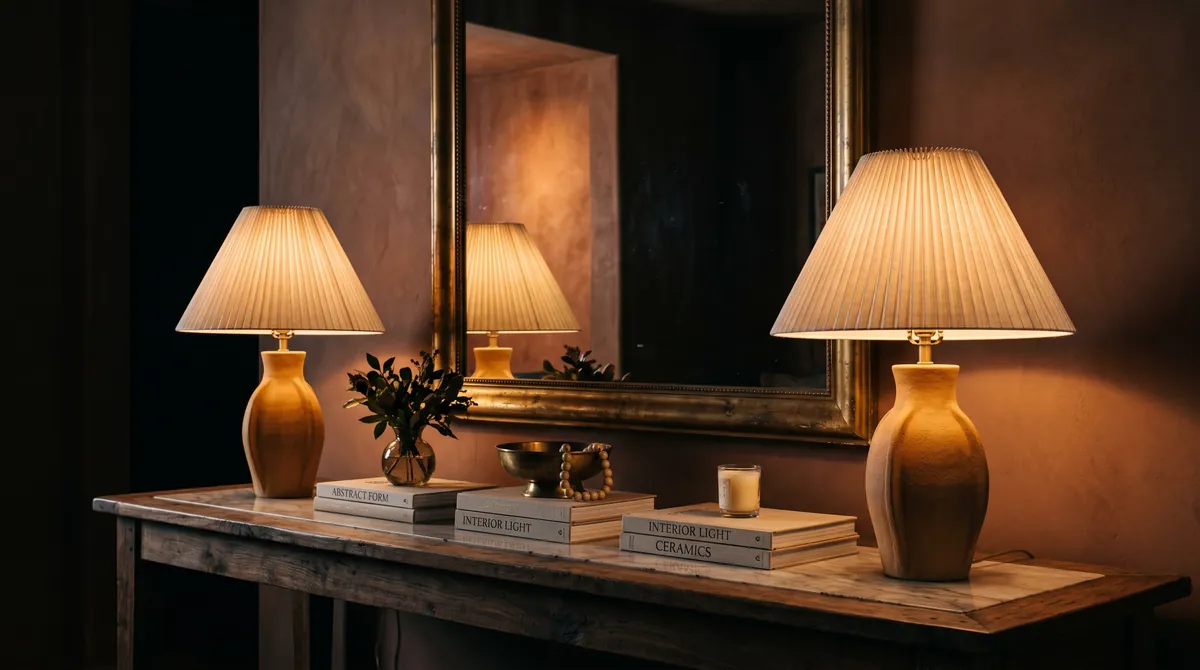
Stand two ceramic lamps with pleated shades at each end of a console beneath a large mirror. The symmetry frames the mirror, and the reflection doubles the evening glow in the hall.
- 02
A mushroom on the bar
Place a small glass mushroom lamp on a drinks cabinet in the dining room. Its dome glows at 2,200 to 2,700 K and turns the corner into a private bar.
- 03
Stone bases by the bed
Choose bedside lamps with travertine or alabaster bases and linen shades, each with its own switch. Warm stone and soft fabric make a villa bedroom feel calm and grounded.
- 04
Cordless light on the terrace
Set a rechargeable, splash-proof table lamp on an outdoor dining or poolside table. It brings indoor intimacy outside, with no cables across the terrace.
- 05
A lamp in the kitchen
Put a small table lamp on an open shelf or a dry corner of the worktop, away from water and heat. In the evening it softens the kitchen more than any ceiling spot.
- 06
Lamps among the books
Set small lamps on the shelves of a large bookcase, between books and objects. They give the wall depth and make the bookcase the warmest corner of the room.
Pairs, symmetry and the single lamp
Pairs of table lamps bring order and calm. They suit formal settings: either side of a sofa, both ends of a console, two bedside tables. They need not be identical, as long as they share height and visual weight. The opposite approach, one sculptural lamp off-centre on a sideboard, feels more relaxed and gallery-like.
Most rooms look best with several table lamps rather than one. Three points of light at different heights, for example on a side table, a console and a shelf, form a triangle that leads the eye across the room.
Materials and finishes
The base gives a lamp its character, the shade decides its light. A white lining inside a shade reflects more light, a gold lining makes it warmer.
- Ceramic: warm, crafted, in endless glazes and colours.
- Glass: catches and reflects light, and sometimes glows itself.
- Stone, marble and alabaster: heavy, stable, translucent when lit.
- Brass, bronze and steel: precise and graphic, ideal for desk lamps.
- Linen, silk and paper: soft, diffuse shade materials.
Lamps, switches and dimmers
Choose warm white of around 2,700 K. (K) is the scale that describes how warm or cool white light looks, and for bedside lamps 2,200 to 2,700 K is restful in the evening. A colour rendering index, or , of 90 or above keeps colours natural. Brightness, measured in lumens, can be modest: about 300 to 600 lumens covers most side and bedside lamps, with the upper end for reading.
Switches matter more than you think. A switch on the base or a touch dimmer is easier than one hidden under the shade, and an inline dimmer on the cable is simple to use. Switched sockets, wired so all table lamps come on from the door, are a fine idea in living rooms; they are fixed wiring and should be installed by a qualified electrician.
glaminia is independent and does not sell lamps or recommend dealers. Images are AI generated illustrations, not photographs of specific products. Have fixed electrical work done by a qualified electrician.