
Track lighting: flexible light for lofts and galleries
A ceiling track lets your light move as your room changes. How surface, recessed and magnetic systems work, which beam angles to choose and how to light art like a gallery.
Track lighting began in shops and galleries, where displays change every few weeks and the light has to follow. At home it offers the same freedom. A single power rail in the ceiling carries spotlights, pendants and wall washers that you can slide, swivel and swap whenever the furniture moves or a new painting arrives. In a loft with concrete ceilings, a period apartment where new cables cannot be chased into fine plaster, or a villa with a growing art collection, it may be the most adaptable light you can install.
How track systems work
A track is a slim aluminium profile with copper conductors inside. An adapter on each light head clicks or twists into the profile and picks up power anywhere along its length. The track itself is fixed and wired once by a qualified electrician. After that, the heads are yours to arrange. The main variants differ in how they meet the ceiling and in the voltage they carry:
- Surface tracks are screwed directly to the ceiling. They are the simplest choice for renovations and suit industrial interiors, where the profile can be part of the look.
- Recessed tracks sit flush in plasterboard or concrete, so only a narrow slot remains visible. They need planning before the ceiling is closed.
- Suspended tracks hang on fine wires below high or sloping ceilings, bringing the light closer to the table or the wall.
- Mains voltage tracks run at 230 volts in Europe (120 volts in North America) and come as single circuit or three circuit versions. Three circuits let you switch or dim groups of heads separately.
- Magnetic low voltage tracks, usually at 48 volts, hold the heads with magnets. A central , the electronic power supply, feeds the whole line. The profiles are often only two or three centimetres (about an inch) wide and carry tiny spots, linear diffusers and even small pendants.
Design ideas for track lighting
Design ideas
- 01
A gallery wall in the loft
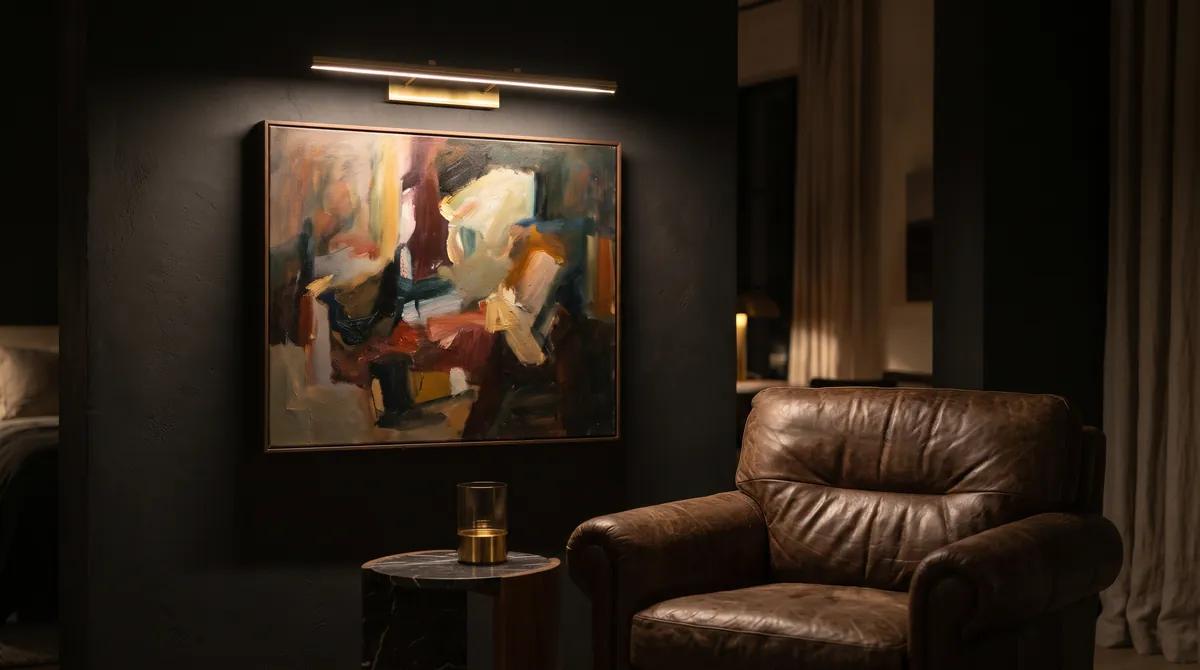
Run a black recessed track parallel to your longest wall and fit narrow 15 degree spots, one per painting, so each canvas glows while the rest of the room stays calm.
- 02
Track as architecture
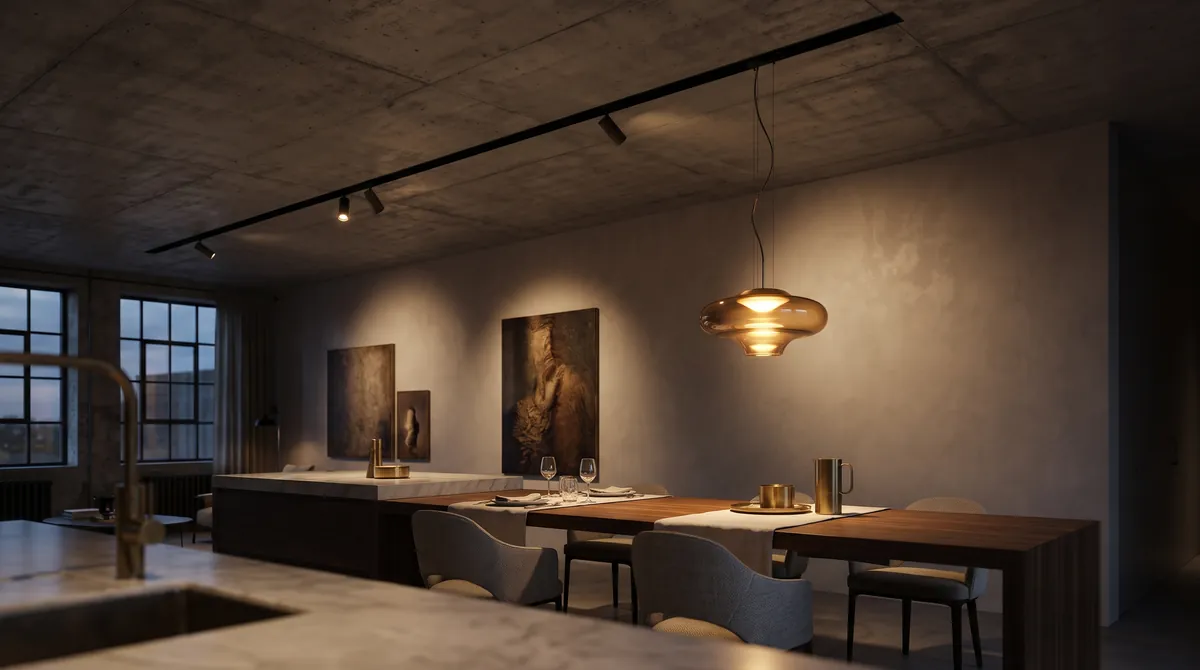
In a concrete penthouse, let a surface track trace one continuous rectangle around the living area, with spots only where furniture and art need them.
- 03
Pendant on the rail
Hang a pendant from a track adapter above the dining table, so it can follow the table when the room is rearranged for a long dinner.
- 04
A magnetic line in the kitchen
Set a slim magnetic track above the front edge of the worktop and combine downward linear modules for working light with two or three spots for open shelves.
- 05
Library in a double height room
Suspend a track about 50 cm (20 inches) below a high ceiling and angle wide flood spots onto the bookshelves to wash the spines evenly from top to bottom.
- 06
Sculpture on a plinth
Light a sculpture from two heads on the same track, one strong and one softer from the other side, to model its form with gentle shadows.
- 07
The dressing room
Fit a short magnetic track with high colour rendering spots in a walk-in wardrobe, so fabrics look the same as they will in daylight.
Beam angles, spacing and positions
The describes how wide the cone of light opens. A narrow beam makes a bright pool with crisp edges, a wide one a soft, even wash. Many track spots accept interchangeable lenses or reflectors, so you can fine tune the effect after the art is hung.
| Beam angle | Effect | Typical use |
|---|---|---|
| 10 to 15° | Narrow spot, dramatic pool | Small paintings, objects, sculpture |
| 20 to 30° | Medium spot | Larger artworks, the centre of a table |
| 35 to 45° | Flood | General light, shelves, kitchen worktops |
| 50 to 60° | Wide flood | Wall washing, wardrobes, large walls |
Values vary between makers; check the beam angle on the data sheet of each head.
For art, a simple rule of thumb is to place the track so that the light meets the centre of the picture at about 30 degrees from vertical. This throws reflections down towards the floor rather than into your eyes. With a ceiling of 2.5 to 2.7 m (8 ft 2 in to 8 ft 10 in) and pictures centred at eye level, that puts the track roughly 55 to 70 cm (about 2 ft) from the wall. Higher ceilings need more distance. To wash a whole wall evenly, space the heads about as far apart as they are from the wall.
Colour temperature, colour rendering and dimming
Colour temperature, measured in Kelvin (K), tells you how warm or cool white light looks. For living spaces, 2,700 to 3,000 K feels warm and relaxed, and 3,000 K is a good choice for art because it flatters both warm and cool palettes. The (CRI) rates how faithfully a light shows colours, on a scale up to 100. Choose 90 or higher for the home and 95 or higher for paintings and textiles.
Most track spots can be dimmed, but the method matters. Mains voltage heads often work with a phase cut dimmer on the wall, three circuit tracks can carry , a digital standard that dims each light individually, and magnetic systems frequently use wireless control through an app or a wall switch. Some heads have a small dimming dial on the body, which is ideal for balancing several artworks by eye.
Choosing a track for your home
Decide whether the track should show or disappear. White on white plaster almost vanishes, while black against concrete or dark timber becomes a graphic line. Recessed versions look cleanest but need depth above the ceiling, so discuss them early with your architect or electrician. For comfort, look for heads with honeycomb louvres or deep-set light sources, which reduce glare when you look up from the sofa.
Stay within one system. Adapters are rarely compatible between makers, and mixing parts can be unsafe. Have the track installed and connected by a qualified electrician, who will also check that the ceiling can carry any pendants you plan to hang from it.
A track does not decide where the light goes. It gives you the freedom to decide, again and again.
glaminia is independent and does not sell lamps or recommend dealers. Images are AI generated illustrations, not photographs of specific products. Have fixed electrical work done by a qualified electrician.