
Picture lights: how to light art at home
From the brass picture light above a portrait to framing projectors in the ceiling: how to light paintings, prints and sculpture without reflections, glare or damage.
A painting changes with the light that falls on it. In daylight it shifts by the hour, in a dark room it disappears, and under a careless spotlight you mostly see a glossy reflection. Good art lighting does the opposite: it lets colour, brushwork and texture come forward while the light itself goes almost unnoticed. You can achieve it with a classic picture light, with spots in the ceiling, or with the precise framing projectors used in museums.
Four ways to light art
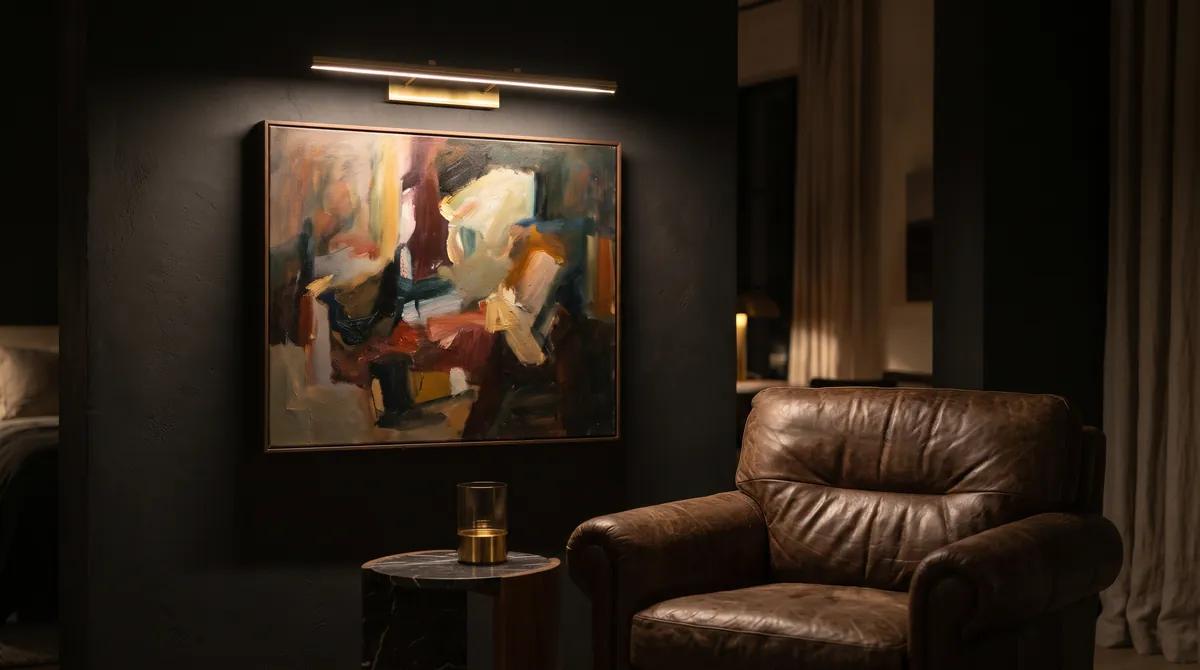
- Picture lights are mounted on the wall or the frame and reach over the artwork on an arm. Traditional models are made of brass, bronze or nickel, often with a long shade, while modern LED versions are slim bars that spread light evenly from top to bottom.
- Ceiling spots and track heads light the work from a distance. They are flexible and suit changing collections, but need careful aiming to avoid reflections and frame shadows.
- Framing projectors have adjustable shutters or masks that cut the beam to the exact shape of the canvas, so the painting seems to glow from within while the wall around it stays dark.
- Wall washers light a whole wall evenly, the calm choice for a salon hang of many works in different sizes.
The picture light is the most domestic of these. It suits libraries, studies and traditional rooms, and its shade adds a piece of craft to the wall. As a rule of thumb, choose a light roughly half as wide as the frame. For tall portraits, a longer arm helps the light reach the lower edge.
Design ideas for lighting art
Design ideas
- 01
Brass light in the library
Mount a slim brass picture light above a portrait between the bookshelves and dim it low in the evening, so the painting glows like a lamp in the room.
- 02
Framed to the edge
Use a ceiling framing projector to mask the beam exactly to a large canvas, so the colours appear to float on a dark wall.
- 03
Salon hang in a hallway
Wash a long gallery wall evenly with wide flood spots, then add one narrower beam on the most important work to create a quiet focal point.
- 04
Sculpture lit from two sides
Light a bronze or stone sculpture with a strong key light from above and to one side and a softer fill from the other, so its volume and surface show.
- 05
Glowing display niche
Line the top of a niche with a high colour rendering LED strip and set ceramics or glass inside, so every piece stands out against the back wall.
- 06
Art above the fireplace
Light the painting over the mantel from two ceiling spots set wide apart, crossing their beams to avoid a dark frame shadow at the top.
- 07
Photographs behind glass
Place the spots a little further from the wall and test the angle carefully, so reflections from the glazing fall towards the floor rather than into your eyes.
The 30 degree rule
Museums light paintings at about 30 degrees from vertical. At this angle, reflections from varnish or glass are thrown down towards the floor instead of into the eyes of the viewer, and the frame casts only a short shadow. A steeper angle exaggerates texture and frame shadows, a flatter one causes glare on the surface.
To find the spot position, measure the height between the centre of the painting, usually hung at about 1.5 to 1.6 m (around 5 ft), and the ceiling. Multiply that height by 0.58 and you have the distance from the wall. For deep or very large frames, move the spot a little further out so the top edge does not cast a shadow on the canvas.
| Ceiling height | Height above picture centre | Spot distance from wall |
|---|---|---|
| 2.4 m (7 ft 10 in) | 0.85 m (2 ft 9 in) | about 50 cm (20 in) |
| 2.7 m (8 ft 10 in) | 1.15 m (3 ft 9 in) | about 65 cm (26 in) |
| 3.0 m (9 ft 10 in) | 1.45 m (4 ft 9 in) | about 85 cm (33 in) |
| 3.5 m (11 ft 6 in) | 1.95 m (6 ft 5 in) | about 1.1 m (3 ft 8 in) |
Based on a picture centre at 1.55 m (5 ft 1 in) and an angle of 30 degrees from vertical.
Colour, protection and brightness
Paintings deserve the best colour rendering you can find. Choose a CRI, the that rates how naturally colours appear on a scale up to 100, of 95 or higher, and check the value for saturated reds, which ordinary LEDs often render poorly. Warm white of 2,700 to 3,000 K flatters oil paintings, gilded frames and old masters, while 3,000 to 3,500 K suits contemporary works with cool blues and crisp whites.
Light can damage art over time. radiation fades pigments and paper, and heat dries out canvas and varnish. Good LEDs emit practically no ultraviolet and little heat in the beam, a great improvement on halogen. Works on paper, watercolours, textiles and photographs remain the most sensitive: keep them out of direct sunlight and light them softly, while oil and acrylic paintings tolerate more.
Brightness is relative. A painting needs to be only about three times brighter than its surroundings to stand out, so dimmable fittings are worth having. Battery picture lights avoid cables on the wall, but hard wired versions, installed by a qualified electrician, give steady light and never need charging.
Sculpture, shelves and objects
Three dimensional objects need light from more than one direction. A single spot from straight above flattens a face or a vase and casts hard shadows beneath. Combine a from about 45 degrees with a weaker fill light from the opposite side, and use narrow beams for small pieces. Glass and crystal look best lit from below or behind, ceramics and bronze from the side, where their surface comes alive.
Good art lighting lets the work come forward while the light itself goes almost unnoticed.
glaminia is independent and does not sell lamps or recommend dealers. Images are AI generated illustrations, not photographs of specific products. Have fixed electrical work done by a qualified electrician.