
Step lights: safe and stylish stairs indoors and out
Small lights set low in walls or under treads make stairs safe at night and give them quiet drama. How to choose optics, heights, spacing, ratings and smart controls.
Stairs are where good lighting matters most and where it is most often forgotten. A single ceiling light leaves the treads flat and their edges hard to judge, and at night nobody wants to switch on the whole hall. Step lights solve both problems. Set low into the wall or under each tread, they place soft light exactly where your feet go, mark the rhythm of the stair and leave the rest of the space in calm darkness.
Types of step light
- Wall recessed step lights sit in the side wall just above the treads, with square, round or slot shaped faces. Louvred or shielded versions direct the light down onto the step and keep the source out of sight.
- Lights under the , the front edge of a tread, are linear profiles or tiny spots that wash the step below with a fine line of light.
- Lights in the , the vertical face of a step, sit at the centre or the side and shine forwards across the tread.
- Handrail lighting integrates an LED line into the underside of the rail and lights every tread along the run.
- Surface step lights mount onto the wall where recessing is impossible, useful in renovations and in old stone walls.
Design ideas for stairs and terraces
Design ideas
- 01
The floating staircase
Hide a warm LED line under the nosing of each cantilevered tread, so in the evening the stair seems to hover in front of the wall.
- 02
Villa entrance steps
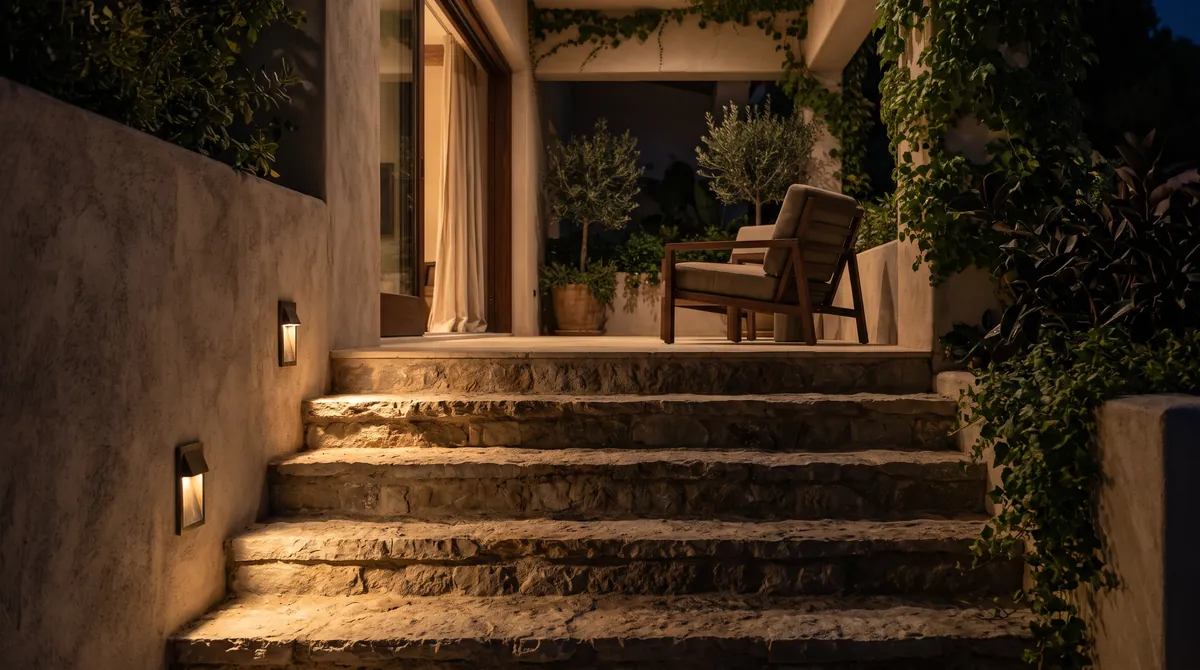
Set one shielded wall light beside every second step of a broad stone flight, so the stair glows in a steady rhythm towards the front door.
- 03
From terrace to pool
Mark the steps down to the pool deck with narrow slot lights in the side walls, kept low and warm so the view over the water stays dark.
- 04
Night path to the bathroom
Fit motion sensors to a few step lights on the bedroom floor, so they switch on at very low output for night time walks without waking anyone.
- 05
Garden stairs in a slope
Light natural stone steps in a terraced garden from small fittings in the retaining walls, letting planting and stone catch the edge of the light.
- 06
Spiral stair in a tower
Follow a spiral stair with a lit handrail, so the curve of the rail becomes a single line of light from bottom to top.
- 07
Down to the wine cellar
Use very warm 2,200 K step lights on the stairs to a wine cellar, for a soft, cave like mood that suits stone walls and candlelight.
Glare, heights and spacing
The best step lights are seen as light on the floor, not as bright points. Choose fittings with louvres, deep recesses or asymmetric optics that throw light downwards and forwards. A face of frosted glass glows nicely but can dazzle at night, so keep its output low. Look at the stair from below as well as from above, because that is where glare from a poorly chosen light is worst.
Heights and spacing depend on the stair and the fitting, but a few rules of thumb help with planning:
| Situation | Height | Spacing |
|---|---|---|
| Indoor stair, wall light | 20 to 40 cm (8 to 16 in) above the tread | Every step or every second step |
| Outdoor flight, wall light | 20 to 40 cm (8 to 16 in) above the tread | Every second or third step, about 1 to 1.5 m (3 to 5 ft) |
| Under the nosing | Directly under the front edge | Continuous on every tread |
| Garden path beside low walls | 15 to 30 cm (6 to 12 in) above the ground | Every 1.5 to 3 m (5 to 10 ft) |
Always test spacing with the actual fitting, as light patterns vary widely.
Outdoor steps and protection ratings
Outdoors, step lights face rain, frost, garden hoses and cleaning. The , a two digit code for protection against dust and water, should be at least IP44 under a roof and IP65 or higher where water runs down the wall or collects on the steps. Near the coast or a pool, choose stainless steel, bronze or powder coated aluminium faces that resist corrosion, and make sure the housings can drain.
Light colour matters as much as the fitting. Warm white of 2,700 to 3,000 K looks natural on stone and timber and keeps a garden restful. Indoors, choose the same colour temperature as the rest of the hall, so the stair does not look like a separate zone. A CRI, the colour rendering index that rates how natural colours look, of 80 is enough for outdoor steps, while 90 is better on fine timber or carpet indoors.
Sensors, timers and dimming
- Motion sensors switch the stair on when someone approaches and off after a set time, ideal for cellar stairs and night paths.
- Twilight sensors and timers switch outdoor steps on at dusk and can dim them late at night.
- Two level operation keeps step lights at a gentle orientation level and raises them when movement is detected.
- Smart home control links step lights to scenes, for example a welcome scene that starts when the gate opens.
Most LED step lights can be dimmed, but low output fittings are sensitive to the type of dimmer, so choose components that are listed as compatible. Recessed housings, cables in walls and all outdoor connections must be installed by a qualified electrician.
Step lights place soft light exactly where your feet go and leave the rest in calm darkness.
glaminia is independent and does not sell lamps or recommend dealers. Images are AI generated illustrations, not photographs of specific products. Have fixed electrical work done by a qualified electrician.