LED luminaires: integrated LEDs versus lamps with bulbs
Integrated LEDs make lights thinner and more daring than any bulb ever allowed. But what about lifetime and repair? A guide to choosing LED luminaires that last.
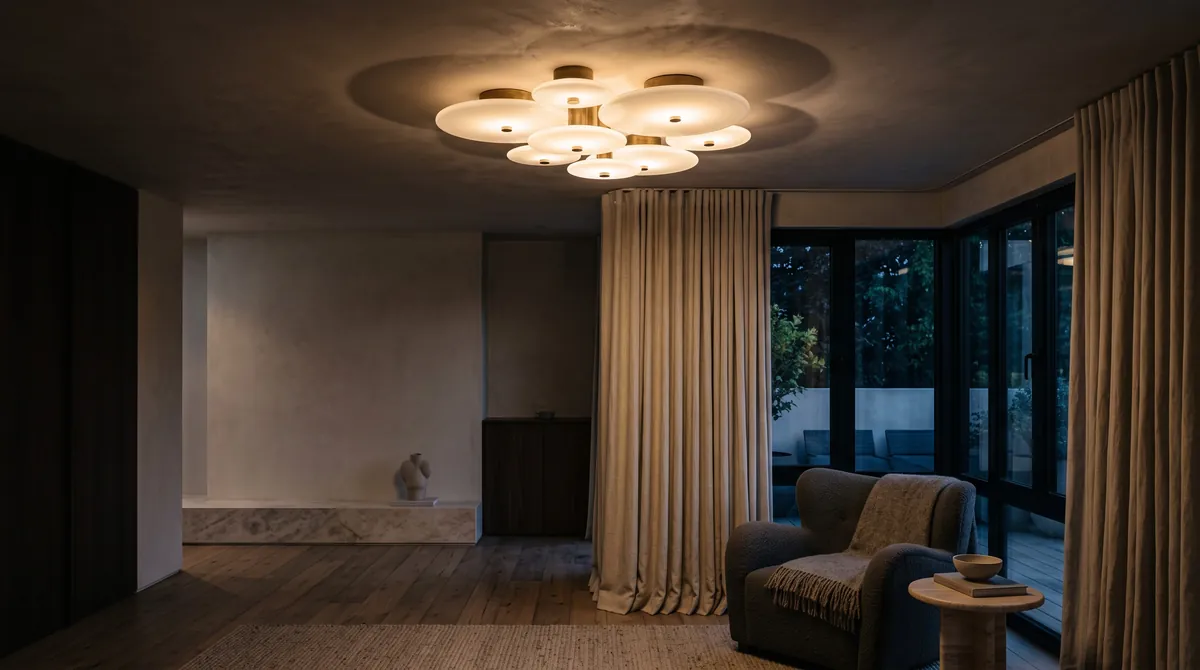
For a century, a lamp was a holder for a bulb. Designers shaped shades and bases around a glass globe of a fixed size, and when the bulb failed you screwed in a new one. LED technology changed this. The light source is now a tiny chip that can be built straight into the , the lighting term for the complete fitting. Lights have become rings, thin lines, flat discs and floating shapes that no bulb could fill. The question for anyone choosing a light today is how to enjoy that freedom without buying something that cannot be repaired.
Two ways to use LED
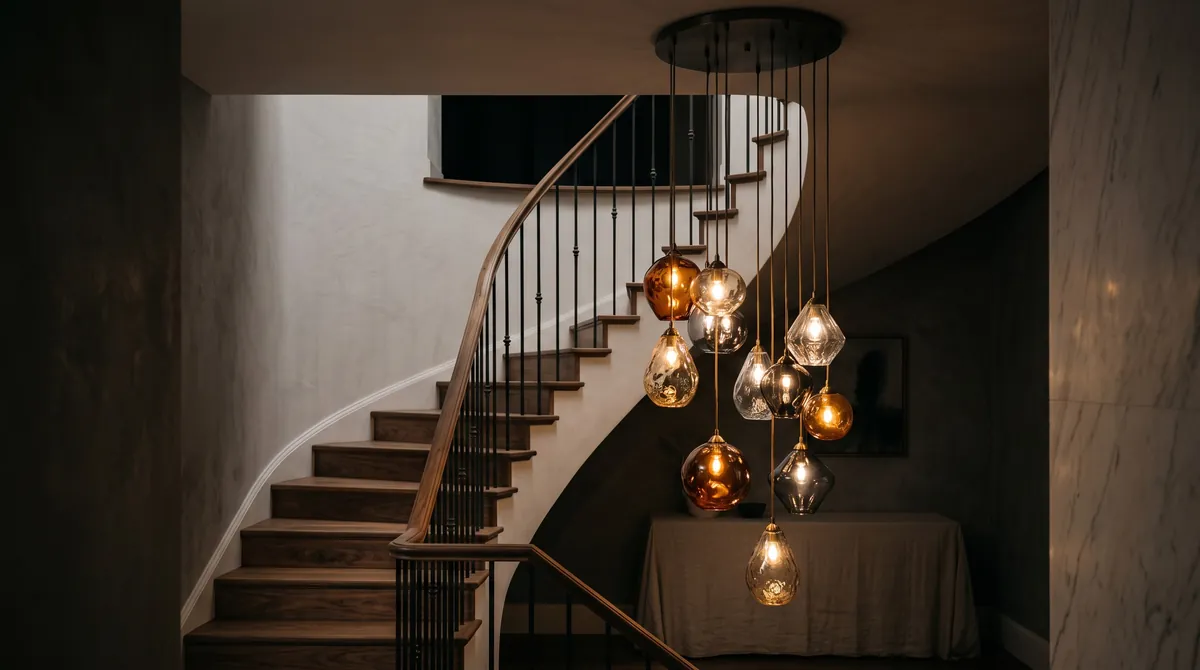
- Replaceable LED lamps, what most people call bulbs, fit standard sockets such as E27, E14, GU10 or G9. The luminaire is built as before, and the light source can be changed in seconds.
- Integrated LED luminaires have LED modules mounted directly in the body, often on an aluminium heat sink, and powered by a , the electronic unit that converts mains power into the current LEDs need.
- Replaceable LED modules are a middle path: the LEDs are built in, but sit on a module that a professional can exchange, sometimes in a standardised format such as those defined by the Zhaga consortium of lighting companies.
Integrated LEDs offer what a bulb cannot: very slim profiles, precise optics, lines of light several metres long and glare control built into the design. Replaceable lamps offer simplicity and an easy way to change brightness or colour temperature later.
Design ideas with integrated LED
Design ideas
- 01
A ring above a round table
Suspend a thin glowing ring over a round marble dining table, slightly smaller in diameter than the tabletop, so the light falls evenly on every place.
- 02
Lines that draw the architecture
Use slim recessed LED profiles to trace the joint between wall and ceiling along a gallery corridor, so the architecture itself becomes the light.
- 03
Floating disc in a stairwell
Hang a large flat LED disc in a double height stairwell, where its wafer thin edge looks almost weightless from below.
- 04
Wall composition of light
Mount a group of small integrated LED wall lights in a staggered pattern on a plain wall, so light and shadow become a composition.
- 05
The bedside reading arm
Choose a slender wall arm with a tiny integrated LED head beside the bed, for focused reading light that leaves the other side of the bed in darkness.
- 06
Classic lamp, modern source
In a period salon, keep a classic lamp designed for a bulb and fit a high quality filament style LED lamp, preserving the original look with far lower energy use.
Lifetime, drivers and repairability
A good LED does not burn out like a filament bulb. It slowly loses brightness. Lifetime is therefore stated as the hours until output falls to a set share of the original, for example at 50,000 hours, meaning 80 per cent of the light remains after that time. At three hours a day, 50,000 hours is more than 45 years.
The weak point is usually the driver. Electronics age with heat, and a cheap driver may fail long before the LEDs. In a well designed integrated luminaire, the driver can be replaced with ordinary tools. European ecodesign rules have pushed in the same direction since 2021, generally expecting light sources and drivers to be removable without damaging the luminaire, at least by a professional. Before choosing, look for:
- A stated lifetime with an L value, such as L80 or L90, rather than a vague number of hours.
- A driver in an accessible place that can be exchanged.
- Spare parts and a warranty period that the maker states clearly.
- Good thermal design: a solid metal body or heat sink rather than LEDs packed into thin plastic.
- Published data on colour rendering, colour temperature and .
Quality indicators: CRI, flicker and colour consistency
Colour temperature is measured in Kelvin (K): 2,700 K is warm like an incandescent bulb, 4,000 K neutral. The colour rendering index (CRI) describes how faithfully colours appear on a scale up to 100. LEDs at 80 can make wood look dull and skin pale, while 90 and more brings back warmth. Flicker, a rapid fluctuation in brightness, is often invisible but can make light feel restless and shows as stripes when you film with a phone. EU rules set limits, and good makers publish their values.
| Indicator | What it means | Look for |
|---|---|---|
| CRI (Ra) | How naturally colours appear, up to 100 | 90 or higher at home |
| R9 | Rendering of saturated red, important for skin, wood and food | High and positive, ideally above 50 |
| Colour temperature | Warmth of white light in Kelvin | 2,700 to 3,000 K for living spaces |
| Colour consistency | How closely identical lights match, in MacAdam steps | 3 steps or fewer |
| Flicker (PstLM, SVM) | Visible flicker and stroboscopic effects | PstLM 1.0 or below, SVM 0.4 or below |
| Lifetime (L value) | Hours until light output drops to a set share | L80 or better at 50,000 hours |
General guidance for homes; data sheets present these values in different ways.
Dimming and the right choice for your home
Integrated LEDs dim through their driver. Phase cut drivers work with suitable wall dimmers, others use DALI, a digital control standard, or wireless control. Look for smooth dimming down to 1 per cent or lower without flicker or colour shift, and consider , which turns the light warmer as it dims, much as a filament bulb does. With replaceable lamps, check that lamp and dimmer are listed as compatible.
Choose integrated LED when the design depends on it: slim lines, rings, precise spots and large architectural forms. Choose lamps with bulbs when you love a classic design, want flexible brightness or value a socket you can find anywhere. Either way, have hard wired luminaires and dimmers installed by a qualified electrician.
The question is how to enjoy the freedom of LED without buying something that cannot be repaired.
glaminia is independent and does not sell lamps or recommend dealers. Images are AI generated illustrations, not photographs of specific products. Have fixed electrical work done by a qualified electrician.