
Pendant lights: how to choose, hang and combine them
A pendant brings light down to where life happens: over the table, the island or the stair. How to choose shades, set the right height, plan clusters and avoid the classic hanging mistakes.
A pendant is the most theatrical of everyday lights. It drops from the ceiling on a cable, rod or chain and brings light down to the height where you eat, cook and talk. Because it hangs in the middle of the view, it is also one of the most visible objects in a room, which is why so many lighting icons are pendants: Poul Henningsen’s PH5 and PH Artichoke, or Cecilie Manz’s bell-shaped Caravaggio, are as much about form as about light.
Open and closed shades: how the light falls
The shape of the shade decides where the light goes. An , such as a metal dome or cone, sends light downward in a defined pool and leaves the ceiling in relative darkness. It is ideal over a dining table or an island, where you want focus and intimacy. A closed shade, such as an opal glass globe or a paper lantern, glows in every direction and fills the room with soft, .
Between the two are shades with an opening at the top, which add a little light to the ceiling, and layered designs that bounce light between several surfaces so the bulb is never seen. Henningsen spent decades refining exactly that idea: light without glare, shaped by carefully curved shades.
| Shade type | Light | Best for |
|---|---|---|
| Open metal dome or cone | Direct, focused pool | Dining tables, kitchen islands |
| Opal glass globe | Diffuse, all-round glow | Living rooms, hallways, stairwells |
| Clear or tinted glass | Sparkle, visible source | Clusters, bars, accents |
| Paper, fabric or rattan | Soft, warm, textured | Bedrooms, relaxed living rooms |
| Layered or multi-shade | Glare-free, direct and indirect | Dining rooms, open-plan spaces |
Hanging heights and sizes
Over a dining table, the bottom of the shade should hang 75 to 90 cm (30 to 35 inches) above the tabletop: low enough to gather the light on the table, high enough to keep the view across it open. Over a kitchen island the same height works, a few centimetres higher if the cook is tall. Wherever people walk underneath, keep at least 2.1 m (7 feet) clear.
A single pendant over a dining table should be roughly half to two thirds of the table’s width, with at least 15 cm (6 inches) to spare at each side. A long table usually looks better with two or three pendants, or one linear fitting, than with one large shade in the middle. Over an island, space several pendants evenly, about 60 to 80 cm (24 to 32 inches) apart from centre to centre, depending on their size.
- Dining table: 75 to 90 cm (30 to 35 in) above the top.
- Kitchen island: the same height, spaced evenly along the length.
- Bedside: shade bottom roughly at eye level when you sit up in bed.
- Hallways and walkways: at least 2.1 m (7 ft) clear headroom.
- Stairwells: every shade well above head height from every step.
Design ideas
- 01
A cascade in the stairwell
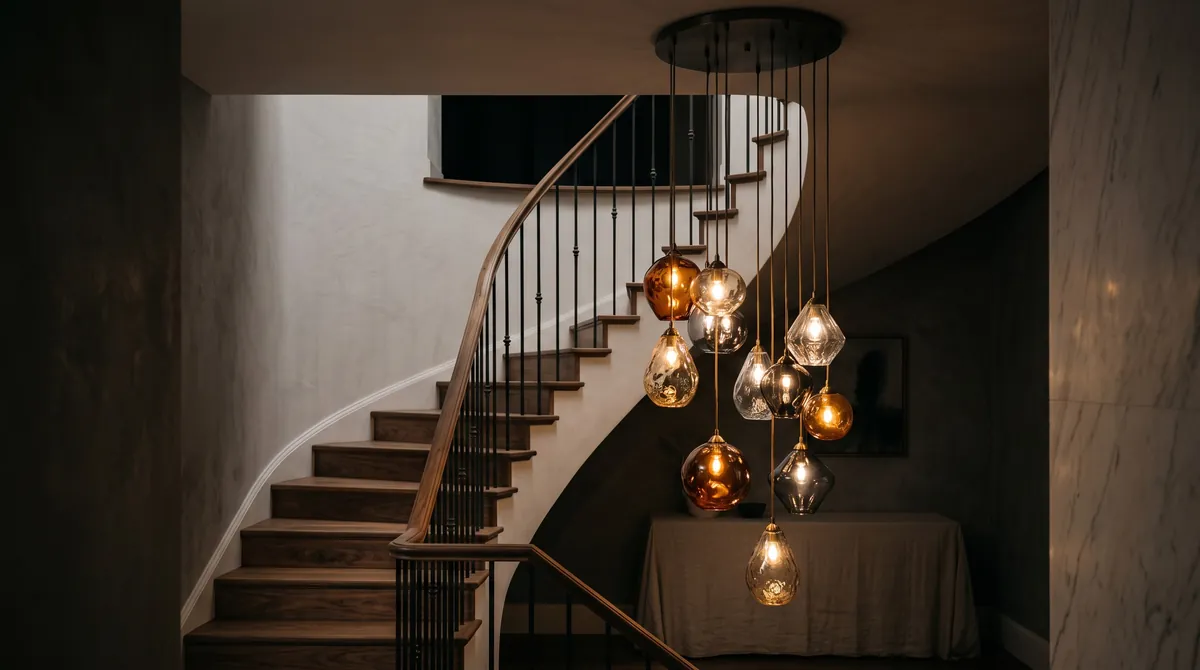
Hang seven hand blown globes in amber, smoke and clear glass at different heights in a double-height stairwell. Lit at night, they read as one sculpture from every landing.
- 02
Two domes over the island
Over a kitchen island, hang two generous metal domes rather than three small ones, white inside for a clean pool on the worktop. On a dimmer, they become bar lighting after dinner.
- 03
Bedside pendants
Free the bedside tables by hanging slim pendants either side of the bed, at about eye level when you sit up. It looks like a fine hotel and suits narrow bedrooms.
- 04
One line for a long table
Above a villa dining table for twelve, hang a single linear pendant that lights the table and sends a little light to the ceiling. Everyone keeps eye contact across the table.
- 05
Rattan on the covered terrace
Use large woven pendants under a covered terrace, with fittings rated for outdoor use and warm 2,700 K light. The weave throws patterned shadows across the floor.
- 06
An off-centre drop
When the ceiling outlet is not above the table, run the cable along the ceiling to a small hook and let the pendant drop exactly over the centre. A textile cable makes the detour part of the design.
- 07
Alabaster in the hall
In an entrance hall, hang a bowl pendant of alabaster or onyx. The stone glows honey-coloured and gives guests a warm first impression.
Clusters, stairwells and double-height spaces
A is a group of pendants that reads as one object. Odd numbers, three, five or seven, usually look more natural than even ones. Vary the heights in a gentle curve or spiral rather than at random, and keep the shades related: one material in different sizes, or one shape in different colours of glass.
Stairwells and double-height halls are where clusters shine, because the drop can be long and the pendants are seen from above, below and the side. Think about the view from the upper landing as much as from the hall, choose shades that look finished from above, and plan how each light will be reached for cleaning.
Cables, canopies and materials
The is the cover on the ceiling that hides the electrical connection, and it is easy to forget. A slim canopy in the ceiling colour almost disappears. For clusters, a long linear or round multi-outlet canopy keeps several cables in order, often with each length set individually. Textile cables, fine steel wires, chains and rigid rods each change the character: rods feel architectural, textile cables softer and more domestic.
Shade materials shape both light and mood. Spun aluminium and steel give a crisp pool. Hand blown glass ranges from clear and sparkling to opal and milky. Ceramic and stone feel substantial, while paper, linen, rattan and wood veneer filter the light into a warm glow that suits bedrooms and relaxed living rooms.
For colour temperature, measured in (K), the scale that describes how warm or cool white light looks, choose 2,700 K for dining and living and 3,000 K for kitchens if you like a crisper light. A dimmer is almost essential over a dining table: bright for homework, soft for dinner. Check that the LED lamp or module is dimmable and suits the dimmer.
Installation
Pendants are connected to fixed wiring, and heavier designs need a secure fixing into a joist or a rated ceiling hook. Shortening cables, adding outlets for a cluster and fitting dimmers are jobs for a qualified electrician. Ask early about the ceiling structure, especially with glass clusters, very long drops or concrete ceilings.
glaminia is independent and does not sell lamps or recommend dealers. Images are AI generated illustrations, not photographs of specific products. Have fixed electrical work done by a qualified electrician.