
Linear pendants: one line of light for long tables
A single slim line of light can hold a long dining table or kitchen island together. How to size, hang, level and dim a linear pendant, and what direct and indirect light do.
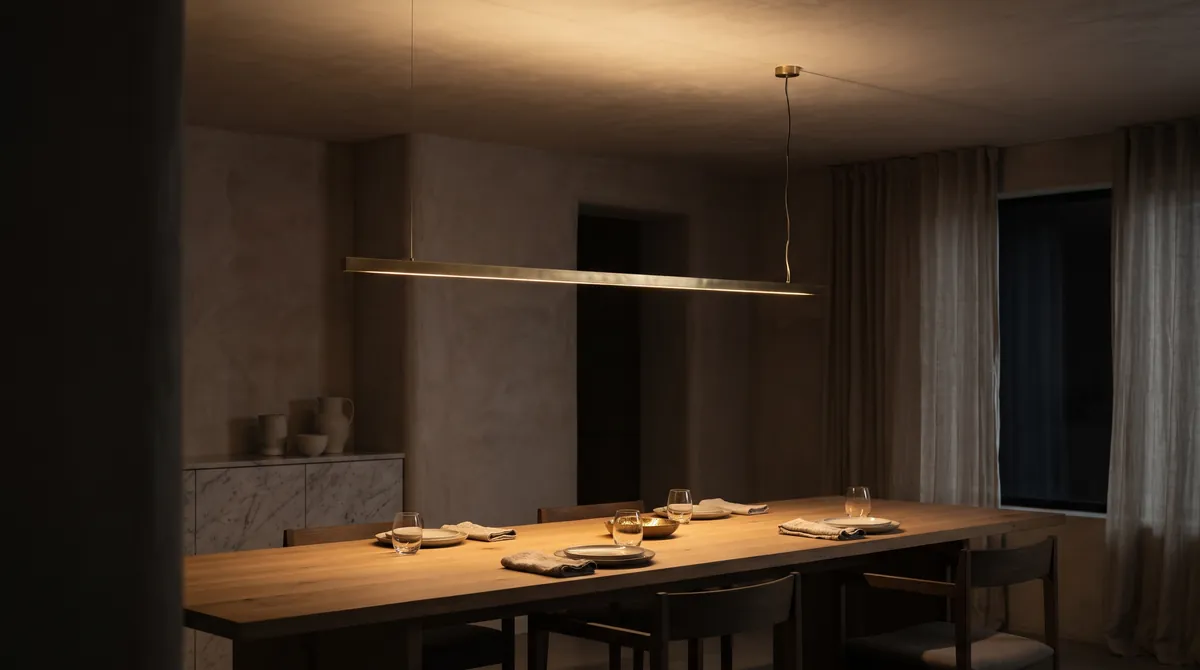
A long table asks for a long light. Three pendants in a row can look busy, while one slim line floating above the tabletop gives the table a clear frame and lights everyone equally from end to end. Linear pendants range from fine brass tubes and slender aluminium bars to long forms in glass or ceramic. Many of the most refined contemporary designs use LED technology to stretch a thin line of light to two metres and more.
Direct, indirect or both
A linear pendant can send its light in several ways, and the choice changes the whole mood of the room:
- Direct light shines downwards only. It concentrates attention on the table and leaves the ceiling dark, which feels intimate and dramatic.
- shines up to the ceiling, which reflects it softly back into the room. It is gentle, but rarely enough on its own over a table.
- Direct and indirect light combines both, often with most of the light going down, for example 70 to 80 per cent. Separate dimming of the two parts lets you move from bright working light to a soft evening mood.
- Diffused bodies of opal glass or fabric glow all round and fill the space evenly, a good choice in rooms without other light sources.
For a dining room, a mainly direct light with a small upward glow tends to work best. The table becomes the bright centre of the room, and the ceiling does not vanish into darkness.
Design ideas for linear pendants
Design ideas
- 01
Brass line over oak
Hang a slim brass linear pendant above a long oak dining table and dim its upward light to a faint glow, so warm metal and wood grain reflect each other.
- 02
Kitchen island in one stroke
Replace a row of small pendants over a kitchen island with one long linear light whose downward beam covers the whole worktop without shadows from your hands.
- 03
Refectory table under a vault
Above a 3 m (10 ft) table in a vaulted dining room, choose a light with a strong upward component, so the curve of the vault glows while the table stays bright.
- 04
The home office desk
Suspend a low glare linear pendant parallel to a long desk, so light falls from the sides of the screen and never straight into it.
- 05
Two lines for a very long table
For tables over 3.5 m (11 ft 6 in), hang two identical linear pendants end to end with a small gap, which reads as one gesture and is easier to level.
- 06
Bar counter in a penthouse
Hang a thin black linear pendant over a bar counter and dim it to a very warm 2,200 K at night for a lounge atmosphere.
- 07
Dining under the pergola
Under a covered pergola, an outdoor rated linear pendant keeps the light on the plates and off the garden, so the night stays dark around the table.
Length, height and position
The pendant should relate to the table, not to the room. A common rule of thumb is about two thirds of the table length, leaving at least 30 cm (12 inches) clear at each end so the diners at the ends are still lit. Centre it over the table, not the room, and run it parallel to the long side.
Hang the underside about 70 to 85 cm (28 to 33 inches) above the tabletop for dining: high enough to see across the table, low enough to keep the light source out of your eyes. Over a kitchen island, 75 to 90 cm (30 to 35 inches) above the worktop is typical. For lights with a strong upward component, keep at least 30 to 50 cm (12 to 20 inches) to the ceiling, so the indirect light can spread.
| Table length | Pendant length (approx.) | Seats |
|---|---|---|
| 1.8 m (6 ft) | 1.0 to 1.2 m (3 ft 3 in to 4 ft) | 6 |
| 2.4 m (8 ft) | 1.4 to 1.6 m (4 ft 7 in to 5 ft 3 in) | 8 |
| 3.0 m (10 ft) | 1.8 to 2.0 m (6 ft to 6 ft 7 in) | 10 to 12 |
| Over 3.5 m (11 ft 6 in) | Two pendants or one long custom piece | 12 or more |
Rules of thumb; leave at least 30 cm (12 in) clear at each end of the table.
Suspension, levelling and glare
Most linear pendants hang on two or more fine steel cables with a separate power cord, or on rigid rods. Small adjusters in the canopy or the body let you level the light precisely, which matters because a long, thin line shows even a slight slope. The ceiling must carry the weight at every suspension point, and the position of the electrical outlet should be planned with the table, not guessed afterwards.
Glare comes from seeing the light source directly. A good linear pendant hides its LEDs behind a , a cover with tiny prisms that spreads and controls the light, or sets them deep in the profile. For desks, look for a (unified glare rating, a measure of discomfort glare) of 19 or below, the value used for office work. Over dining tables, an opal diffuser keeps the line soft when you look up.
Colour temperature and dimming
Warm white of 2,700 K suits dining rooms and evening light, while 3,000 K is a good compromise over a kitchen island used for cooking and homework. Choose a colour rendering index (CRI), the measure of how naturally food, skin and wood appear, of at least 90. Some linear pendants offer , which changes from cooler light by day to warmer light in the evening.
Dimming is essential over a dining table, where the same light serves a family breakfast and a late dinner. Integrated LED pendants usually dim through their driver, with a compatible wall dimmer, through DALI or wirelessly. As with every fixed light, the connection belongs in the hands of a qualified electrician.
One slim line floating above the tabletop gives the table a clear frame.
glaminia is independent and does not sell lamps or recommend dealers. Images are AI generated illustrations, not photographs of specific products. Have fixed electrical work done by a qualified electrician.