
LED strip lighting: hidden lines of light
LED strips draw lines of light into coves, shelves and stairs. How to avoid visible dots, choose colour and voltage, dim smoothly and get a finish that lasts for years.
Some of the most beautiful light in a room comes from sources you never see: a ceiling that seems to float on a band of warm light, a bookcase glowing from within, steps that hover above the floor. Most of these effects are made with LED strips, flexible tapes covered with tiny light emitting diodes. They are simple in principle, but the difference between a harsh line of glaring dots and a soft, even glow lies entirely in planning and installation.
What an LED strip is made of
An LED strip is a thin circuit board on a roll, with LEDs every few millimetres and an adhesive back. You cut it at marked points, usually every few centimetres, and connect it to a , the power supply that converts mains electricity to the low voltage the strip needs, typically 12 or 24 volts. Strips come in several forms:
- Standard SMD strips have visible individual LEDs, often 60 to 120 per metre (about 18 to 36 per foot). They need a to look smooth.
- COB strips (chip on board) place the LEDs so closely under a continuous coating that they give an unbroken line, even in a shallow profile.
- Neon style strips are cased in flexible silicone, which diffuses the light and bends around curves.
- Tunable white and colour strips change colour temperature or produce colours, but need more channels and a compatible controller.
Design ideas with hidden light
Design ideas
- 01
Floating ceiling cove
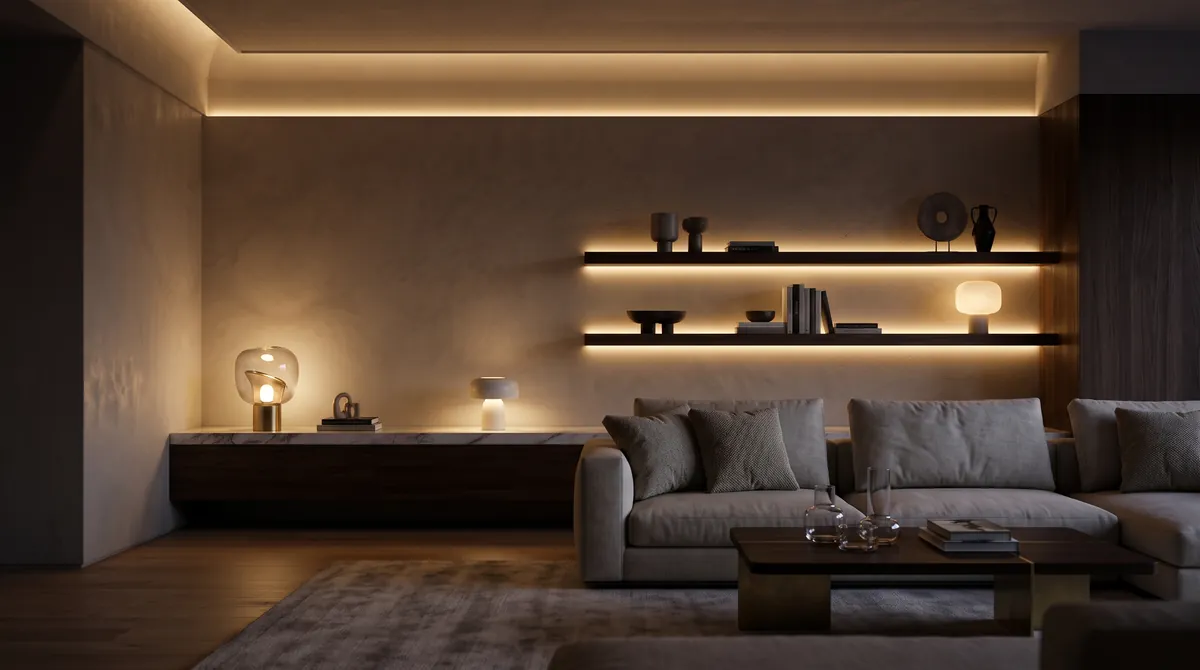
Hide a warm 2,700 K strip in a cove around the edge of the living room ceiling, so the ceiling appears to hover and the room fills with soft indirect light.
- 02
Backlit bookshelves
Set slim profiles at the front underside of each shelf, angled towards the back wall, to make books and ceramics glow without a visible source.
- 03
Kitchen worktop line
Mount a strip in a profile at the front edge of the wall cabinets, aimed at the splashback, for shadow free working light with high colour rendering.
- 04
The floating bed
Run a strip under the base of a platform bed, set back about 10 cm (4 inches) from the edge, so the bed seems to rest on a pool of light, dimmed low as a night light.
- 05
Stair treads in light
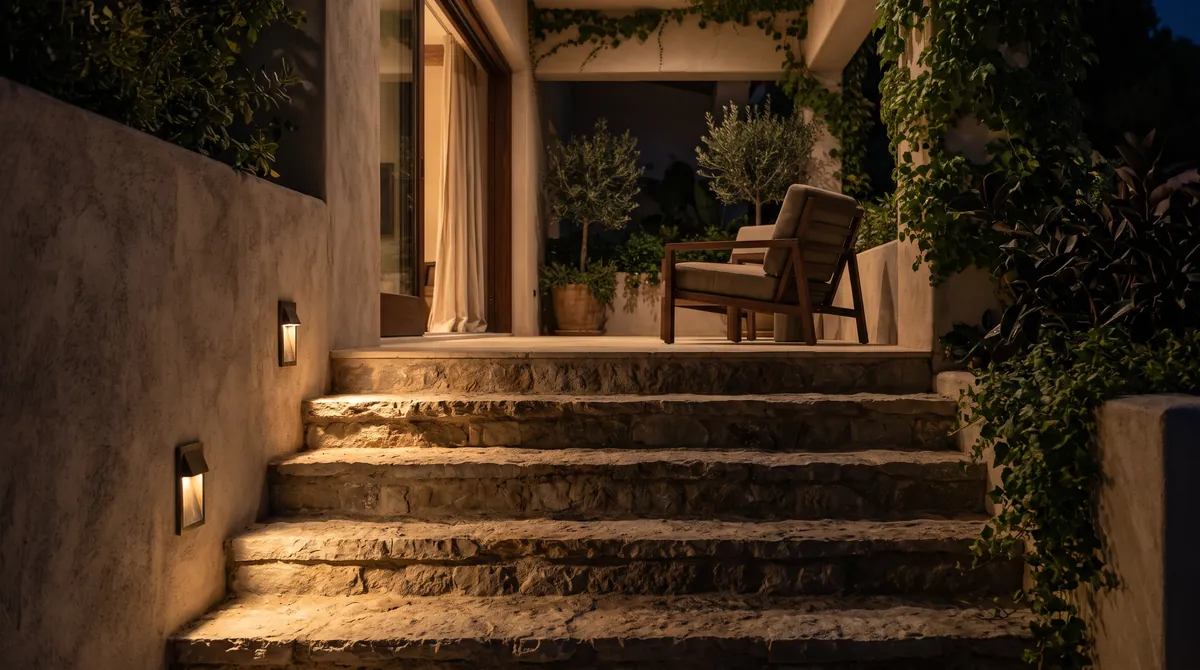
Recess a profile under the nosing of each tread, so a thin line lights the step below, safe at night and dramatic from the hall.
- 06
Mirror halo in the bathroom
Fix a strip behind a mirror mounted a few centimetres off the wall, creating a halo around the glass and soft light on the face.
- 07
Wardrobe that wakes up
Integrate strips into the rail or the front edge of the shelves in a dressing room, switched by door contacts, so the light comes on as the doors open.
Profiles and diffusers against dots and glare
Seen directly, an LED strip looks like a string of glaring points, and its reflection on a glossy worktop or polished marble shows every dot. The cure is an aluminium profile with a diffuser, a cover of opal or frosted plastic that blends the points into one line. The deeper the profile, the further the diffuser sits from the LEDs and the smoother the light. As a rule of thumb, the gap between LEDs and diffuser should be at least as large as the spacing between the individual LEDs.
Aluminium also carries heat away. LEDs age faster when they run warm, so a strip stuck straight onto timber or plasterboard at high output loses brightness and colour sooner. In ceiling coves, leave roughly 15 to 30 cm (6 to 12 inches) between the strip and the ceiling, so the light can spread instead of forming a hard bright band. Brightness is measured in lumens (lm), the amount of light a source emits.
| Application | Output per metre | Colour temperature | CRI |
|---|---|---|---|
| Ceiling cove, indirect | 800 to 1,500 lm | 2,700 to 3,000 K | 90 or more |
| Shelves and cabinets | 300 to 700 lm | 2,700 to 3,000 K | 90 or more |
| Kitchen worktop | 800 to 1,200 lm | 3,000 to 3,500 K | 90 or more |
| Stairs and plinths | 100 to 400 lm | 2,700 K | 80 or more |
| Bathroom mirror | 600 to 1,000 lm | 3,000 to 4,000 K | 90 or more |
Approximate rules of thumb; a dimmable system lets you fine tune after installation.
Voltage, drivers and dimming in plain words
Low voltage loses strength along a long strip, so the far end can look dimmer and even slightly different in colour. A 24 volt strip carries the same power with less current than a 12 volt one and runs further, often 5 to 10 m (16 to 33 ft) from one feed point depending on its power, against roughly half that at 12 volts. Longer runs are fed from both ends or from several points. Choose a driver rated about 20 per cent above the total load, and place it where it stays cool and accessible, never sealed behind plaster.
Dimming happens in the driver or a separate controller. Mains dimmable drivers work with a suitable wall dimmer. controllers (pulse width modulation) switch the LEDs on and off very rapidly; a high switching frequency avoids flicker that you might notice by eye or see as stripes on a phone camera. DALI and wireless systems let you dim strips together with the rest of the lighting. Check that driver, controller and dimmer are listed as compatible.
Colour quality deserves attention too. Warm white from 2,700 to 3,000 K suits living spaces, and the colour rendering index (CRI), a scale up to 100 for how true colours look, should be at least 90 for kitchens, wardrobes and anything near food, wood or skin. Buy all strips for one room from the same product line, ideally the same batch, so the white matches along the line.
Installation quality
Good results depend on clean, straight profiles, mitred corners and soldered or properly clamped joints, not tape pressed onto a dusty surface. Outdoors, in bathrooms and near showers, use strips and profiles with a suitable IP rating, the code for protection against dust and water. Connecting drivers to the mains and any work in wet areas is a job for a qualified electrician.
The best strip lighting is the light you notice and the strip you never see.
glaminia is independent and does not sell lamps or recommend dealers. Images are AI generated illustrations, not photographs of specific products. Have fixed electrical work done by a qualified electrician.