
In-ground and floor lights: light from below
Set flush into stone, decking or lawn, in-ground lights wash facades, trees and walls from below. What to know about glare, heat, protection and drive over ratings.
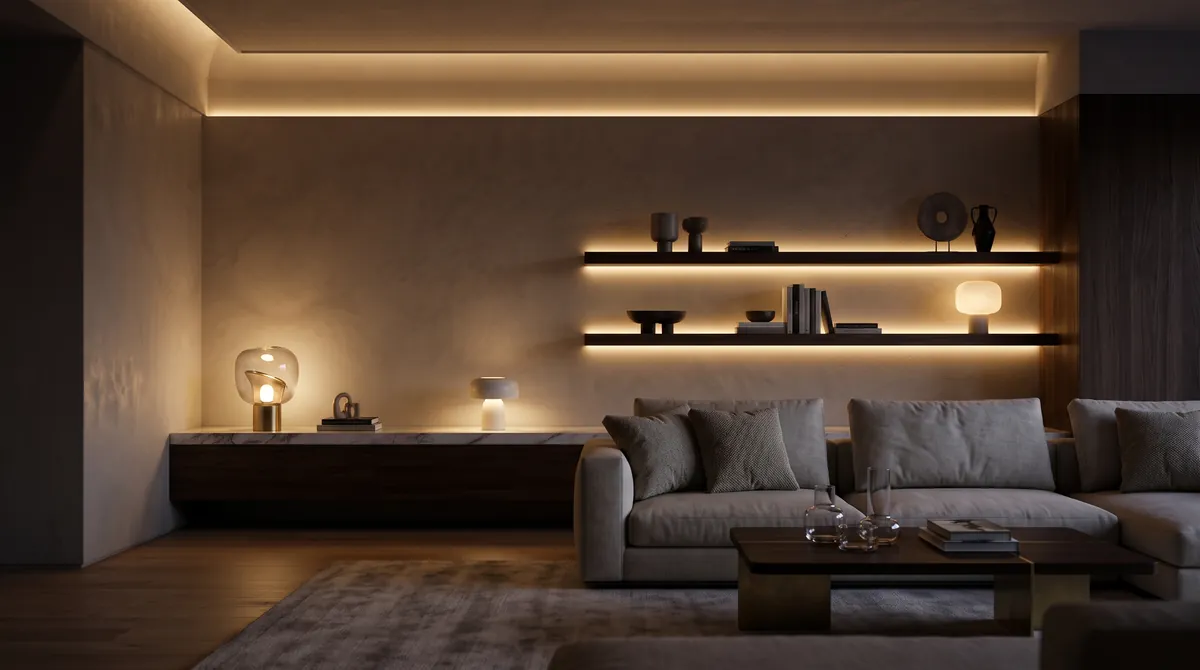
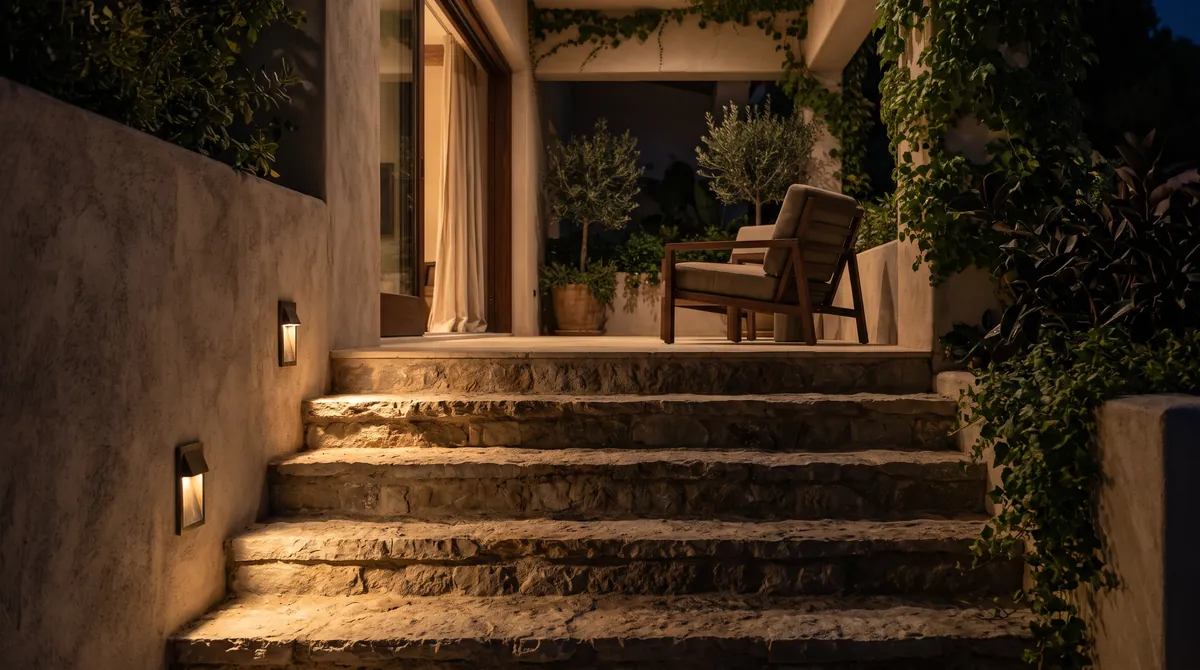
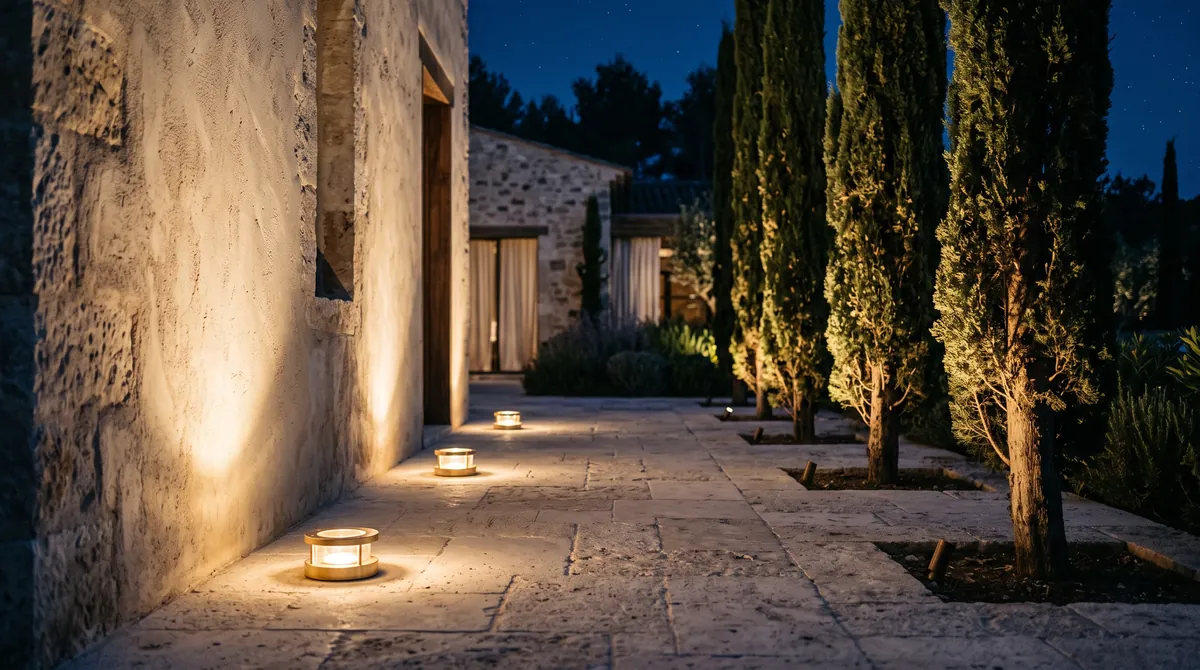
Light from below is rare in nature, which is exactly why it is so striking. A cypress lit from its roots, a rough stone facade grazed at night, a corridor floor that glows softly along the wall: in-ground lights turn ordinary surfaces into scenery. Because the fitting sits flush with the ground, you see the effect rather than the lamp. Indoors the same family appears as floor recessed lights, part of what German speakers call Bodenleuchten, which mark walls and paths with low, calm light.
Types of in-ground and floor light
- Outdoor uplights are round or square fittings set into paving, gravel or lawn and aimed upwards at trees, walls and columns. Many have a tilting inner reflector, so the beam can lean towards its target.
- Wall grazers are narrow linear or asymmetric fittings placed close to a facade. They send light steeply up the surface to reveal every joint and ridge.
- Marker lights are small, low output points that outline paths, pool edges and driveways without lighting the surroundings.
- Indoor floor recessed lights sit in stone, tile, screed or timber floors along walls, in corridors, at the foot of stairs or in front of large windows.
- versions have reinforced bodies and thick toughened glass for driveways and courtyards where cars park and turn.
Design ideas with light from below
Design ideas
- 01
Cypress avenue at night
Place one narrow beam uplight at the foot of each cypress along the drive, just in front of the trunk, so the trees read as a rhythm of slender green flames.
- 02
Grazing a stone facade
Run a line of linear grazers 10 to 20 cm (4 to 8 inches) from a rough stone or rammed earth wall to draw its texture into deep relief.
- 03
Olive tree as sculpture
Light an old olive from two sides with wide beams, one slightly stronger than the other, so the twisted trunk and silver canopy become a three dimensional sculpture.
- 04
Floating hallway wall
Set small asymmetric floor lights along one long hallway wall to graze it softly, so the corridor feels wider and the ceiling stays free of fittings.
- 05
Pool edge markers
Outline the coping of an infinity pool with tiny warm white marker lights, enough to show the edge without competing with the view over the water.
- 06
Columns of a loggia
Put one uplight in front of each column of a terrace or loggia, repeating the architecture in light after dark.
- 07
Threshold of a glass wall
Sink a line of floor lights just inside and just outside a large sliding window, so at night the floor seems to run on from living room to terrace.
Positioning, beam angles and spacing
The distance between light and surface decides the effect. Close to a wall, the beam strikes at a shallow angle and reveals texture. Further away, the wall is lit more evenly but looks flatter. For trees, choose the beam by the shape of the crown: narrow for slim columnar trees, wider or two lights for broad canopies.
| Target | Beam angle | Position (rule of thumb) |
|---|---|---|
| Slim tree, column | 8 to 15° | 30 to 50 cm (12 to 20 in) from the trunk |
| Broad tree, large shrub | 25 to 40°, or two lights | 50 to 100 cm (20 to 40 in) from the trunk, under the canopy |
| Textured facade | Narrow or asymmetric | 10 to 30 cm (4 to 12 in) from the wall, every 0.8 to 1.5 m (2.5 to 5 ft) |
| Smooth wall, even wash | Wide, 40 to 60° | 50 to 100 cm (20 to 40 in) from the wall |
| Indoor corridor wall | Asymmetric or narrow | 5 to 15 cm (2 to 6 in) from the wall, every 1 to 2 m (3 to 6.5 ft) |
Beam patterns vary widely; always confirm with the data sheet and a test at night.
Glare, heat and drive over ratings
In-ground lights point straight up, so glare is the main risk. Choose fittings with the light source set deep inside the body, an anti-glare louvre or a honeycomb insert, and place them where nobody looks directly into them: never in the middle of a path or beside a sun lounger. Indoors, keep output low enough that the floor glows rather than dazzles.
The glass on top can become warm. High output fittings may get hot enough to be uncomfortable for bare feet or to scorch leaves lying on them. LED models run far cooler than the old halogen units, and some are designed specifically for a low surface temperature, the right choice near pools, terraces and indoor floors. Data sheets usually state the surface temperature or the areas a fitting is suitable for.
Load ratings tell you what may stand on the glass. Walk-over fittings are made for people and garden furniture. Drive over versions carry cars and are rated for a stated static load in kilograms or kilonewtons, so check that it matches the heaviest vehicle, and remember that turning wheels add stress. The describes resistance to impact on a scale up to IK10, the toughest class.
Protection, materials and light colour
The (ingress protection) shows how well a fitting resists dust and water: the first digit covers solids, the second water. For outdoor ground lights, IP67, which withstands temporary immersion, is the usual minimum. IP68 is needed where water may stand for long periods and for use under water. Indoors, IP65 or higher is sensible in bathrooms, wet rooms and anywhere floors are mopped.
- Stainless steel, in a marine grade near the sea or pools, or bronze for top rings that stay handsome for decades.
- Installation sleeves of composite or metal that hold the fitting firmly and make later replacement easier.
- A gravel drainage bed under each fitting, so rainwater drains away instead of collecting around the body.
Warm white of 2,700 to 3,000 K suits stone, timber and most planting, and around 3,000 K can make foliage look fresher. Choose a CRI (colour rendering index, a measure of how naturally colours appear) of at least 80 outdoors and 90 indoors. Separate circuits or dimming for trees, facades and paths let you compose the scene, and a timer or twilight sensor switches the garden on at dusk.
In-ground lights are always part of a fixed installation. Buried cables, sealed connections and the link to the mains are work for a qualified electrician.
glaminia is independent and does not sell lamps or recommend dealers. Images are AI generated illustrations, not photographs of specific products. Have fixed electrical work done by a qualified electrician.