Japanese inspired lighting: calm, paper and shadow
What Tanizaki’s In Praise of Shadows, paper lanterns and wabi-sabi can teach you about low, warm, quiet light, and how to create a calm light scene at home.
Most Western lighting advice is about brightness: how many , how many fittings, how to banish every dark corner. Japanese aesthetics start from the other end. They ask what darkness is good for, and how a little light, placed low and filtered through paper, can make a room feel deeper and calmer.
In Praise of Shadows
The key text is a short essay by the novelist Jun’ichirō Tanizaki, published in 1933 as In’ei Raisan and known in English as In Praise of Shadows. The first full English translation, by Thomas J. Harper and Edward Seidensticker, appeared in 1977, and architects and designers have returned to it ever since.
Tanizaki wrote at a time when bright electric light was spreading through Japan, and he felt that something was being lost. He set a Western ideal of clarity and brilliance against the traditional Japanese house, where deep eaves and paper screens kept rooms in soft half light. In that dimness, he argued, materials show their true beauty: lacquerware seen by candlelight, gold leaf catching a faint gleam at the back of a room, the shadowy alcove that holds a single scroll.
He was not against light as such. He was against light that flattens everything and leaves nothing to the imagination. Read today, his essay is a plea for gradation, for treating shadow as a material in its own right.
Darkness is not the enemy of a beautiful room. It is what gives the remaining light its value.
Paper, wood and bamboo
The traditional Japanese house filtered daylight through , sliding screens of wooden lattice covered with translucent paper. Light passing through them becomes even and pale, without hard shadows. After dark, people used the , a paper covered frame around an oil lamp or candle, and the chōchin, a collapsible lantern of paper stretched over a spiral of bamboo.
The paper is , traditionally made from the long fibres of plants such as the paper mulberry. It is strong, slightly irregular and glows warmly when lit from behind. Gifu, in central Japan, has long been known for its paper lanterns, and it was there that the story of the modern paper lamp began.
Noguchi’s Akari
In 1951 the American artist Isamu Noguchi visited Gifu and was asked by the town’s mayor to help the local lantern trade. He kept the washi and bamboo but replaced the candle with an electric bulb and used wire to free the shapes into sculpture. He called the lamps Akari, a Japanese word for light or illumination.
Akari lamps are still made in Gifu by the original manufacturer, Ozeki & Co., in more than 200 versions, from small table lanterns to large ceiling pieces. They proved that a paper lamp could be serious design, and they remain the reference point for every paper globe that followed.
Wabi-sabi and Japandi
Two terms often appear in this context. is a traditional aesthetic that finds beauty in things that are imperfect, impermanent and modest: the uneven glaze of a tea bowl, the patina of old wood. It has its roots in Zen Buddhism and the tea ceremony. In lighting it suggests handmade shades, natural irregularities and light that changes as the evening goes on.
Japandi is a much newer word, a blend of Japanese and Scandinavian that came into use around 2016. It combines Japanese restraint with Nordic warmth: natural materials, muted colours, low furniture and very little clutter. Its lighting is warm, indirect and quiet, a meeting point of paper lanterns and Nordic shades.
Whichever label you prefer, the same principles define Japanese inspired light:
- Low placement: lamps on the floor or at seated height rather than bright light from the ceiling.
- Diffusion: paper, linen or frosted glass that softens the source.
- Warm, dim light: modest brightness, a warm colour temperature and plenty of shadow.
- Natural materials: washi, bamboo, wood, ceramic, stone and linen.
- Restraint: few fittings, each with a purpose, and empty space around them.
Creating a calm light scene at home
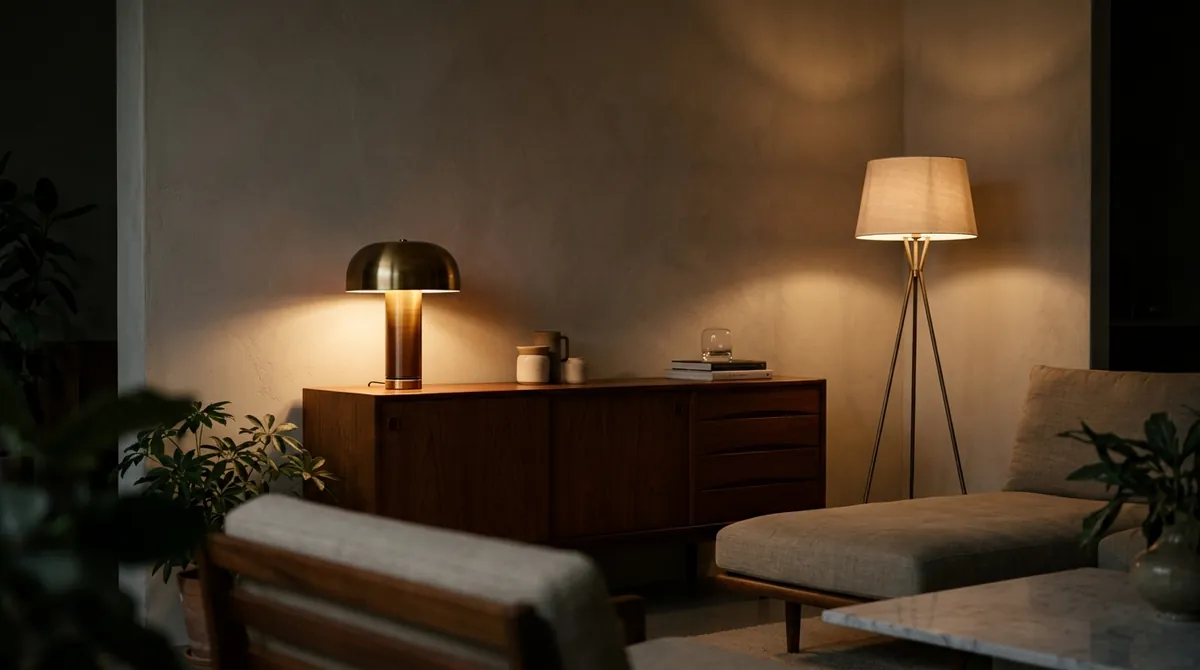
Start by switching off the overhead light in the evening. Place a paper floor lantern in a corner, perhaps beside a low chair or a plant, so that its glow washes the wall and the floor. Add a linen or paper pendant hung low over a table, and a small lantern near the place where you sit.
Colour temperature matters here more than anywhere. It is measured in (K): the lower the number, the warmer and more amber the light. For a Japanese inspired room choose 2,200 to 2,700 K, and make it dimmable. Brightness is measured in lumen, the amount of light a bulb gives off, and less is more: a floor lantern often needs no more than 300 to 450 lumen.
Let shadow do some of the work. Leave corners unlit, light a ceramic vase or a textured plaster wall from the side, and resist the urge to add more fittings. LED bulbs are the sensible choice in paper shades because they run far cooler than old incandescent bulbs; always stay within the maximum wattage stated for the lamp.
Japanese inspired lighting combines easily with contemporary design. Paper lanterns look striking beside a modern sofa, oak furniture and stone, and they pair naturally with Scandinavian pieces, which is the essence of Japandi. Keep to one family of shades, paper or linen in similar tones, so the room stays calm.
glaminia is independent and does not sell lamps or recommend dealers. Images are AI generated illustrations, not photographs of specific products. Have fixed electrical work done by a qualified electrician.