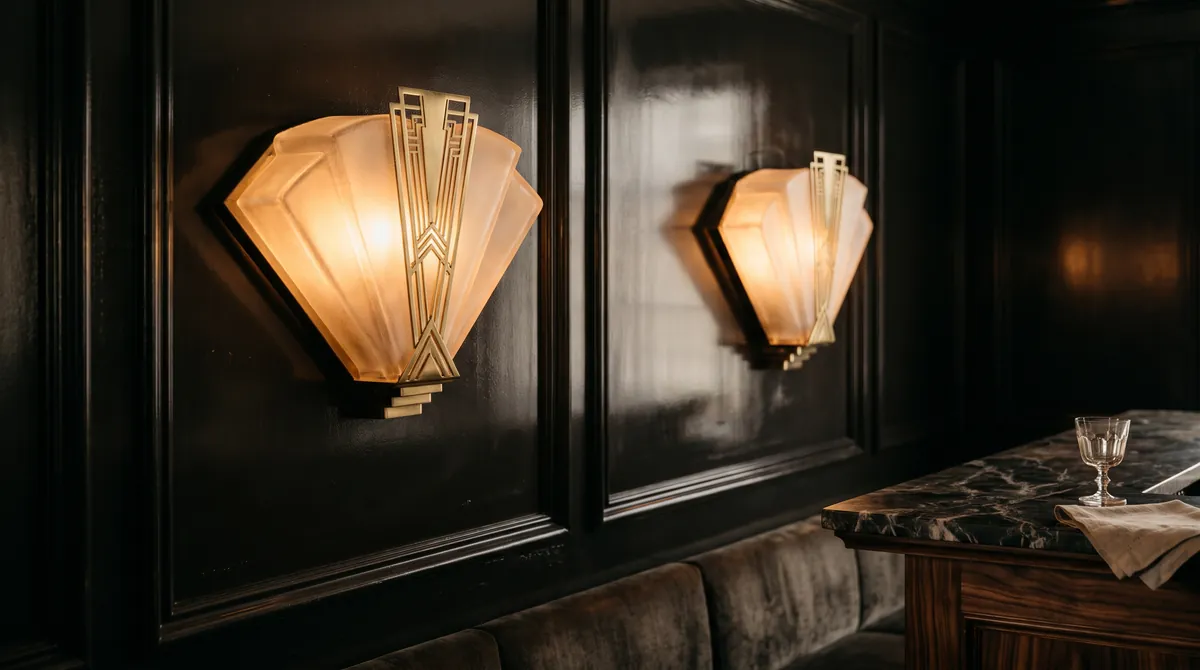
Scandinavian lighting: soft light for long winters
Why Danish and Finnish designers became masters of warm, glare free light, and how to bring the Nordic way of lighting into your own home.
In Copenhagen in December the sun sets in the middle of the afternoon, and in Helsinki even earlier. When darkness takes up most of the day, light stops being a technical matter and becomes part of how you live. That, in a sentence, is why Scandinavia produced so many of the lamps designers still admire.
Light against the dark
Nordic lighting starts with a simple observation: harsh light feels cold, especially in a dark room. A bare bulb hanging from the ceiling throws hard shadows and makes the night outside the window look even blacker. A few soft pools of warm light at different heights do the opposite. They make a room feel sheltered and inhabited.
Danes and Norwegians have a word for that mood: , a cosy, contented feeling built on comfort and company. Candles are part of it, but so are well shaded lamps, a low pendant above the dining table and a reading light beside the armchair. The word became an international trend in the mid 2010s, yet the lighting habits behind it are far older.
Poul Henningsen and the war on glare
No one shaped Nordic light more than the Danish designer and critic Poul Henningsen (1894 to 1967). He disliked the of electric bulbs, the dazzling brightness that makes you squint, and spent his career designing shades that hide the light source and guide its light. A lamp he showed at the 1925 Paris exhibition won a gold medal. In 1926 he developed his three shade system for the Forum building in Copenhagen, and he worked with the manufacturer Louis Poulsen for the rest of his life.
The principle is easy to see in the PH5 pendant of 1958. Stacked, curved shades reflect the light downwards and sideways, so you see a glowing object but never the bulb itself. In the same year he designed the PH Artichoke for the Langelinie Pavilion in Copenhagen, a cascade of metal leaves, originally in copper, that turns a single light source into a soft, layered glow.
Danish design kept refining the idea. Arne Jacobsen’s AJ lamp, created around 1960 for the SAS Royal Hotel in Copenhagen, uses an angled, asymmetric shade that sends light exactly where it is needed. Le Klint, founded in 1943 by Tage Klint, built a company on pleated shades whose folds break up the light. The family’s first pleated shade had been folded around 1900 by his father, the architect P. V. Jensen-Klint, for his own use.
Nordic lighting is less about brightness than about where the light falls and how gently it arrives.
Finland: brass, birch and sculpture
Finnish lighting has its own accent. Alvar Aalto designed the brass Golden Bell pendant in 1937 for the Restaurant Savoy in Helsinki, and Artek, the company founded in 1935 by the Aaltos, Maire Gullichsen and Nils-Gustav Hahl, still makes it. Paavo Tynell (1890 to 1973), for decades managing director and principal designer of the firm Taito, turned perforated brass and glass into lamps of great delicacy, among them his snowflake pendant of around 1950.
Wood plays a larger role here too. Finnish birch is pressed into thin slats, or lamellas, and assembled by hand into pendants that glow through narrow gaps. The designer Seppo Koho has worked in this way for the Finnish company Secto Design since the early 2000s. A shade gives warm, filtered light and draws a quiet pattern of light and shade around it.
Materials that soften light
Look closely at Nordic lamps and the same handful of materials returns again and again:
- : white, milky glass that diffuses light evenly, used in many Danish table and wall lamps.
- Wood and lamellas: thin slats of birch, pine or oak that filter light and add warmth.
- Pleated shades: folded paper or plastic that breaks the light into gentle gradients.
- Painted metal: matt white inner surfaces that reflect light and keep the bulb out of sight.
- Brass and copper: warm metals that glow when lit and develop a patina over time.
What these materials share is a refusal to show the naked bulb. Each one reflects, filters or diffuses the light before it reaches your eye. This is what designers mean by glare free: you see light, not its source.
Daylight and the seasons
Nordic interiors are also planned around daylight. In summer the evenings stay bright for hours, so rooms are kept pale, with white or soft grey walls, light wooden floors and thin curtains that let in as much daylight as possible. In winter the same pale surfaces bounce every bit of lamplight around the room.
This seasonal thinking is useful wherever you live. Pale surfaces make a modest number of lamps go further, while dark walls and floors need more light sources to feel equally welcoming.
Bringing the Nordic way of lighting home
Start by switching off the ceiling light more often. Instead, create several low points of light: a pendant over the dining table, a floor lamp beside the sofa, a table lamp on a sideboard, perhaps a small lamp on a windowsill. Three to five sources in a living room feel more Nordic than one powerful fitting.
Choose warm light. Colour temperature is measured in (K); 2,700 K is a warm white close to a classic incandescent bulb, and late in the evening you can go down to 2,200 K with dimmable LED bulbs. Dimmers are part of the Nordic toolkit, and fitting them to fixed wiring is a job for a qualified electrician.
Mix the classics with contemporary pieces. A PH pendant over a modern table, a birch lamella shade above a plain oak bench or a pleated floor lamp beside a new sofa all work well, as long as the palette stays calm: pale wood, linen, wool and a few dark accents. One or two design icons are plenty; simpler shades can fill the rest of the room.
glaminia is independent and does not sell lamps or recommend dealers. Images are AI generated illustrations, not photographs of specific products. Have fixed electrical work done by a qualified electrician.